
Could your next business investment become a costly liability if it fails to meet the £12.50 daily ULEZ charge or the latest Euro 6 emission standards? Finding the right second hand vans for your fleet shouldn't feel like a gamble with your hard-earned capital. You likely want a vehicle that works as hard as you do, but the fear of buying a "lemon" with hidden mechanical issues or being caught out by the 2026/27 Van Benefit Charge of £4,170 is a genuine concern for many UK business owners.
We're here to help you move forward with total confidence. In this roundup, you'll discover which models offer the best reliability and load capacity for your specific trade. We'll also demystify the differences between HP and PCP finance, explain the nuances of VAT qualifying vehicles, and provide a clear checklist for your next inspection. From understanding nationwide delivery options to navigating Clean Air Zones, this guide ensures your next purchase is a strategic asset rather than a source of stress.
Key Takeaways
- Learn why Euro 6 compliance is now a non-negotiable requirement for avoiding daily charges in Clean Air Zones across the UK.
- Identify the most reliable second hand vans for your specific trade, balancing payload capacity with long-term mechanical dependability.
- Master the essential inspection points to spot hidden commercial wear in suspension systems and load areas before you commit to a purchase.
- Navigate the complexities of VAT reclamation and compare HP and PCP finance options to better manage your business cash flow.
- Discover how to simplify your search by leveraging professional vehicle valuations and the convenience of nationwide delivery.
Navigating the Second Hand Van Market in 2026
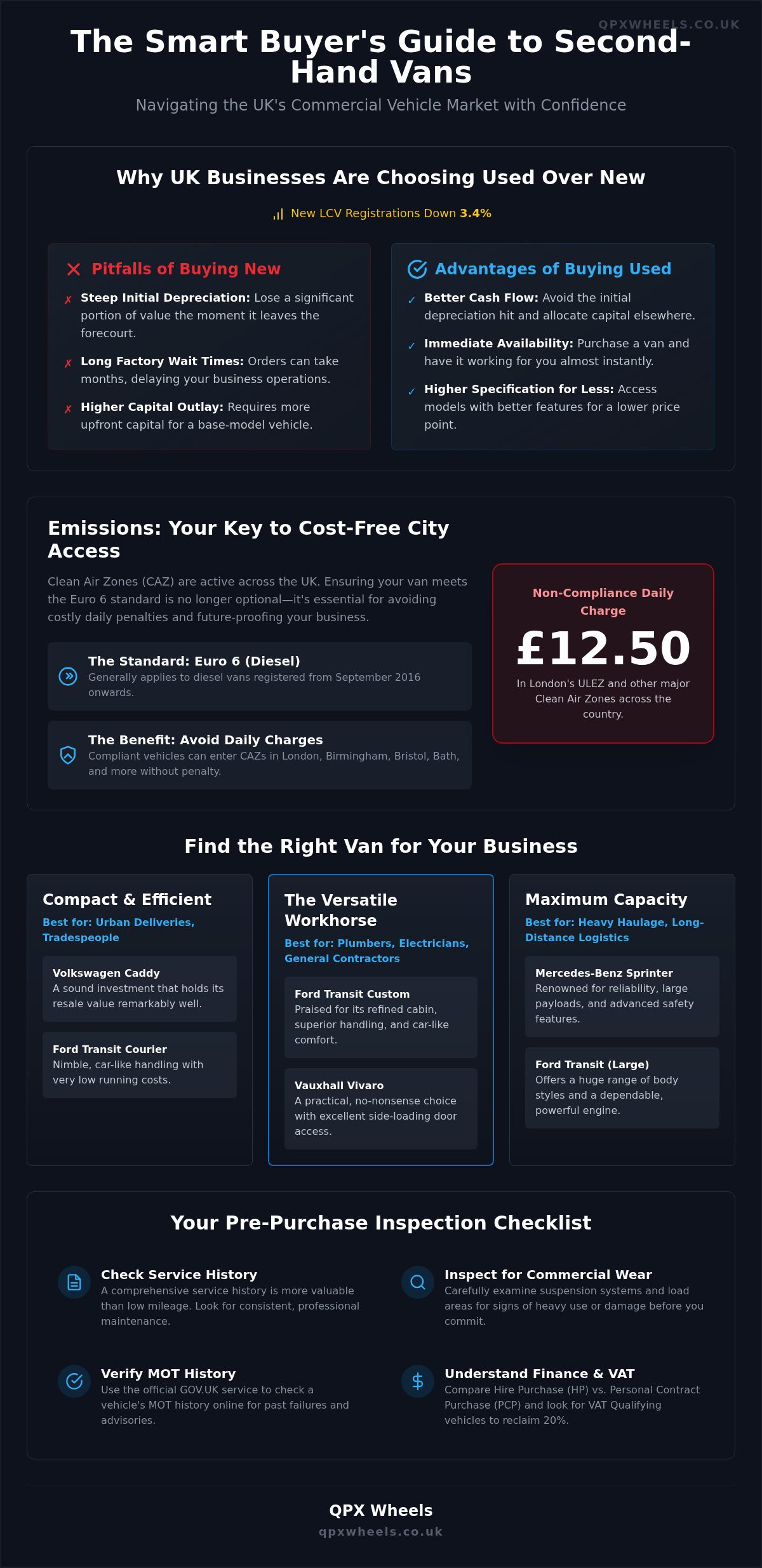
The UK commercial vehicle market is undergoing a significant shift. With new light commercial vehicle registrations seeing a year-on-year decline of 3.4% in early 2026, more professionals are turning to the pre-owned sector to keep their operations moving. Choosing second hand vans isn't just about saving money; it's a strategic move to secure reliable transport without the punishing lead times or steep initial depreciation of factory-fresh models. Understanding the history and development of the van shows how these vehicles have evolved from simple delivery boxes into sophisticated, tech-heavy offices on wheels, making the used market richer in quality than ever before.
A primary driver for this shift is cash flow management. A new van can lose a significant portion of its value the moment it leaves the forecourt. By opting for a quality used vehicle, your business avoids this initial hit, allowing you to allocate capital toward growth or equipment instead. Quality in the commercial sector is often misunderstood. Whilst low mileage is attractive, a comprehensive service history is far more valuable. A well-maintained workhorse with 80,000 miles on the clock often proves more reliable than a low-mileage vehicle that has spent years idling in city traffic or skipping essential oil changes.
Why Businesses are Choosing Used Over New
One of the biggest hurdles for new vehicle buyers is the wait. Factory orders can often take months to arrive, whereas a used van is ready for work almost immediately. This speed is vital for businesses that have just won a new contract and need to scale their fleet quickly. Additionally, buying pre-owned allows you to secure a higher-spec model, perhaps with air conditioning or advanced safety features, for a much lower capital outlay than a base-model new van. Insurance premiums also tend to be more competitive for established models with proven safety records.
The Importance of Euro 6 and ULEZ Compliance
In 2026, emission standards are the cornerstone of any smart purchase. Clean Air Zones (CAZ) now operate in major cities like Birmingham, Bristol, and Bath, alongside London's 24/7 Ultra Low Emission Zone. For diesel vehicles, Euro 6 standards are the benchmark for compliance. Generally, diesel vans registered from September 2016 meet these requirements, helping you avoid the £12.50 daily charge that applies to non-compliant vehicles. Future-proofing your business means ensuring your next purchase can enter these zones without penalty, especially as standards continue to evolve. Investing in a Euro 6 compliant van today protects you from rising operational costs and ensures you can serve customers anywhere in the country.
The Best Second Hand Vans by Category: A Comprehensive Roundup
Selecting the right vehicle depends entirely on your daily operational requirements. A courier navigating London's narrow streets has very different needs compared to a construction firm hauling heavy machinery across the North West. When browsing second hand vans, it is vital to match the body style to your specific trade. Beyond just the physical dimensions, you should always verify the vehicle's maintenance record via the official MOT history check to ensure that previous owners haven't neglected essential repairs under the pressure of heavy workloads.
Compact Efficiency: The Small Van Favourites
Small vans are the ideal solution for urban deliveries and tradespeople who don't require massive tool storage. The Volkswagen Caddy remains a firm favourite in this category. It's often cited as the gold standard because it holds its resale value remarkably well, making it a sound long term investment. For new startups with a tighter budget, the Ford Transit Courier offers a nimble, car-like driving experience with surprisingly low running costs. These compact models excel in city parking, but you must carefully assess the load volume against exterior dimensions to ensure your kit actually fits.
The Versatile Middle Ground: Medium-Sized Workhorses
This category is the backbone of the UK's trade sector. The Ford Transit Custom and the Vauxhall Vivaro consistently battle for the top spot amongst plumbers and electricians. The Transit Custom is frequently praised for its refined cabin and handling, whilst the Vivaro is often seen as a practical, no-nonsense alternative with excellent side-loading door configurations. These doors are essential for safe kerbside access in busy areas. This "mid-size" balance of payload capacity and everyday driveability makes them the most popular choice for general contractors across the country.
Maximum Capacity: Large Vans for Heavy Duty
When your business involves heavy haulage or long distance logistics, only a large van will suffice. The Mercedes-Benz Sprinter dominates this space, especially for couriers who value its legendary durability over high mileages. If driver comfort and safety technology are your priorities, the Volkswagen Crafter is a formidable rival. It offers a sophisticated suite of assistance systems that reduce driver fatigue on long shifts. However, always keep a close eye on payload limits. Exceeding the 3.5 tonne gross vehicle weight on a standard UK driving licence can lead to significant legal complications and safety risks.
Whether you require a standard panel van or something more specialised, such as disabled-friendly transport or a luxury commercial vehicle, choosing a partner with 16 years of expertise ensures you find a reliable workhorse. You can explore our current range of second hand vans to find a vehicle that has been rigorously inspected for your peace of mind.
Essential Checks When Inspecting a Pre-Owned Commercial Vehicle
A commercial vehicle is more than just transport; it's a vital tool for your daily operations. When you're evaluating second hand vans, a surface-level glance isn't enough to guarantee long-term reliability. Professional sellers often utilise a 39-point inspection philosophy to ensure every component, from the brake pads to the door seals, is fit for purpose. This rigorous approach minimises the risk of unexpected downtime, which is the hidden cost that can turn a bargain purchase into an expensive mistake. You need to look past the fresh valet and focus on the mechanical health and structural integrity of the vehicle.
Hidden wear is common in the commercial sector because these vehicles often carry heavy loads over long distances. Pay close attention to the suspension; if the van sits unevenly or feels excessively "bouncy" during a test drive, it may have been frequently overloaded. Check the load area for internal dents or gouges. Whilst some wear is expected, heavy damage to the internal ribbing can indicate a life of hard use that might have stressed the chassis. Always insist on an HPI clear status to ensure you aren't inheriting outstanding finance or a hidden accident history that could affect the van's future resale value.
Mechanical Red Flags to Watch For
The clutch and gearbox are under constant strain, especially in vans used for stop-start urban deliveries. During your test drive, check for a high biting point or any "crunching" when shifting between gears. Listen carefully to the engine for any high-pitched whining, which often signals a failing turbocharger, and watch the exhaust for excessive blue or black smoke under acceleration. Uneven tread wear on the inner or outer edges of the front tyres often indicates that the suspension is misaligned or that the bushings are significantly worn. These issues don't just affect safety; they also increase your fuel consumption and tyre replacement costs.
The Paperwork Trail: Beyond the Logbook
The history of a vehicle is just as important as its current condition. Use the official MOT history check to look for recurring advisories that suggest a pattern of neglect. If the same suspension or brake issues appear year after year, the previous owner likely did the bare minimum to pass the test rather than properly maintaining the vehicle.
- Verify that the V5C logbook matches the vehicle identification number (VIN) found on the dashboard or door pillar.
- Confirm the presence of at least one spare key, as modern transponder keys can cost hundreds of pounds to replace.
- Ensure the original manufacturer manuals are present, which are essential for understanding specific maintenance schedules and warning lights.
Securing a van with a full, documented service history is always worth the premium. It provides proof that the vehicle has received regular oil changes and belt replacements, which are the lifeblood of any hard-working diesel engine.
Finance and VAT: Making Your Van Purchase Cost-Effective
Navigating the financial side of second hand vans can feel daunting, but it's where you can truly maximise your return on investment. It isn't just about the sticker price; it's about how the purchase impacts your monthly balance sheet. Protecting your business liquidity is vital, especially for sole traders and small enterprises where cash flow is the lifeblood of daily operations. Working with specialist finance brokers can help you secure competitive rates that aren't always available on the high street, ensuring your repayments remain sustainable as you grow.
Hire Purchase (HP) for Commercial Vehicles
Hire Purchase remains the most popular choice amongst UK tradespeople for several reasons. Unlike PCP, which often leaves you with a large balloon payment at the end, HP is structured so that you own the vehicle outright once the final instalment is paid. This makes it an excellent tool for long-term asset management. Because you're working towards ownership, you can often claim capital allowances against your business profits, reducing your overall tax liability. Agreements can be tailored with or without a final larger payment to keep monthly costs manageable, depending on your preference for fixed outgoings.
VAT Considerations for the Used Market
VAT is perhaps the most misunderstood element of buying second hand vans. It's crucial to distinguish between "VAT qualifying" vehicles and those sold under the VAT margin scheme. If a van has always been owned by VAT-registered businesses, it remains VAT qualifying, meaning a VAT-registered buyer can reclaim the full 20% from HMRC. Conversely, vans previously owned by private individuals or non-VAT registered entities are usually sold under the margin scheme. Whilst you can't reclaim the tax on these, the initial purchase price is often lower, which benefits businesses that aren't VAT registered themselves.
When you're trading in an old vehicle, the VAT should be handled as a separate part of the transaction to ensure your accounting remains accurate. For a standard commercial van purchase, you can typically reclaim the 20% VAT in full on your next quarterly return provided the vehicle is used solely for business purposes. Managing these details correctly ensures your new workhorse supports your growth rather than draining your reserves.
If you're ready to explore your options, you can apply for HP and PCP finance through our specialist team to find a plan that fits your budget.
Why Sourcing Your Next Van from QPX Wheels Makes Business Sense
Trust is the most valuable currency in the commercial vehicle market. With a 16-year legacy in the industry, we understand that a van isn't just a purchase; it's a commitment to your livelihood. We specialise in sourcing high-quality second hand vans that meet the rigorous standards discussed throughout this guide. Our goal is to move away from transactional sales and toward a supportive partnership that respects your time and your budget. This grounded approach ensures that every trade buyer is treated as a long-term partner rather than a one-off transaction.
Sourcing your next vehicle shouldn't be a source of anxiety. We provide a calm and reassuring environment where transparency is the priority. This ethos has allowed us to build a foundation of trust amongst the local community and national businesses alike. We handle the complexities so you don't have to, ensuring that every vehicle in our inventory has undergone thorough verification before it reaches your fleet.
The QPX Wheels Difference: Nationwide Delivery
One of the primary hurdles for busy professionals is the time spent travelling to view stock. We eliminate this barrier through our nationwide delivery service. Whether you're based in London, Manchester, or the furthest reaches of the North West, we ensure your new workhorse arrives safely at your door. Every vehicle is transported with care to maintain its condition. Because we operate with complete transparency, you're protected by distance selling regulations. This means you can buy with total confidence, knowing that the vehicle arriving at your premises is exactly as described.
Ongoing Peace of Mind and Support
Our support doesn't end when the keys are handed over. We offer extended warranties specifically designed to minimise business downtime. If a mechanical issue does arise, you won't be left stranded. For those looking to upgrade, our professional vehicle valuation service ensures you receive a fair and transparent price for your part-exchange. We handle all the complex paperwork, from V5C transfers to finance settlements, so you can keep your focus on your business.
Choosing a partner with nearly two decades of expertise means you're investing in clarity. We take pride in our reputation for ethical conduct and high standards. By handling the complexities of the transaction for you, we ensure that your transition into a reliable second hand van is as smooth and efficient as possible. We're here to help you find the right tool for the job, backed by a team that values your long-term satisfaction above all else.
Securing Your Business Future on the Road
Choosing the right workhorse for your trade requires a balance of mechanical due diligence and financial strategy. By prioritising Euro 6 compliance, you protect your business from daily city charges whilst ensuring your fleet remains future-proof. Understanding the nuances of VAT and selecting a finance model that preserves your liquidity are equally vital steps in making a cost-effective investment. When you combine these insights with a rigorous inspection philosophy, you move away from the risks of the secondary market and toward long-term operational success.
At QPX Wheels, we use our 16 years of industry experience to simplify this journey for you. We offer tailored HP and PCP finance options to suit your budget and provide nationwide delivery to bring your vehicle directly to your site. Investing in quality second hand vans should be a milestone for your business growth, not a source of stress. Our team is here to guide you through every valuation, inspection, and paperwork detail with the expertise your business deserves.
Ready to find your next reliable partner? Browse our latest inventory of quality second hand vans today and take the first step toward a more efficient fleet. We look forward to helping you get your business moving with confidence.
Frequently Asked Questions
Do I have to pay VAT on a second hand van?
VAT is payable if the vehicle is "VAT qualifying" or if the dealer is selling it under the standard 20% rate. If you are a VAT registered business, you can typically reclaim this amount in full on your next return. If the van is sold under the VAT Margin Scheme, the tax is only applied to the dealer's profit, which often results in a lower purchase price for non-VAT registered buyers.
What is the best high-mileage second hand van to buy?
The Mercedes-Benz Sprinter is widely regarded as the premier choice for high-mileage reliability due to its robust engine and chassis. It is common to see these vehicles performing well beyond 200,000 miles when maintained correctly. The Volkswagen Transporter also holds its value and mechanical integrity well over long distances, provided the service history confirms that essential belt and oil changes were performed on schedule.
Is Hire Purchase (HP) better than PCP for a work van?
HP is generally preferred by businesses that want to own their workhorse outright at the end of the term. It allows you to claim capital allowances and avoids the large final balloon payment common with PCP. PCP might be more suitable if you prioritise lower monthly outgoings and plan to upgrade to a newer model every few years, though it usually involves strict mileage limits.
How can I tell if a used van is Euro 6 compliant?
You can verify compliance by checking the Euro status on the V5C logbook or using an official online ULEZ checker with the vehicle's registration. Most diesel second hand vans registered from September 2016 onwards meet Euro 6 standards. This compliance is vital for avoiding the £12.50 daily charge in London's ULEZ and similar fees in Clean Air Zones across Birmingham, Bristol, and other major UK cities.
What should I look for in a van’s service history?
Look for evidence of regular oil changes and documented proof of cambelt or timing chain replacements at the manufacturer's recommended intervals. A full service history provides peace of mind that the engine has been cared for properly under heavy commercial use. You should also check for receipts regarding clutch or turbocharger work, as these are common high-cost repairs for vans used in stop-start urban delivery environments.
Can I get a second hand van delivered to my business address?
We provide a nationwide delivery service that brings your chosen vehicle directly to your business premises anywhere in the UK. This service is designed to save you the time and expense of travelling to a forecourt, allowing you to focus on your daily operations. Every van is transported safely and remains protected by distance selling regulations to ensure your complete satisfaction upon arrival.
What is an HPI check and why is it essential for vans?
An HPI check is a comprehensive report that confirms a vehicle has no outstanding finance, has not been reported stolen, and has never been written off by an insurer. For commercial buyers, this check is essential to ensure you are gaining legal title to the asset. It prevents the risk of the vehicle being repossessed by a finance company due to a previous owner's unsettled debt.
What are the most reliable second hand van brands in the UK?
Ford and Volkswagen are consistently the most reliable brands for second hand vans in the UK market. The Ford Transit Custom is praised for its accessible parts and ease of repair, whilst the Volkswagen Transporter is favoured for its build quality and exceptional resale value. Both brands offer extensive dealer networks, making it easier to maintain your vehicle and minimise potential downtime for your business.


