
A low odometer reading isn’t proof of a car’s history. To learn how to verify mileage consistency on a used car, compare its recorded readings across MOT history, service records and vehicle documents. In England, Scotland and Wales, cars more than three years old have MOT mileage records you can review.
Look beyond the dashboard figure: a clear sequence of readings can support the stated mileage, while a drop or gap in the records calls for closer attention. A single mismatch might be a clerical error, but it shouldn’t be ignored.
This guide explains what counts as a mileage discrepancy, which records can help you check a car’s history and how to spot possible rollback patterns. You’ll learn what to compare, how to interpret inconsistencies and when to pause before deciding.
Key Takeaways
- Compare recorded readings with the car’s age, condition and service history; unusually low mileage or mismatched wear deserves a closer look.
- Check whether a mileage drop could be a simple recording mistake, then look for supporting evidence across separate records.
- Ask when and where each reading was recorded to help make sense of gaps or changes in the vehicle’s history.
- Repeatedly low annual use or a sudden drop between readings can signal a pattern worth investigating before you decide.
How Can I Check the Odometer Reading of My Car?
Compare the dashboard reading with MOT records, service entries and vehicle history data. In England, Scotland and Wales, the Digital Markets, Competition and Consumers Act 2024 applies to traders’ mileage descriptions through Part 4, Chapter 1, according to the UK legislation register.
Cross-checking Mileage Records
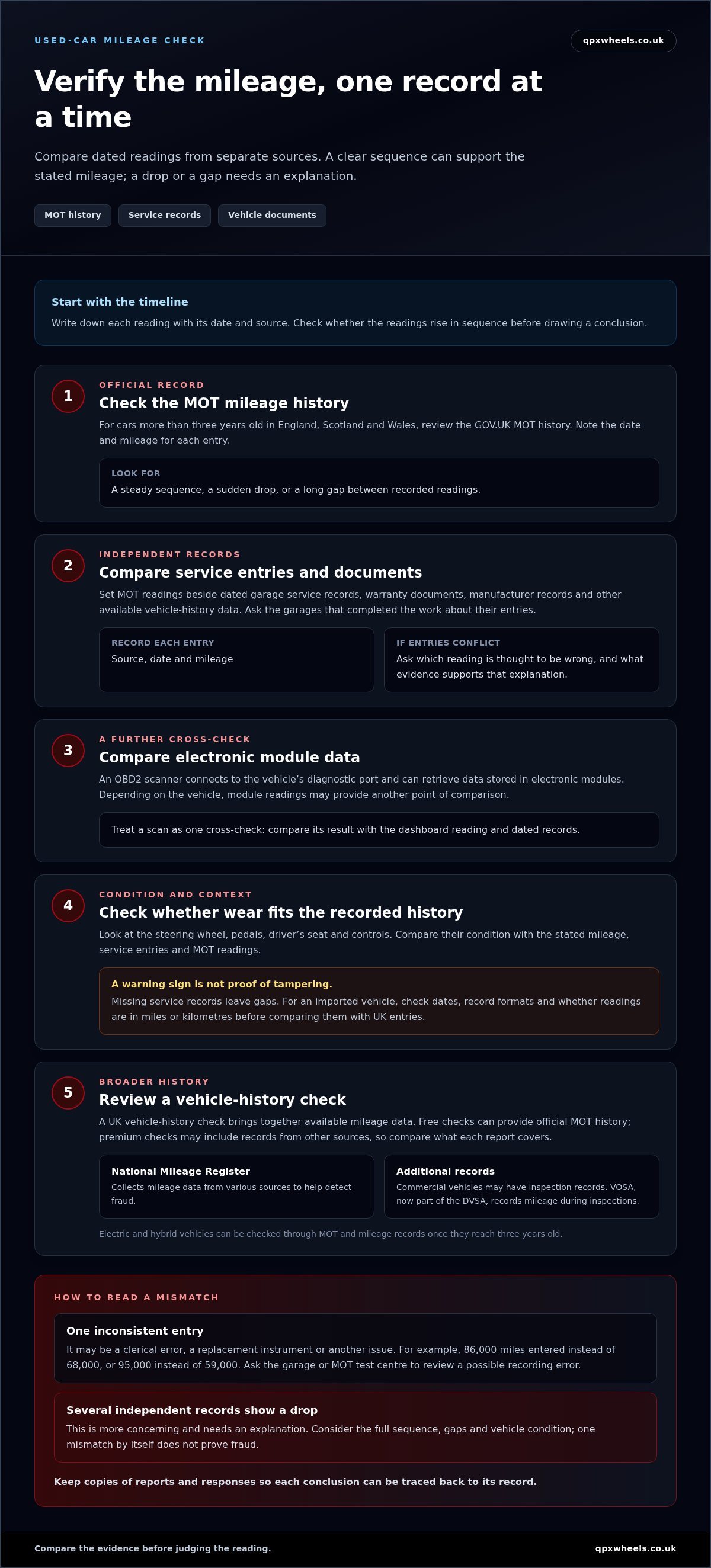
Cross-checking means comparing dated mileage entries from separate records to see whether they form a consistent history. For vehicles more than three years old, review the GOV.UK MOT history and compare it with service records; ask the garages that completed the work about their entries. MOT certificates and service records can show a mileage drop, a long gap, or a likely typing error, such as 86,000 miles entered instead of 68,000. A recorded 95,000 miles instead of 59,000 is another example of an obvious error. These differences need context before you judge the vehicle’s accurate mileage.
Reading Mileage from Vehicle Modules
An OBD2 scanner connects to a vehicle’s diagnostic port and can retrieve data stored in electronic modules. Depending on the vehicle, readings in modules may provide another point to compare with the dashboard and service history. Use the scan as one cross-check, then compare any result with dated records and the vehicle’s displayed mileage.
Comparing Condition with Service History
Compare visible wear with the mileage and maintenance recorded over time. Check the steering wheel, pedals, driver’s seat and controls, then compare their condition with service entries and MOT readings. Wear that seems inconsistent with the stated mileage is a warning sign, not proof of tampering. Missing service records leave gaps, too. For an imported vehicle, dates, units and record formats may differ, so check whether readings are in miles or kilometres before comparing them with UK entries.
Using a Vehicle History Check
A UK vehicle history check brings together available mileage data to help identify conflicting entries. Free checks can provide access to official MOT history, while premium checks may include records from other sources; compare what each report covers. The National Mileage Register collects mileage data from various sources to help detect fraud. Electric and hybrid vehicles can be checked through MOT and mileage records once they reach three years old. Commercial vehicles may have additional inspection records. VOSA, now part of the DVSA, records mileage during inspections, which can be especially relevant for commercial vehicles.
What Is a Mileage Discrepancy?
A mileage discrepancy is a conflict between the odometer and another record of the distance a vehicle has travelled. It may reflect a typing error, a replacement instrument or deliberate rollback, so one mismatch alone doesn’t prove fraud. Verifying mileage consistency means comparing dated readings and checking whether the evidence supports the vehicle’s stated mileage.
To assess a possible discrepancy, compare each dated entry in the MOT history, service records and any vehicle history database. Check that readings rise in sequence, and note who recorded them and when. A sudden fall or conflicting entries needs an explanation. Ask the garage or MOT test centre to review a possible clerical error, then compare its response with the other records.
Financially, inaccurate mileage can distort a car’s valuation and maintenance expectations. Two otherwise identical cars may be valued differently if one has travelled further, because mileage informs wear, service needs and future buying decisions. It can also affect leasing assessments and the vehicle’s resale prospects. A vehicle valuation service can help assess a vehicle’s value using its mileage and condition.
A UK dealer should not describe an unverified odometer reading as accurate. If a trader knows the true mileage, they must tell consumers; if checks cannot verify it, they should disclose that uncertainty. In England, Scotland and Wales, traders’ mileage descriptions fall under Part 4, Chapter 1 of the Digital Markets, Competition and Consumers Act 2024. Knowingly selling a clocked vehicle without disclosure is a criminal offence under the Consumer Protection from Unfair Trading Regulations 2008 and the Fraud Act 2006.
Distinguish evidence of an error from evidence of tampering. A single inconsistent entry followed by records forming a coherent sequence may indicate a recording mistake. Several independent records showing lower mileage after higher readings are more concerning. Missing service history, unexplained gaps and wear that conflicts with the stated distance add context, but don’t establish the cause on their own. Keep copies of reports and responses so you can trace each conclusion to its record.
What Information do I Need to Verify a Vehicle for Mileage Issues?
If readings don’t match, ask the seller when and where each was recorded, and what explains the difference. Request the relevant MOT and service documents, then compare their dates and mileage entries with other available records.
Comparing Independent Mileage Sources
Comparing independent sources means checking separate records against one another to see whether mileage rises consistently over time. MOT entries, garage service records, warranty documents and manufacturer records can all provide useful mileage data. Manufacturers may record mileage during production, initial delivery and servicing; warranty providers may also log readings during cover.
Note the date and source of each entry before comparing readings. A mismatch between two sources is a reason to investigate, not automatic proof of fraud. Ask the seller which entry they believe is incorrect and what evidence supports that explanation. This helps distinguish a genuine discrepancy from a recording mistake.
Missing Mileage Records
Missing records leave gaps in a vehicle’s mileage history, but don’t explain why information is absent. A car may have incomplete paperwork, or a service may not have produced a record available to the current keeper. For an imported vehicle, records may be held in another country’s system or use a different format. Ask the seller about missing periods and request invoices or documents that fill the gaps.
Connected-car data can provide another comparison point. Connected vehicles may transmit location, speed and distance travelled through sensors and communication modules to cloud platforms. Mileage checks can compare reported mileage with distance calculated from connected-car data, flagging discrepancies for investigation. Coverage and formats vary, so compare like with like: confirm units and dates, and establish whether each entry is an odometer reading or calculated distance.
Data entry errors can also create sharp, misleading jumps. For example, a technician might enter 91,000 miles instead of 19,000 miles during an MOT or service; an MOT typing error might show 105,000 instead of 15,000 miles. Check the original document and ask the garage or MOT test centre to review the entry. A correction should make sense alongside other dated readings, rather than being accepted without comparison.
Identifying odometer inconsistencies and rollback patterns
A rollback pattern appears when a later odometer or record shows less mileage than an earlier one. Compare the dates and readings in MOT history and service records, then look for a sustained sequence rather than judging one entry alone. A vehicle showing only 500 miles per year for three consecutive years isn’t automatically clocked, but that unusually low use merits attention.
A sharp drop is more concerning: a reading 30,000 miles lower at the next MOT is a red flag for possible tampering. Check the vehicle’s documents and ask the seller to explain the change. A replaced instrument cluster, a mistaken entry or a unit conversion may account for a mismatch, but the explanation should fit the available records.
Clocking means altering an odometer to make a vehicle appear to have travelled less. Digital odometers can be manipulated, so a tidy dashboard or electronic reading isn’t proof of accurate mileage. Look for physical clues such as disturbed trim around the instrument panel, inconsistent display condition, or wear on the steering wheel, pedals and driver’s seat that seems at odds with the stated reading. No single clue proves fraud; compare each with dated records and the vehicle’s overall condition.
Treat missing history, repeated gaps and mileage moving backwards across several records as reasons to pause. Ask the seller when each reading was recorded, who supplied it, and whether original invoices or MOT documents support the account. Dealers shouldn’t describe an odometer reading as accurate unless they’ve checked it. If checks can’t verify the mileage, traders should tell customers rather than present an uncertain figure as fact.
Keep copies of the mileage check, MOT entries and seller’s explanation together. A clear evidence trail helps separate an isolated clerical error from a pattern that remains unexplained. Once the mileage history is understood, request a vehicle valuation to help assess the car in light of its recorded distance and condition.
QPX Wheels: Used Vans
QPX Wheels sells used vans for buyers who have reviewed a vehicle’s mileage records and are ready to consider their next vehicle. Use the checks in this guide to assess the readings and supporting history for any van you’re considering, then weigh mileage alongside its condition and service needs.
If you’re comparing a van with a car, QPX Wheels also sells used cars. Its Vehicle Valuation Service can help if you’re assessing a vehicle you plan to sell. Hire Purchase (HP) Finance is an option for buyers considering how to fund a vehicle purchase.
For a straightforward next step, contact QPX Wheels to discuss its used vans.
Make your next vehicle decision with confidence
Knowing how to verify mileage consistency on a used car gives you a stronger basis for deciding whether to proceed, ask for an explanation or consider another vehicle. Keep your evidence together and decide what matters most: a clear history, the vehicle’s condition or how it will suit your everyday needs.
If you’re comparing options, QPX Wheels offers used cars and vans, while its Vehicle Valuation Service can help if you’re considering the value of a vehicle you own. Take the time you need to choose a vehicle that fits your plans, rather than letting one dashboard reading make the decision for you.
Contact QPX Wheels to discuss your next vehicle and take the next step at your own pace.
Frequently Asked Questions
Can You Check the Mileage History of Imported Vehicles, Electric Vehicles (EVs), and Commercial Vehicles?
Yes, but available records can differ by vehicle and country of origin. Imported vehicles may have overseas service or inspection documents to compare with UK records, including units such as kilometres and miles. Electric and hybrid vehicles can be checked through MOT and mileage records once they reach three years old. Vans have their first annual MOT at three years old, while Heavy Goods Vehicles require an annual test from first registration.
Is It Safe to Buy a Car With Mileage Problems?
It may be possible to consider a car with a mileage discrepancy if its history and the seller’s explanation are clear. Distinguish a known recording error from an unexplained sequence that moves backwards, and consider how uncertainty affects the vehicle’s value and maintenance planning. A trader who knows the true mileage must tell consumers. If checks leave the mileage unverified, that uncertainty should be disclosed before you decide.
What Are the Benefits of Reviewing Mileage History?
Reviewing mileage history helps you judge whether a car’s use fits its condition and likely maintenance needs. It also makes comparisons between similar vehicles more meaningful, since a lower dashboard figure alone doesn’t tell the whole story. Check whether recorded readings align with the vehicle’s service schedule and invoices. A coherent record gives you a clearer basis for discussing value and planning future ownership.


