
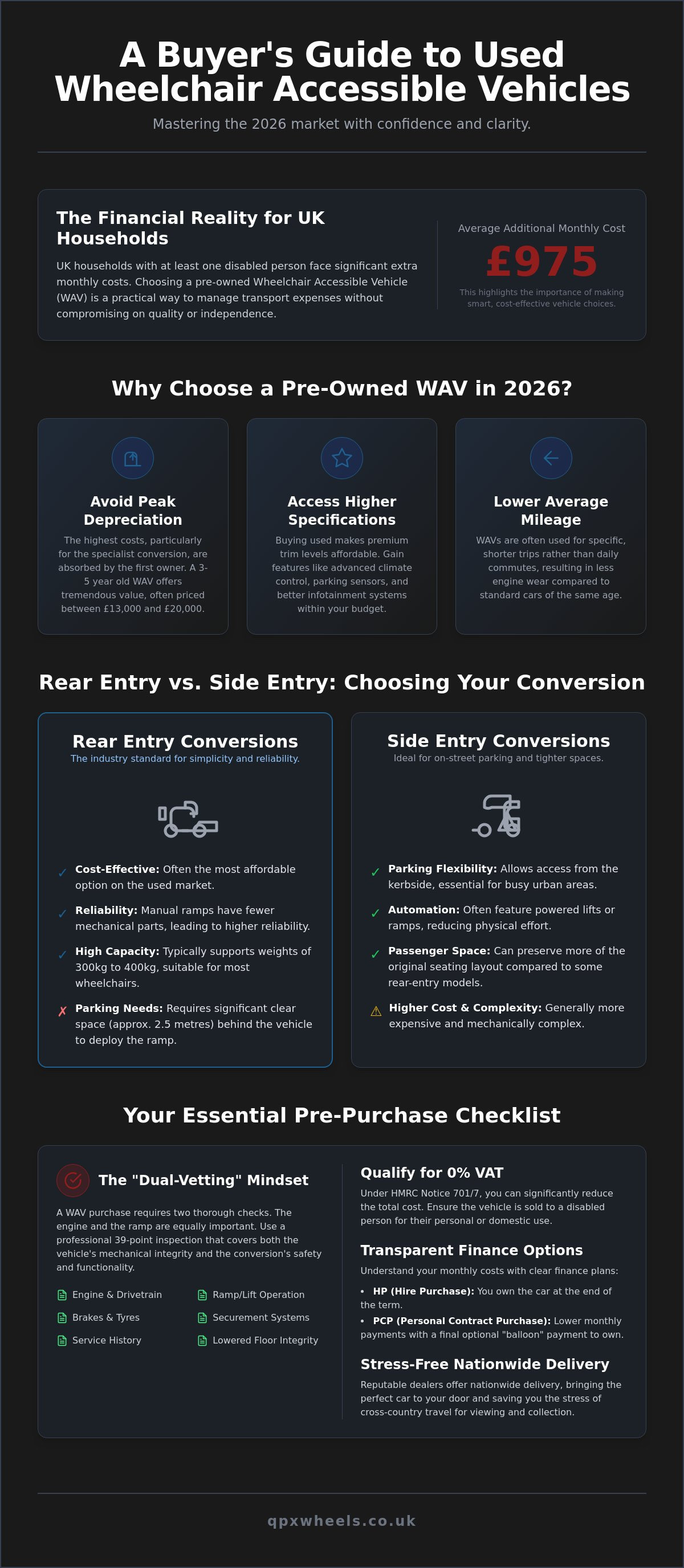
Did you know that a UK household with at least one disabled person faces an average of £975 in additional costs every single month? When you're already managing these significant financial pressures, the process of buying a used wheelchair accessible vehicle shouldn't add to your anxiety. It's completely natural to worry about the long-term reliability of a conversion ramp or feel overwhelmed by complex finance jargon that often feels like it's written in another language. You need a car that works for your life, not a list of technical problems to solve.
You deserve a dependable partner to help you find a vehicle that offers true independence. This guide will help you master the 2026 market with absolute confidence, ensuring you secure a high-quality WAV that fits your wheelchair's exact height and width requirements whilst staying within your budget. We'll explain the latest HMRC VAT exemption rules, clarify your finance options, and show you how to arrange nationwide delivery so the perfect car arrives at your door without the stress of a cross-country trip.
Key Takeaways
- Learn how to qualify for 0% VAT under HMRC Notice 701/7 to significantly reduce the total cost of your mobility vehicle.
- Discover the practical differences between rear and side-entry conversions to choose the most convenient layout for your daily travel and parking.
- Follow a professional 39-point inspection checklist to guarantee safety and mechanical integrity when buying a used wheelchair accessible vehicle.
- Explore transparent HP and PCP finance options that provide clear monthly costs and long-term financial stability.
- Understand how nationwide delivery services can save you the stress of travelling across the UK to view and collect your car.
Understanding the Used WAV Market: Why Buy Pre-Owned in 2026?
The 2026 market for pre-owned mobility vehicles has shifted in favour of the buyer. Recent changes to Motability Scheme regulations and the rising costs of new conversions have made the secondary market an exceptionally smart choice for UK households. When you're buying a used wheelchair accessible vehicle, you aren't just purchasing a car. You're investing in a specialist tool that has already had its highest costs absorbed by a previous owner. This makes high-specification models, which might have been unaffordable when new, much more accessible for those who need them most.
A successful purchase requires a "dual-vetting" mindset. We believe the engine and the ramp are equally important. It's not enough for the car to run well if the conversion is stiff or unsafe; conversely, a perfect lift is useless if the base vehicle is unreliable. You can learn more about the technical standards and history of these conversions in this Wikipedia article on WAVs. By focusing on both aspects, you ensure long-term satisfaction and safety for every passenger.
The Benefits of Lower Depreciation
The most significant saving comes from the initial conversion cost. A new WAV carries a heavy premium for the bespoke ramp and floor modifications. In the secondary market, this cost is largely absorbed by the first owner. Buying a vehicle that is three to five years old often places the price point between £13,000 and £20,000, offering substantial savings compared to new alternatives. Interestingly, these vehicles often have lower mileage than standard family cars. They're typically used for specific trips rather than long daily commutes. This means you can often find a five-year-old vehicle with the engine wear of a much younger car. Buying used allows you to access "luxury" trim levels with better climate control and parking sensors whilst staying within a sensible budget.
Choosing Your Vehicle Size: Small, Medium, or Large?
Size matters for both the passenger and the driver. Small, car-derived models like the VW Caddy or Citroën Berlingo are perfect for domestic driveways and tight supermarket car parks. They offer great fuel economy but might feel cramped if you use a larger powerchair. Medium and large vans, such as the Ford Transit or Mercedes Sprinter, provide a more open cabin and often feature motorised lifts rather than manual ramps. Whilst these offer superior interior space and more room for additional passengers, they require more consideration for height-restricted car parks and narrower residential streets. Balancing your need for interior cabin space against the practicalities of manoeuvrability is the first step in finding your perfect match.
Rear Entry vs Side Entry: Comparing Conversion Types for Your Needs
The conversion type you choose will define your daily routine. When you are buying a used wheelchair accessible vehicle, the choice between a manual ramp and a motorised lift is often a matter of physical capability and budget. Most models on the UK market feature a rear-entry design, which is popular because it is straightforward and often more affordable. However, side-entry options provide a different set of benefits, particularly for those living in busy urban areas where parking is a constant challenge.
Lowered floors are a hallmark of a quality conversion. By dropping the floor level, engineers create more headroom for the wheelchair user and a better line of sight through the windows. This prevents the "closed-in" feeling that can occur in standard vans. You should also consider seating. Some conversions allow for the wheelchair user to sit in the front passenger position, while others place them in the second or third row. This affects how many other passengers you can carry; a compact WAV might fit three people plus the wheelchair, whereas a larger van can accommodate a full family.
Rear Entry Conversions: The Industry Standard
Rear entry is the favourite choice for many because of its simplicity. These vehicles usually feature a manual ramp that folds down from the tailgate. They are incredibly reliable because there are few mechanical parts to fail. You do need to ensure you have enough clear space behind the car. Most ramps require at least 2.5 metres of room to deploy safely. Standard manual ramps are robust, typically supporting weights between 300kg and 400kg, which is ample for most manual and electric chairs. This configuration is often the most cost-effective way of buying a used wheelchair accessible vehicle without compromising on safety.
Side Entry and Automated Lifts
Side entry conversions are the best choice if you frequently park on narrow streets. They allow the passenger to enter directly from the pavement, avoiding the need to manoeuvre into traffic. These often feature motorised lifts or automated ramps. Whilst these are convenient, they do require more regular maintenance to keep the sensors and motors in top condition. For those seeking total independence, "drive-from-wheelchair" models are often side-entry. These specialised vehicles can be expensive, but you may find assistance through Motability Foundation grants to help cover the costs of these more complex adaptations.
Finding the right configuration is much easier when you can see a variety of layouts in person. We invite you to browse our current range of disabled friendly vehicles to compare these entry types for yourself.
The Essential 39-Point Inspection Checklist for Used WAVs
A standard MOT provides a basic level of roadworthiness, but it doesn't cover the intricate modifications that make a vehicle accessible. When you're buying a used wheelchair accessible vehicle, you must evaluate two distinct systems: the base automotive chassis and the specialised mobility conversion. Our 39-point inspection is designed to address this complexity, ensuring that every safety-critical component is verified by experts who understand the nuances of these vehicles.
The inspection should follow a logical sequence to catch both obvious and hidden issues. Start by verifying the HPI status and service history to ensure the car hasn't been involved in major accidents or had its mileage tampered with. Next, operate the ramp or lift multiple times. It should move smoothly without any jerking or grinding noises. You must also test the Wheelchair Tie-down and Occupant Restraint System (WTORS). Check that the floor tracks are clear of debris and that the belts lock firmly into place. Finally, always check the interior headroom whilst the wheelchair user is in position. It's vital that there is enough clearance to prevent discomfort or injury on bumpy roads. Don't forget to look underneath; because the floor is lowered, the fuel tank and exhaust are often modified or repositioned. You need to ensure these parts are securely mounted and free from corrosion.
Vetting the Mobility Equipment
The safety of the passenger depends entirely on the condition of the conversion hardware. Look closely at the tie-down straps for any frayed webbing or damaged buckles. If the vehicle is fitted with an electric winch to help pull the wheelchair inside, test it under a realistic load to ensure the motor isn't straining. We also recommend checking the rubber seals around the ramp or tailgate. If these are perished, you'll likely experience excessive road noise or, worse, water ingress that can damage the interior floor and cause rust in the wheelchair tracking.
Mechanical Reliability of the Base Vehicle
The extra weight of a conversion and a heavy powerchair puts additional stress on a car's components. A professional 39-point inspection is vital because it looks for "suspension sag," where the rear of the vehicle sits too low due to worn springs. Check the service book for recent stamps and ensure the cambelt has been changed if the vehicle has reached the manufacturer's recommended interval. Reliability starts with a well-maintained engine, but for a WAV, it ends with a chassis that can handle the specific demands of mobility transport. Our 16 years of experience ensures that every car we vet meets these rigorous standards.
Finance, VAT Exemption, and the Cost of Ownership
Understanding the financial landscape is a crucial step when buying a used wheelchair accessible vehicle. With UK households containing a disabled person facing an average of £975 in additional monthly costs, every saving matters. Fortunately, the tax system and specialised finance products are designed to make these life-changing vehicles more affordable. By mastering the regulations, you can ensure you aren't paying more than necessary for your independence.
Mastering VAT Zero-Rating
One of the most significant savings available is the ability to claim 0% VAT on your purchase. Under HMRC Notice 701/7, a used WAV can be zero-rated if it has been "substantially and permanently" adapted for a wheelchair user. This isn't a refund you claim back later; it's a 20% saving applied at the point of sale. To qualify, the vehicle must be for the personal use of a disabled person or a charity. You'll need to complete a simple declaration form, which we help our customers navigate. Ensuring this paperwork is correct is vital to avoid unexpected tax bills later.
Finance Options: HP vs PCP
Choosing the right way to pay depends on how long you plan to keep the vehicle. Hire Purchase (HP) is a favourite for those who intend to own their WAV for seven years or more. It offers a straightforward path to full ownership with fixed monthly payments. Alternatively, PCP finance can offer lower monthly outgoings, making a newer three-to-five-year-old model more accessible. In the current 2026 market, typical APR rates for used WAVs range from 8.9% to 10.9%. Deposits can be as low as £500, or even 0% in some cases, depending on your credit profile. As an experienced broker, we work with specialised lenders to find the most transparent and competitive rates for your circumstances.
Running costs also require a slightly different approach than a standard car. Your insurance premium might be affected by the modifications, so it's best to use a specialist broker who understands the value of the conversion. Additionally, you should budget for an annual safety check of the ramp or lift alongside your standard car servicing. This ensures the mechanical components of the conversion remain as reliable as the engine itself. If you're ready to explore your budget, you can view our bespoke Hire Purchase (HP) Finance options today.
Why QPX Wheels is Your Trusted Partner for Nationwide WAV Sales
Choosing where to shop is just as vital as the vehicle you pick. When you're buying a used wheelchair accessible vehicle, you need more than a salesperson; you need a seasoned guide who understands the logistics of mobility. With over 16 years of experience in the UK market, we've refined a process that prioritises your comfort over a quick transaction. We don't do high-pressure sales. Instead, we offer a calm, supportive environment where you can explore your options at your own pace. Every vehicle in our showroom is selected for its reliability, ensuring your investment provides years of trouble-free service.
We understand that part-exchanging a car can be a source of stress. To simplify this, our transparent vehicle valuation service provides an honest assessment of your current car or van. We handle all types of vehicles, not just those with adaptations. This allows you to put the value of your old car toward a newer, more efficient model without the hassle of a private sale. Our goal is to handle the complexities so you don't have to.
The Convenience of Nationwide Delivery
One of the biggest hurdles for our customers is the physical difficulty of travelling long distances to view a car. We've solved this by offering nationwide delivery across the UK. Whether you're in the North West or London, we can bring your specialised vehicle directly to your door. This makes buying a used wheelchair accessible vehicle a stress-free experience from start to finish. We organise secure transport and provide a thorough handover whilst ensuring you're comfortable with the ramp or lift operation. Because we operate under strict distance selling regulations, you can proceed with absolute peace of mind. We handle all the paperwork remotely, including VAT declarations and finance agreements, saving you an unnecessary journey and a lot of physical effort.
A Commitment to Quality and Ethics
Trust is built on verification and long-term support. That's why every vehicle we sell is HPI clear, which guarantees it has no outstanding finance or hidden accident history. We go beyond the basics by offering extended warranties that cover both the mechanical parts of the car and the specific mobility adaptations. This is a crucial safety net that many generic dealers simply don't provide. Our reputation in the local community and across the UK is built on this grounded, honest approach. We want you to feel as confident in your car three years from now as you do on the day it arrives. If you're ready to find a safe, reliable car that fits your life, you can browse our current stock of disabled-friendly vehicles and vans to see our latest arrivals.
Secure Your Independence with Confidence
You now have the essential knowledge to navigate the 2026 mobility market. Whether you've chosen a compact rear-entry model or a more spacious side-entry van, the priority remains on safety and specific wheelchair dimensions. Don't forget to use the 39-point inspection checklist to verify the mechanical integrity of both the engine and the conversion. By correctly applying for VAT zero-rating, you can ensure your budget is used effectively to secure a reliable, high-quality vehicle.
Buying a used wheelchair accessible vehicle should be an empowering milestone rather than a source of anxiety. With 16 years of industry experience, we're here to act as your dependable guide. We provide expert HP and PCP finance brokerage alongside nationwide UK delivery to make the entire process effortless. Our team is ready to help you find a car that offers the freedom and reliability you deserve.
Explore our range of used WAVs and apply for finance today. We look forward to helping you get back on the road with total peace of mind.
Frequently Asked Questions
Can I get VAT relief on a used wheelchair accessible vehicle?
Yes, you can qualify for 0% VAT if the vehicle is substantially and permanently adapted for your personal or domestic use. You'll need to complete a simple declaration form at the point of sale to confirm your eligibility under HMRC Notice 701/7. This saving is applied immediately, so you don't have to worry about reclaiming the tax from the government later.
What is the best used van for a wheelchair conversion?
The Citroën Berlingo and Peugeot Partner are widely considered the most reliable choices for smaller conversions. If you need more cabin space, the Ford Tourneo Connect or the Volkswagen Caddy are excellent alternatives. These models are favourites amongst converters because their chassis allows for a lowered floor without compromising the vehicle's structural integrity or driving comfort.
Do I need a special driving licence to drive a used WAV?
A standard Category B car licence is usually sufficient for most small and medium-sized wheelchair accessible vehicles. You only need to consider a different licence category if the vehicle's Maximum Authorised Mass (MAM) exceeds 3,500kg. This is rare for domestic WAVs but can occur with very large van conversions that carry multiple passengers or heavy motorised lifts.
How do I measure my wheelchair to ensure it fits in a used WAV?
You must measure the total height from the ground to the top of the passenger's head whilst they are seated in the chair. Also, record the widest point of the wheels and the total length from the front of the footrests to the back of the chair. Comparing these figures against the vehicle's entrance height and floor width ensures a safe and comfortable fit every time.
Is finance available for second-hand wheelchair accessible vehicles?
Yes, specialised finance is available, and we offer both Hire Purchase (HP) and PCP options to suit different budgets. When buying a used wheelchair accessible vehicle, our team acts as a broker to find competitive rates from lenders who understand the unique value of converted transport. We provide clear, transparent monthly costs so you can plan your household finances with absolute certainty.
What is the difference between a WAV and a standard van with a ramp?
A true WAV features a lowered floor and a dedicated Wheelchair Tie-down and Occupant Restraint System (WTORS) for maximum safety. A standard van with a portable ramp often lacks the necessary headroom and secure floor tracking. This makes a purpose-built WAV much safer and more comfortable, as the lowered floor provides a better view through the windows and a shallower ramp angle.
How does nationwide delivery work if I buy a vehicle online?
We arrange for a professional driver to deliver your vehicle directly to your UK address at a time that suits you. The delivery includes a full handover where we demonstrate how to use the ramp and tie-down systems safely. Buying online also grants you protections under distance selling regulations, giving you additional peace of mind that the vehicle will meet your exact requirements upon arrival.
Are used WAVs covered by a warranty for the conversion parts?
We provide extended warranties that can cover both the base vehicle and the specific mobility adaptations, such as the ramp or winch. This is a vital consideration when buying a used wheelchair accessible vehicle, as it protects you against the cost of specialised repairs. Having this coverage ensures that your vehicle remains a dependable tool for your independence throughout your ownership.


