
What if the most cost-effective way to drive through a UK city in 2026 isn't a brand-new electric vehicle, but a carefully selected petrol model? Whilst the shift toward electric is clear, the market for used petrol cars UK remains incredibly robust for those who know what to look for. It's understandable if you feel a bit overwhelmed by the conflicting news about petrol bans and expanding Clean Air Zones. You need a car that fits your life without the constant worry of hidden mechanical faults or sudden price hikes at the pump.
We are here to help you find a reliable, ULEZ-compliant vehicle that balances smooth performance with long-term value. This guide provides a clear roadmap through the current landscape, from understanding the new £200 standard VED rate to choosing the right extended warranty. We will break down the best finance options available and show you how to verify a car's Euro 6 status so you can drive with total confidence.
Key Takeaways
- Learn how to navigate emissions regulations and identify Euro 6 models that keep your daily driving free from Clean Air Zone charges.
- Discover the most reliable used petrol cars UK buyers can choose in 2026, focusing on engine efficiency and the benefits of downsized turbo technology.
- Master a professional inspection routine to identify potential mechanical pitfalls, from checking turbo health to verifying critical timing belt service intervals.
- Explore flexible finance routes like Hire Purchase (HP) and PCP to secure a high-quality vehicle whilst maintaining a comfortable monthly budget.
- Understand how services like nationwide delivery and comprehensive warranties remove the stress of buying from a distance and ensure long-term peace of mind.
Why Used Petrol Cars Remain a Smart Choice for UK Drivers in 2026
The transition to electric power is well underway, yet the market for used petrol cars UK remains incredibly active. Many drivers find that the traditional internal combustion engine offers a level of flexibility that newer technologies struggle to match. Whether you are popping to the local shops or driving across the country, the convenience of a five-minute refuel at any service station is hard to beat. This infrastructure readiness means you never have to plan your route around charging stops or worry about broken plug points. It's a straightforward way to stay mobile without the added complexity of managing battery range.
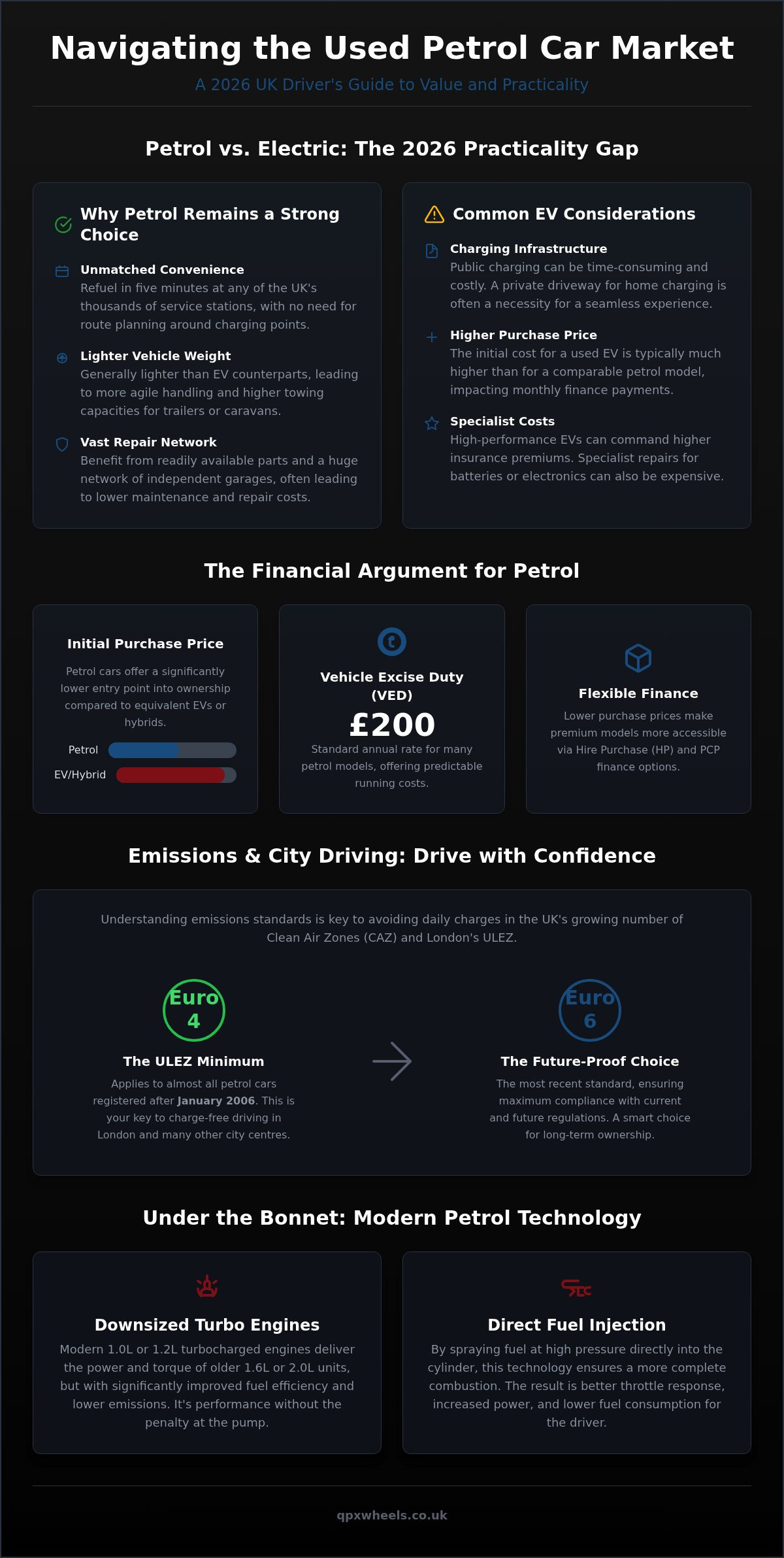
Petrol vs. Electric: The 2026 Practicality Gap
UK charging infrastructure has improved, but it hasn't solved every problem for every driver. If you don't have a driveway for a home charger, relying on the public network can be both expensive and time-consuming. A petrol engine provides a dependable solution for those who need a car that is always ready to go. Petrol vehicles also tend to be lighter than their battery-powered counterparts. This weight advantage often results in better handling and higher towing capacities, making them a preferred choice for caravan owners or those who frequently carry heavy loads on the motorway.
The Financial Argument for Petrol
The numbers often fall in favour of petrol when you look at the total cost of ownership. Whilst the 5p fuel duty cut is scheduled to end in September 2026, the initial purchase price of a used petrol car is typically much lower than an equivalent EV or hybrid. This lower entry point makes it easier to manage your monthly outgoings through Hire Purchase or PCP finance. By spreading the cost, you can secure a higher-specification model that might otherwise be out of reach.
Insurance is another factor to consider. High-performance electric cars often command higher premiums due to specialist repair costs and battery safety protocols. In contrast, petrol cars benefit from a vast network of independent garages and readily available parts. For low-mileage drivers, the savings on insurance and the standard £200 VED rate often outweigh the higher fuel costs. Market data from May 2026 suggests that used car prices are stabilising after years of volatility. The average price of a used car reached nearly £18,000 this year, and petrol models continue to hold their value well because demand remains high amongst sensible buyers who value mechanical simplicity.
Understanding Modern Petrol Tech: Euro 6 and Engine Efficiency
Choosing from the available used petrol cars UK market requires a basic grasp of the technology under the bonnet. The Euro 6 standard is the most significant benchmark for drivers today. Introduced to reduce harmful exhaust emissions, it's the criteria used by many major UK cities to determine which vehicles can enter their centres for free. Unlike diesel cars, which usually need to be registered after September 2015 to be compliant, almost all petrol cars registered after January 2006 meet the required Euro 4 standard for ULEZ and CAZ zones. However, aiming for a Euro 6 model provides the best future-proofing as regulations evolve. This approach ensures you are making a sensible choice amongst the wide variety of used petrol cars UK has available.
Navigating Clean Air Zones (CAZ) and ULEZ
Many major cities now operate active emissions charges to improve air quality. Birmingham, Bristol, and Glasgow have well-established schemes, whilst others are considering similar measures to manage traffic pollution. When you follow the official Buy a vehicle: step by step guide, verifying the emissions rating should be your first priority. By 2026, most petrol cars on the secondary market will comfortably meet these standards, giving you the freedom to travel nationwide without unexpected daily costs.
Efficiency and the Downsized Turbo
Modern engine design has shifted toward smaller, more efficient units. You will frequently see 1.0L and 1.2L engines in cars that previously would have required a 1.6L or 2.0L powerplant. Engine downsizing is a method to improve efficiency without sacrificing torque by using a turbocharger to force more air into the combustion chamber. This technology, combined with direct injection, ensures that every drop of fuel is used effectively. Direct injection sprays fuel at high pressure directly into the cylinder, whilst older multi-point systems inject it into the intake manifold. The result is better throttle response and lower fuel bills for the average driver.
Turbocharged vs. Naturally Aspirated Engines
Turbocharged engines are excellent for low-end power, making them ideal for overtaking or merging onto motorways. However, some drivers still prefer naturally aspirated engines for their linear power delivery and long-term mechanical simplicity. These engines lack the complex turbo components that can sometimes require attention as a vehicle ages. Stop-start technology is another common feature that cuts the engine when you are stationary in traffic, significantly improving urban fuel economy. If you are looking for a car that balances these technical benefits, you can view our latest petrol car stock to find a model that suits your driving style.
Selecting the Right Body Style for Your Petrol Powerplant
When you are browsing the market for used petrol cars UK, the shape of the vehicle dictates your daily running costs just as much as the engine technology. The humble hatchback remains the efficiency king for most drivers. Its compact footprint and aerodynamic profile allow small petrol engines to work less hard, especially at cruising speeds. We have seen a significant surge in demand for cheap automatics in this category. Drivers are increasingly looking for stress-free urban travel without the premium price tag often associated with hybrid alternatives. A small petrol automatic provides a smooth, simplified driving experience that is perfect for stop-start traffic.
For those who prioritise refined comfort on longer journeys, the petrol saloon is a classic choice. Whilst they are larger than hatchbacks, their sleek, low-slung silhouettes often yield better fuel economy on the motorway than a boxy SUV. A saloon offers a settled, quiet ride that makes it the motorway cruiser's favourite. It is an excellent middle ground for drivers who need a professional-looking vehicle with enough boot space for luggage but don't want the bulk of a full-sized 4x4.
The Rise of the Petrol SUV
Modern petrol SUVs have largely replaced diesel as the standard for British families. This shift occurred because Euro 6 petrol engines are now powerful enough to handle the weight of a larger chassis without the emissions anxieties of older diesel models. However, it is vital to evaluate real-world MPG. Because an SUV is taller, it faces more wind resistance. A petrol crossover will typically use more fuel than a hatchback with the same engine. When searching, key models like the Nissan Qashqai or Kia Sportage are popular because they balance a commanding driving position with engines designed for modern efficiency.
Compact Petrol Cars: The Budget-Friendly Entry Point
If you are a new driver or looking to minimise outgoings, compact petrol hatchbacks are the gold standard. These vehicles often sit in the lowest insurance groups, sometimes as low as group 1 or 2, which makes them significantly cheaper to protect. In restricted urban centres, their agility makes parking and navigating narrow streets much easier. Despite their small exterior dimensions, many modern city cars offer surprising practicality. Models such as the Hyundai i10 or Volkswagen Up! often provide over 250 litres of boot space, which is more than enough for a weekly shop or a couple of suitcases for a weekend away.
The Petrol Buyer's Inspection Checklist: Avoiding Mechanical Pitfalls
Securing the best used petrol cars UK market has to offer requires a keen eye and a methodical approach. Whilst modern engines are reliable, they have specific needs that differ from diesel counterparts. Start with the turbocharger if you are looking at the downsized models we discussed earlier. A high-pitched "police siren" whistle during acceleration often points to worn bearings. Similarly, a puff of blue or grey smoke from the exhaust when you lift off the throttle suggests the turbo seals are failing. These are expensive components to replace, so catching these signs early is vital.
Don't forget to check the timing belt (cam belt) or chain. Most manufacturers specify a replacement interval based on mileage or age. If a belt snaps, it often results in catastrophic engine failure. If the car uses a timing chain, listen for a metallic rattling sound during a cold start, which indicates the chain has stretched. You should also peek under the oil filler cap for "mayonnaise," a creamy white sludge that signals a potential head gasket issue. Finally, verify the HPI status to ensure the vehicle hasn't been stolen, written off, or burdened with hidden debt.
The Importance of a Full Service History (FSH)
Petrol engines are particularly sensitive to missed oil changes. Old oil can lead to carbon buildup on the valves, especially in direct injection systems. A Main Dealer stamp is excellent, but a folder full of receipts from an independent specialist shows a previous owner who truly cared. This documentation doesn't just provide peace of mind; it significantly protects your future resale value. A car with a gap-free history is always easier to sell than one with missing years.
Test Driving a Petrol Car: What to Listen For
Always insist on a cold start. If the engine is already warm when you arrive, the seller might be hiding a "hunting" idle or a misfire that only appears when the car is cold. A smooth, consistent idle is the primary indicator of a healthy petrol fuel system. On the road, test the clutch by finding a safe incline; if the engine revs but the car doesn't move proportionately, the clutch is slipping. Ensure the gear changes are crisp and silent. If you want a vehicle that has already passed these rigorous checks, you can buy cars from our expertly vetted range today.
Financing and Delivering Your Used Petrol Car with QPX Wheels
Once you have identified a vehicle that meets your needs from the used petrol cars UK market, the next step is securing it with a payment plan that fits your life. We understand that buying a car is a significant commitment. That is why we focus on providing tailored finance solutions that respect your budget and long-term goals. Whether you are looking for a compact city car or a family SUV, our goal is to simplify the financial side of the transaction so you can focus on the road ahead.
HP vs. PCP: Which Finance Route Suits You?
Choosing between Hire Purchase (HP) and Personal Contract Purchase (PCP) depends on how you plan to use the car. HP is a favourite for those who intend to keep their vehicle for many years. It is a straightforward route to ownership where you pay a deposit and then fixed monthly instalments. Once the final payment is made, the car is yours. PCP, on the other hand, often allows for a lower monthly commitment. This is achieved by deferring a portion of the car's value to the end of the agreement as a 'balloon payment.' It is an excellent option if you like to change your car every few years. If you have an existing vehicle, our vehicle valuation service ensures you get a fair price to use as a part-exchange, helping to reduce your initial deposit.
Buying with Confidence: Warranties and Nationwide Support
Distance should never be a barrier to finding the right car. Our nationwide delivery service brings your chosen vehicle directly to your doorstep, regardless of where you are in the country. This service is managed from our central operations with the same care and attention we give to our local customers. To ensure your long-term satisfaction, we offer extended warranties that protect against unexpected mechanical issues. With 16 years of industry experience, we have built a reputation for transparency and reliability. We don't just sell cars; we act as a seasoned guide to help you navigate the complexities of the secondary market. Every vehicle undergoes a comprehensive 39-point check before it leaves us, ensuring it meets our high standards for safety and performance.
Drive Away with Confidence in Your Next Petrol Car
Finding the right vehicle amongst the many used petrol cars UK drivers can choose from is a matter of preparation and professional guidance. By prioritising Euro 6 compliance and following a strict mechanical checklist, you can enjoy the flexibility of petrol power without the worry of city charges or hidden faults. The market in 2026 remains a fantastic place for buyers who value refuelling convenience and lower initial purchase costs compared to newer alternatives.
At QPX Wheels, we simplify this journey by using our 16 years of industry expertise to vet every car we sell. We offer tailored HP and PCP finance options that make quality vehicles accessible to all budgets, whilst our nationwide delivery service ensures you aren't limited by your location. We take pride in being a seasoned guide that handles the paperwork and logistics so you don't have to.
Browse our latest range of quality used petrol cars with nationwide delivery today. It's time to find a reliable partner for your future journeys.
Frequently Asked Questions
Are petrol cars being banned in the UK?
No, there is no current ban on driving or buying used petrol cars. The government's legislation focuses on the sale of new internal combustion engine vehicles in the future. For those looking at the secondary market, petrol models remain a legal and highly practical choice for the foreseeable future. You can continue to drive, buy, and sell these vehicles across the country without restriction, making them a safe long-term investment for your transport needs.
Is a used petrol car ULEZ compliant?
Most petrol vehicles registered after January 2006 meet the Euro 4 emissions standard required for ULEZ compliance. This means the majority of used petrol cars UK buyers find on the market today won't face the daily £12.50 charge in major city centres or similar fees in other Clean Air Zones. It's always best to verify the specific Euro rating of a vehicle before purchase to ensure you can travel through restricted areas without unexpected costs.
What is the best mileage for a used petrol car?
Mileage should always be considered alongside service history. Whilst a car with 30,000 miles on the clock sounds ideal, a vehicle with 70,000 miles that has been meticulously maintained is often a more reliable choice. Modern engines are built to last well beyond 100,000 miles if they receive regular oil changes and belt replacements. We recommend looking for a balance where the annual mileage reflects a consistent and healthy pattern of use over its lifetime.
Should I buy a petrol or diesel car in 2026?
For most drivers in 2026, petrol is the more versatile choice. Diesel engines are specifically designed for high-mileage motorway journeys and can suffer from expensive filter blockages if used for short city trips. Petrol models are generally cheaper to insure and maintain, whilst also being much more likely to meet urban emissions standards. If your annual mileage is below 12,000 miles, a petrol car usually offers the best balance of performance and long-term value.
How much does it cost to deliver a used car nationwide?
We provide a nationwide delivery service to ensure you can access our high-quality stock regardless of your location. The cost is calculated based on the distance from our operations to your doorstep, providing a convenient alternative to travelling across the country yourself. This service allows you to complete your purchase from the comfort of your home, with the peace of mind that your new vehicle will arrive safely and ready for the road.
Can I get finance on a used petrol car with a low deposit?
Yes, we offer tailored finance solutions that can be adjusted to suit your specific budget and deposit availability. Whether you have a small amount to put down or a vehicle to part-exchange, our specialists can help you find a monthly payment plan that works. Finding affordable used petrol cars UK is much easier when you can spread the cost through our flexible Hire Purchase or PCP options, even if your initial deposit is relatively low.
What is the difference between HP and PCP finance for used cars?
Hire Purchase (HP) is a straightforward path to ownership where you pay for the car in fixed monthly instalments until the balance is cleared. Once the final payment is made, you own the vehicle. Personal Contract Purchase (PCP) typically offers lower monthly payments because a large portion of the car's value is deferred until the end of the term. At that point, you can pay the balloon payment to keep the car or simply return it.
Are small petrol engines reliable for long motorway journeys?
Modern small engines are perfectly capable of handling long-distance travel. The rise of downsized turbochargers means that a 1.0L or 1.2L engine now produces the same power as much larger units from a decade ago. These engines are designed to cruise at motorway speeds efficiently without feeling underpowered. As long as the car has been properly maintained and the cooling system is in good health, a small petrol engine will be a dependable motorway companion.


