
With some electric vehicles losing over 70% of their value in just three years, it's no wonder so many UK drivers feel stuck in their current finance deals. If you've checked your settlement figure and realised it's higher than your car's actual market value, you probably feel trapped. It's a stressful position to be in, especially whilst the Bank of England base rate remains at 3.75% and living costs continue to fluctuate. Many motorists fear they'll be rejected for a new loan or forced to drive a car that no longer meets their needs.
The good news is that a negative equity part exchange doesn't have to be a dead end. You can navigate this process to secure a reliable used vehicle while managing your existing debt responsibly and transparently. Our goal is to help you transition into your next car with total confidence and clarity. In this 2026 guide, we'll show you how to settle your old finance and move forward. You'll learn how to get a fair valuation and find a vehicle that has passed a rigorous 39-point inspection, ensuring your next move is a step toward peace of mind.
Key Takeaways
- Understand that a negative equity part exchange is entirely possible, allowing you to move into a new vehicle even if your current finance balance exceeds your car's value.
- Learn the essential first steps, including how to request an accurate settlement figure and why a professional valuation is key to a fair deal.
- Explore your options for managing the financial gap, such as paying the shortfall upfront or rolling the balance into a new finance plan.
- Discover the paperwork you'll need to organise, from your V5C to MOT certificates, to make the trade-in process as simple as possible.
- Find out how QPX Wheels uses 16 years of expertise and a rigorous 39-point inspection to give you total peace of mind during your upgrade.
Understanding Negative Equity Part Exchange: Is It Possible?
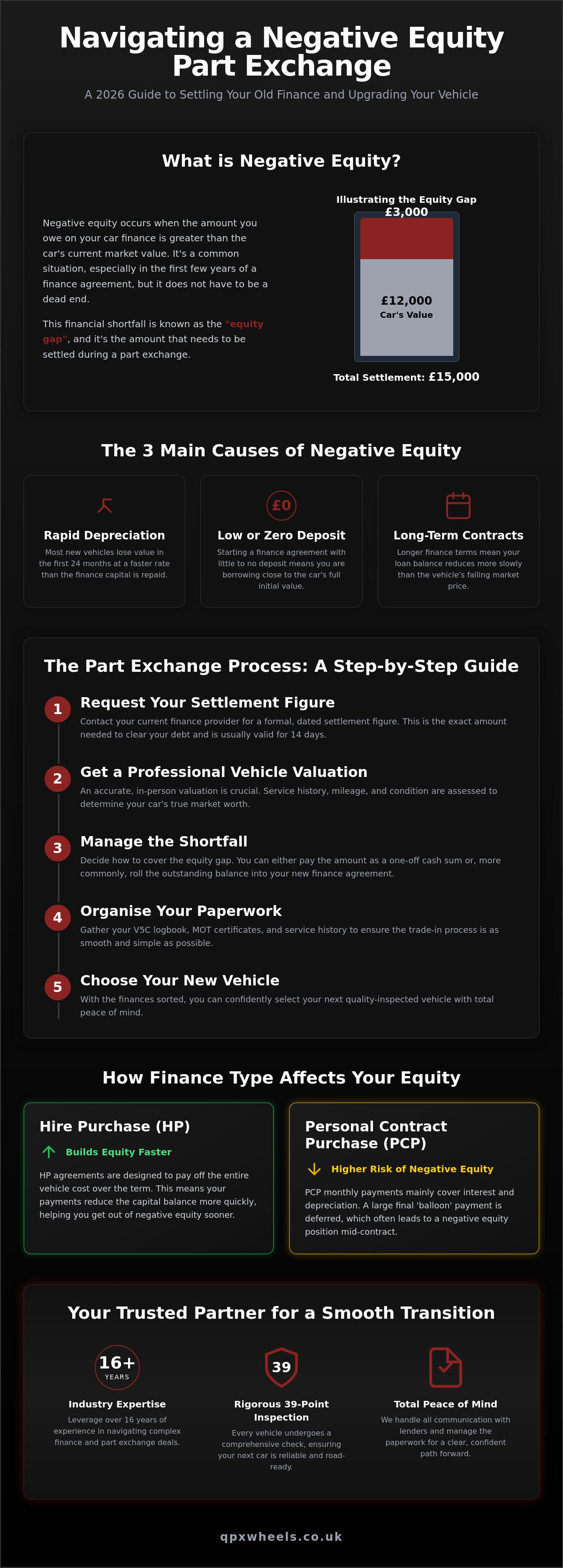
Yes, you can absolutely complete a negative equity part exchange in the UK. Whilst it might feel like you're stuck in a cycle of debt, many motorists find themselves in this exact position. Understanding Negative Equity is the first step toward regaining control of your car finance. Simply put, it's the shortfall that exists when your vehicle's current market value is lower than the settlement figure required by your lender. It's a common hurdle, but it's one that professional dealerships handle every day.
Why does this happen? It isn't usually down to a bad decision on your part. Instead, it's often a result of three main factors:
- Rapid initial depreciation, especially with certain modern models that lose value quickly in their first few years.
- Starting a finance agreement with a very low or zero deposit, meaning you owe almost the full value of the car from day one.
- Choosing a long-term contract where the loan balance reduces slowly compared to the vehicle's falling market price.
A professional dealership acts as the essential bridge in this scenario. We handle the communication with your current finance provider, settle the old debt, and help you transition into a more suitable vehicle. You aren't just selling a car; you're restructuring your financial position with a partner who understands the market.
Depreciation vs Loan Repayments
Most vehicles lose value at a faster rate during the first 24 months than you can pay off the capital on a standard loan. This creates a temporary bubble of debt. Market fluctuations also play a role. If the used car market sees a sudden influx of a specific model, values can drop unexpectedly, widening the gap between what you owe and what the car is worth. This is why gap insurance is frequently discussed, as it's designed to cover this specific financial hole if the car is written off whilst you're still in a negative position.
The Impact of Finance Types (HP vs PCP)
The type of agreement you choose significantly affects your equity position. Hire Purchase (HP) typically builds equity faster because you're paying off the entire cost of the car over the term. Personal Contract Purchase (PCP) is different. Because PCP agreements defer a large balloon payment until the end of the term, your monthly payments mostly cover the interest and depreciation. This often leads to negative equity at specific intervals, particularly in the middle of the contract. Ultimately, negative equity is simply the shortfall between your professional valuation and your final settlement figure.
How to Part Exchange a Car on Finance: The Step-by-Step Process
Completing a negative equity part exchange is a methodical process that relies on accuracy and timing. Whilst the prospect of dealing with lenders might feel daunting, a reputable dealer handles the heavy lifting, ensuring the transition is smooth and transparent. It's a straightforward five-step journey that moves you from your current debt into a more suitable vehicle with minimal fuss.
Requesting Your Settlement Figure
The first step is always to obtain a formal settlement figure from your current finance provider. You shouldn't rely on a verbal "rough estimate" or the balance shown on your last monthly statement. This document is a legal requirement that shows exactly how much is needed to clear the debt on a specific date. Most UK finance companies provide these letters with a 14-day validity period. You'll need your finance agreement number to hand when you call or log in to your provider's portal to request this.
Professional Vehicle Valuation
Once you know what you owe, you need to know what your car is worth. Online automated tools are helpful for a ballpark figure, but they often lack the nuance of a physical inspection. Factors like a full service history, low mileage, and excellent cosmetic condition can significantly increase your car's trade-in value. For a truly accurate figure, you should seek a Professional Vehicle Valuation: What Is Your Car Worth? to ensure your equity gap is calculated on real-world data rather than generic algorithms.
With both figures in hand, you can calculate the "equity gap" by subtracting the valuation from your settlement figure. There are several Key Considerations Before Trading, particularly when deciding how to bridge this gap. You might choose to pay the shortfall in cash or roll it into a new agreement. Once you've selected your next vehicle from our range, the dealer organises the settlement of your old finance directly with the lender. This ensures that the old debt is cleared properly and your new agreement starts on a fresh, transparent footing. If you're ready to see what's available, you can view our current stock of cars and vans to find your next upgrade.
This structured approach removes the guesswork. It allows you to move forward with the quiet confidence that every financial detail is being handled by experts. By following these steps, you ensure that your negative equity part exchange is a stepping stone to a better driving experience rather than a source of stress.
Dealing with Negative Equity: Your Options When You Owe More
Finding yourself with a shortfall doesn't mean your plans for a new vehicle have to stop. You have several paths forward, each with its own financial implications. The right choice depends on your current savings, your monthly budget, and how soon you need to change your car. Our role is to help you weigh these options with total transparency so you can make a decision that feels right for your circumstances.
One of the cleanest ways to move forward is by paying the "shortfall" in cash. If you have the savings available, clearing the difference between your car's valuation and the settlement figure allows you to start your next agreement with a clean slate. This prevents old debt from following you into your new purchase. However, we understand that this isn't always possible, which is why other strategies exist to help you manage a negative equity part exchange effectively.
Rolling Over Finance: Pros and Cons
Rolling your existing debt into a new agreement is a very common way to change vehicles. In this scenario, the dealer settles your old finance and adds the remaining shortfall to the loan for your next car. This is often referred to as negative equity car finance. The primary benefit is convenience; it allows you to upgrade without a large upfront cash payment.
You must consider the long-term impact of the "snowball effect". By adding old debt to a new vehicle's price, you'll likely start your next agreement with even deeper negative equity. Because you are borrowing a larger amount relative to the car's value, lenders will perform much stricter affordability checks. They want to ensure you can comfortably manage the repayments over the full term of the new contract.
The "50% Rule" (Voluntary Termination)
If your negative equity is particularly high, you might look into Voluntary Termination. Under Section 99 of the Consumer Credit Act 1974, UK consumers have a legal right to terminate a finance agreement once they have paid 50% of the "total amount payable". This includes interest and any final balloon payments.
This can be a powerful tool if you feel trapped in a deal that no longer works for you. By exercising this right, you can hand the car back to the lender and walk away without paying the remaining shortfall. Whilst this appears on your credit file, it's a legal right rather than a default, so the impact is typically minimal if you've kept up with all your payments. In some cases, this is a far more stable financial move than rolling debt into a new loan.
Finally, if your car is still performing well, simply delaying the trade-in might be the best strategy. Every monthly payment you make brings you closer to the "breakeven" point where the car's market value aligns with the outstanding debt. A little patience now can lead to a much stronger financial position in six to twelve months.
Key Considerations Before Trading in a Financed Vehicle
Before you commit to a negative equity part exchange, you should consider the practical logistics that ensure a smooth transition. A critical part of our process at QPX Wheels is the HPI check. This isn't just a formality; it's a legal necessity that allows us to verify the current finance status of your vehicle and confirm there are no hidden issues. By being transparent about your car's history, we can build a deal that stands on solid ground from the very start.
Timing also plays a massive role in the cost of your swap. Generally, the middle of a finance term is the most expensive time to switch vehicles. This is because the steepest part of the depreciation curve has already happened, but you haven't yet paid off enough of the capital to balance the scales. If you can wait until the final third of your agreement, you'll often find the equity gap is much smaller. We always recommend checking your position regularly so you can strike when the numbers make the most sense for your budget.
We've designed our service to be as accessible as possible for drivers across the country. Our nationwide delivery and collection service means you don't even have to leave your driveway to complete a finance swap. We'll bring your new car or van to you and take your old one away, handling the paperwork on-site for total convenience. This removes the stress of driving a car you no longer want to a physical showroom.
Documentation Checklist for Finance PX
To keep things moving quickly, you'll need to have your paperwork organised before the valuation is finalised. Make sure you have the following items ready for inspection:
- The V5C registration document (logbook) which must be in your name.
- Your current MOT certificate and a complete record of the vehicle's service history.
- Proof of ID and address, such as a driving licence and a recent utility bill, for your new finance application.
- Both sets of car keys and any locking wheel nut keys.
The Role of Vehicle Condition
The physical state of your car directly impacts the size of your negative equity gap. Whilst every dealer expects "fair wear and tear" based on the age and mileage of the vehicle, significant damage or neglected maintenance will devalue your part exchange. Providing a full service history can add hundreds of pounds to a valuation, as it proves the car has been cared for properly and remains reliable. If you're ready to find a vehicle that has been maintained to our exacting standards, you can browse our latest vehicle stock and start your application online.
Why QPX Wheels is Your Trusted Partner for Finance Part Exchanges
QPX Wheels has spent 16 years building a reputation as a trusted specialist with a national reach. We understand that a negative equity part exchange is more than just a financial transaction; it's about helping you find a vehicle that fits your life without the stress of hidden fees or high-pressure sales tactics. Unlike large national chains that rely on automated volume, we pride ourselves on a transparent, community-oriented approach that puts your peace of mind first. We act as your reliable partner, assisting you through every complexity of the settlement process.
Our experience allows us to provide fair and honest valuations that reflect the true market position of your vehicle. We don't just look at a screen; we look at the car or van you've cared for. By offering a straightforward assessment, we help you understand exactly where you stand, ensuring you can move into your next finance agreement with total confidence. This honesty is the foundation of our business and the reason our customers return to us year after year.
Our 39-Point Inspection & Warranty
When you are rolling debt into a new agreement, the reliability of your next vehicle is paramount. You need to know that your new monthly payment is an investment in a dependable asset. This is why every car and van in our stock undergoes The Benefits of Our 39-Point Vehicle Inspection. This rigorous mechanical standard ensures that your next vehicle is in peak condition before it ever reaches your driveway.
To further support your transition, we include a free three-month warranty with every vehicle we sell. Our after-sales care is designed to offer RAC-level standards of protection, giving you a safety net whilst you settle into your new car. We believe that professional care shouldn't end when the paperwork is signed, which is why our team remains available to support you long after the delivery is complete.
Nationwide Delivery & Collection
We've removed the geographical barriers to finding a great deal. Our nationwide delivery and collection service is designed specifically for those on finance. We can deliver your new vehicle to your door and collect your part exchange in one seamless visit. Our team is trained to handle the logistics of settling your old finance agreement on-site, ensuring the transition is handled correctly and professionally.
Because we operate nationally, you also benefit from the protection of distance selling regulations. This adds an extra layer of security to your purchase, ensuring you are completely satisfied with your new vehicle. If you are ready to see how we can help you move forward, you can browse our latest used cars and vans today and speak with our friendly team about your options. We are here to make your next car purchase simple, honest, and entirely transparent.
Take Control of Your Car Finance Future
Dealing with a shortfall on your car finance can feel like an uphill struggle, but you now have the tools to move forward with confidence. You've learned that a negative equity part exchange is a practical solution that allows you to transition into a more suitable vehicle whilst managing your existing debt responsibly. By securing a formal settlement figure and an accurate valuation, you can bridge the gap and start fresh with a clear plan.
At QPX Wheels, we bring 16 years of expertise to every deal, ensuring you receive a fair assessment and professional care. Every vehicle we sell passes a rigorous 39-point vehicle inspection, so you can trust that your new car or van is built to last. Our nationwide delivery and collection service means we'll handle the logistics of your swap wherever you are in the UK, making the entire process as simple as possible.
Ready to see what your car is worth? Get a Fair Valuation and Upgrade Your Financed Car Today. We're here to guide you through a smooth, honest, and stress-free upgrade. We look forward to helping you get back on the road in a vehicle you truly love.
Frequently Asked Questions
Can I part exchange a car on finance if I don’t have the V5C logbook?
You generally cannot complete the transaction without the original V5C logbook. This document is essential for the dealer to prove the vehicle's history and to notify the DVLA of the change in keepers. If your logbook is missing, you should apply for a replacement from the DVLA immediately. Whilst we can begin the valuation process, the physical document must be present before the final handover can take place.
How much negative equity can I roll over into a new car loan?
The amount you can roll over depends on the lender's specific loan-to-value limits and your personal affordability. Most finance companies allow a certain percentage of the vehicle's value to be exceeded, but they will perform strict checks to ensure you can manage the higher monthly payments. A negative equity part exchange requires a transparent look at your budget to ensure the new deal remains a sustainable investment for your future.
Will a negative equity part exchange hurt my credit score?
The act of part exchanging itself does not damage your credit score. However, applying for a new finance agreement involves a hard credit check, which can cause a small, temporary dip in your rating. If you have kept up with your previous payments and the dealer settles the old debt in full, it shows lenders that you are a responsible borrower. It's always best to check your eligibility before committing to multiple formal applications.
What happens if the dealer’s valuation is lower than my settlement figure?
This confirms that you are in a negative equity position, leaving a shortfall that must be cleared. You can choose to pay this difference in cash to start your next agreement with a clean slate, or you can roll the debt into your new finance plan if the lender approves. We provide fair, honest valuations based on 16 years of experience to ensure the gap is handled with total transparency and professional care.
Do I need to inform my finance company before I part exchange?
You don't need to ask for permission, but you must request an official settlement figure from them. This document tells the dealer exactly how much is required to close your account on a specific date. Once the deal is agreed, the dealership takes responsibility for paying this amount directly to your lender. This ensures the old finance is settled correctly, fulfilling your legal obligations and allowing you to move into your new vehicle.
Can I part exchange a financed van for a car, or vice versa?
Yes, you can swap between different vehicle types with ease. At QPX Wheels, we specialise in both used cars and used vans, so we are perfectly placed to help you transition regardless of the vehicle you currently drive. The process of settling your old finance and setting up a new agreement remains the same. This flexibility is ideal if your lifestyle or business needs have changed since you started your original contract.
Is it better to sell my car privately or part exchange it when on finance?
Part exchange is almost always the better option for financed vehicles. Selling a car with outstanding finance privately is legally complex because you don't technically own the car until the final payment is made. Most private buyers are also reluctant to take on the risk. A professional negative equity part exchange removes these hurdles, as the dealer handles the legal settlement directly with your finance provider, ensuring a safe and simple transaction.
How long does the finance settlement process take during a part exchange?
The settlement process is typically very quick and is usually finalised within a few working days. Once you have signed your new agreement, the dealer sends the settlement funds to your old finance provider immediately. Whilst the payment is often transferred the same day, it can take between three and five working days for the lender's systems to update and for you to receive a final closure letter for your peace of mind.


