
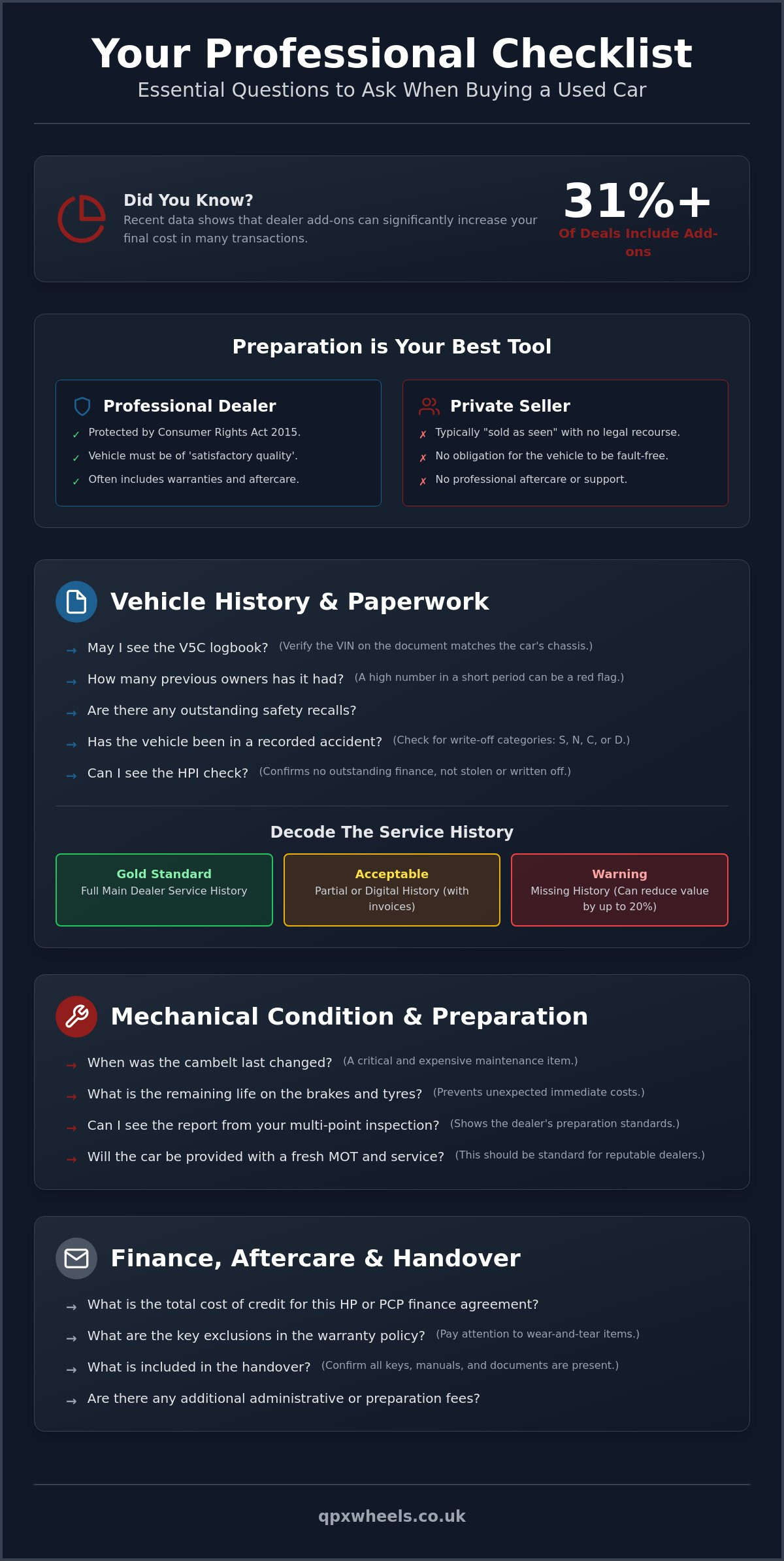
Did you know that recent data from July 2026 shows over 31 per cent of car transactions now include extra dealer add-ons that can significantly increase your final cost? It is a figure that explains why so many people feel a sense of trepidation when they step onto a dealership forecourt. You likely want to avoid hidden mechanical issues and the confusion of finance jargon, but without a clear strategy, it is easy to feel like you are losing control of the conversation.
We believe that transparency is the foundation of a great purchase. By learning the essential questions to ask when buying a used car from a dealer, you can move past the sales talk and focus on the facts that actually matter. This guide provides a professional checklist to help you audit a vehicle's preparation standards and financial transparency with total confidence.
We will break down the non-negotiable queries regarding vehicle history, mechanical health, and the specifics of HP or PCP finance. This methodical approach ensures you find a car that fits your lifestyle whilst giving you the peace of mind that comes from a truly informed decision.
Key Takeaways
- Learn how to transition from an emotional buyer to an analytical one by preparing a specific list of questions before you even step onto the forecourt.
- Master the essential history and paperwork questions to ask when buying a used car from a dealer to ensure the V5C logbook and service records align with the vehicle’s description.
- Identify critical mechanical indicators, such as the condition of the cambelt and remaining brake life, to prevent unexpected repair bills shortly after purchase.
- Understand the importance of a dealership’s multi-point inspection process and why a fresh MOT and service should be a standard part of your handover.
- Gain clarity on the total cost of credit for HP or PCP finance and learn how to scrutinise warranty exclusions to protect your investment long-term.
Why Preparation is Your Best Tool When Visiting a Car Dealership
Stepping onto a dealership forecourt can feel overwhelming. It is easy to get swept up in the aesthetic appeal of a polished exterior or the latest dashboard technology. However, a successful purchase requires a shift from an emotional mindset to an analytical one. You aren't just buying a vehicle; you're entering a professional transaction. Preparation is the bridge between hope and certainty.
While dealerships generally offer a higher safety net than private individuals, preparation standards vary across the industry. Some businesses might perform a basic visual check, whilst others invest in rigorous multi-point inspections. By preparing specific questions to ask when buying a used car from a dealer, you encourage transparency. Asking open-ended questions, such as "How do you decide which cars meet your retail standards?" rather than simple yes/no queries, forces a more detailed and honest response. This positions the dealer as a service provider who is accountable for the quality of their stock.
The Difference Between a Trader and a Private Seller
One of the primary advantages of choosing a professional dealership is the legal safety net. Under the Consumer Rights Act 2015, vehicles sold by a trader must be of satisfactory quality, fit for purpose, and as described. Unlike a private sale, where "sold as seen" often leaves the buyer with no recourse, a professional dealer cannot legally opt out of these obligations. Wikipedia's overview of the used car market highlights that professional dealerships provide a layer of verification that is often absent in the private secondary market. Beyond legalities, dealers offer extended warranties and aftercare that a private handshake simply cannot match.
Setting the Tone for Your Interaction
Your first few minutes at the dealership set the tone for the entire negotiation. Signalling that you are a knowledgeable buyer doesn't require mechanical expertise; it requires organisation. Before you visit, it's wise to request the vehicle's HPI status or a similar history check. This shows the dealer you've done your homework. Group your questions to ask when buying a used car from a dealer into logical categories like history, mechanical condition, and the final deal. This methodical approach ensures no detail is overlooked. It demonstrates that you value transparency and long-term satisfaction over a quick sale.
The Essential History Checklist: Verifying the Vehicle’s Past
A vehicle's history is the most reliable indicator of its future performance. Whilst a car might look pristine under the showroom lights, its paperwork tells the real story. One of the first questions to ask when buying a used car from a dealer is simply: "May I see the V5C logbook?" You need to verify that the Vehicle Identification Number (VIN) on the document matches the one etched on the car's chassis or windscreen. This ensures the car is exactly what the dealer claims it to be.
It's also vital to enquire about the number of previous owners and the reason the car is currently for sale. A high number of owners in a short period can sometimes signal a recurring fault that previous keepers couldn't resolve. Additionally, you should check for outstanding safety recalls. Manufacturers often issue recalls for specific components; confirming these have been addressed ensures your safety and prevents future inconvenience. Finally, always ask if the car has been involved in a recorded accident. Vehicles categorised as S, N, C, or D have suffered varying levels of damage, which must be factored into both the price and your insurance premiums.
Decoding Service History
Service history is not a single category; it exists on a spectrum. A "Full Main Dealer Service History" is the gold standard, showing the car was maintained by technicians trained specifically for that brand. A "Partial" history suggests gaps where maintenance might have been neglected. Industry experts often suggest that a missing service history can reduce a car’s resale value by as much as 20 per cent. Don't just look for a stamped book; many modern cars use digital records. Ask the dealer to print these off or show them on screen. Physical invoices are even better, as they provide proof of what parts were actually replaced.
The HPI Check and Provenance
An HPI check is a non-negotiable part of the process. It reveals if the car has outstanding finance, has been reported stolen, or was previously written off by an insurer. Whilst UK regulations are strict, looking at international standards such as the FTC Used Car Rule demonstrates how transparency regarding vehicle history and warranties is a global benchmark for professional traders. You should also verify the mileage against the MOT history records available online. Discrepancies here are a major red flag for "clocking."
If you are looking for vehicles with fully verified backgrounds and transparent records, you can browse our current selection of used cars online. We prioritise clarity so you can buy with total confidence.
By preparing these specific questions to ask when buying a used car from a dealer, you protect yourself from the most common pitfalls of the secondary market. A reputable dealer will have this information ready and will welcome your diligence.
Mechanical Condition: Questions to Reveal Maintenance Needs
Once you are satisfied with the paperwork, it is time to look under the metal. While a dealer's visual preparation is often excellent, physical components have finite lifespans. One of the most critical questions to ask when buying a used car from a dealer involves the cambelt, also known as the timing belt. If this belt snaps, it can cause catastrophic engine failure. You need to know exactly when it was last changed or if the engine is chain-driven, which generally requires less frequent attention. If a change is due soon, this is a significant expense you should account for before signing.
Wear-and-tear items like brakes and tyres are often overlooked because they are expected to degrade. However, replacing all four tyres or a full set of discs and pads can cost hundreds of pounds. Ask specifically about the remaining life on the brake pads. If they are below 3mm, they will likely need replacing within a few thousand miles. Similarly, check the tyres. Are they from a reputable brand, or are they budget options? Matching tyres from a premium manufacturer often suggest a previous owner who did not cut corners on maintenance.
Identifying "Big Ticket" Maintenance Items
For manual vehicles, enquire about the condition of the clutch and dual-mass flywheel. If the pedal feels heavy or there is a vibration when pulling away, expensive repairs could be on the horizon. On automatic models, ask if the gearbox fluid has been changed according to the manufacturer's schedule. Many modern gearboxes are described as sealed for life, but specialists often recommend changes every 40,000 to 60,000 miles to ensure longevity. Always look for fluid leaks under the bonnet or damp patches on the ground after a test drive; these can signal failing gaskets or cooling system issues.
Interior and Electronic Functionality
The cabin experience is about more than just comfort. Every button, dial, and touchscreen should work perfectly. Ask the dealer if the air conditioning has been recently re-gassed; a system that blows warm air might just need a service, or it could have a costly leak in the condenser. It is also worth asking if the car has been smoked in or used to transport pets. Persistent odours are difficult to remove and often indicate deeper wear in the upholstery. Finally, always verify the presence of two keys. Modern car keys are complex electronic devices, and sourcing a replacement can easily cost over £200. Including these points in your questions to ask when buying a used car from a dealer ensures you aren't met with hidden costs the week after you get home.
The Test Drive and Dealership Preparation Standards
A test drive is more than a quick trip around the block; it is your opportunity to verify the dealer's preparation standards in a real-world environment. Whilst the previous sections focused on history and static mechanicals, this stage is about how the vehicle performs under load. When considering questions to ask when buying a used car from a dealer, you should always enquire about their standard multi-point inspection process. A professional dealer doesn't just wash the car; they perform a systematic check of all safety and functional components.
At QPX Wheels, we leverage over 16 years of industry experience to ensure every vehicle meets a rigorous benchmark before it ever reaches our forecourt. You should feel comfortable asking for a copy of the workshop report or the pre-delivery inspection (PDI) health check. This document provides a transparent look at what was checked and, more importantly, what was fixed. If you find a minor fault during your drive, ask directly: "Will this be rectified before I take delivery?" A reputable business will be happy to commit to these repairs as part of the sale agreement.
Auditing the Dealer’s Inspection Process
The value of a professional PDI cannot be overstated. It is the final safety net that ensures the car is fit for the road. You should also ask if the car will be serviced and MOT’d before handover. Even if the current MOT has several months remaining, a fresh 12-month certificate provides an extra layer of independent verification. This is particularly vital for buyers using our nationwide delivery service, as it ensures the vehicle is in peak condition before it arrives at your door.
What to Listen and Feel for During the Drive
Always insist that the engine is "cold" when you first start it. A warm engine can mask starting issues, battery weakness, or initial rattles that only occur during a cold cycle. Once on the road, choose a route that includes high-speed dual carriageways. A car might feel perfect at 30mph but reveal a wheel balance issue or steering vibration at 70mph. Listen carefully for suspension knocks whilst driving over uneven surfaces and test the brakes on a quiet stretch of road. They should bring the car to a stop in a straight line without any pulling or pedal judder.
By integrating these observations into your questions to ask when buying a used car from a dealer, you move from being a passive observer to an active auditor. If you are ready to find your next vehicle from a partner that values transparency, you can browse our current stock of Lancashire cars for sale today.
Finalising the Purchase: Finance, Aftercare, and Handover
The final stage of your journey is where the emotional excitement of a new car meets the reality of the paperwork. Once you are satisfied with the vehicle's condition and history, your questions to ask when buying a used car from a dealer should pivot toward the financial and logistical details. Transparency here is just as vital as it was during the mechanical inspection. You need a clear answer on the final "on the road" price. This should be a single, transparent figure that includes all taxes and preparation costs, ensuring there are no hidden admin fees waiting for you at the point of signature.
We believe that a successful transaction is built on long-term satisfaction rather than a quick sale. This is why you should ask specifically about the terms of the warranty. It is important to know exactly what is excluded, such as wear-and-tear items like bulbs, tyres, or brake pads. If the standard cover feels too brief for your needs, enquire about extended warranties that can provide longer-term security for your investment. Furthermore, if you have a current vehicle, ask for a clear breakdown of the part-exchange valuation to see how it offsets your new purchase.
Understanding Your Finance Agreement
As specialists in HP and PCP finance brokerage, we know that the total cost of credit is more important than the monthly figure alone. Hire Purchase (HP) typically involves higher monthly payments but results in full ownership once the final instalment is paid. In contrast, Personal Contract Purchase (PCP) offers lower monthly costs but includes a large optional final payment if you wish to keep the car at the end of the term. Always ask for a clear breakdown of the APR, any mileage limits, and the early settlement figures. This ensures you aren't caught out by unexpected costs if your circumstances change mid-agreement.
Post-Sale Support and Delivery
Your relationship with the dealer shouldn't end when the keys are handed over. Clarify the process if a fault develops within the first 30 days. A supportive dealer will have a clear, proactive procedure to handle such issues under the Consumer Rights Act without causing you unnecessary stress. If you aren't local to our Northwest base, ask about our nationwide delivery service. This is a convenient, professional option that brings your new vehicle directly to your doorstep, anywhere in the UK. During the handover, whether in person or at your home, ensure the dealer provides a full demonstration of the vehicle’s controls and technology so you can drive away with total confidence.
Drive Away with Total Confidence
Buying a vehicle is one of the most significant secondary-market purchases you will make. By mastering the right questions to ask when buying a used car from a dealer, you move from a place of uncertainty to one of professional assurance. You now have the tools to audit a vehicle’s past, verify its mechanical health, and scrutinise the fine print of any finance agreement. This methodical approach doesn't just protect your wallet; it ensures your long-term satisfaction on the road.
At QPX Wheels, we pride ourselves on being a transparent partner in your journey. With over 16 years of industry experience, we offer a supportive environment where every question is welcomed. Whether you need expert HP and PCP finance brokerage or want to take advantage of our safe, professional nationwide delivery, we handle the complexities so you don't have to. Our goal is to ensure you feel grounded and informed at every stage of the transaction.
Ready to find a vehicle that meets our high standards? Browse our latest stock of quality used cars and vans at QPX Wheels today. We look forward to helping you find your perfect match with the honesty and clarity you deserve. Safe travels on your next adventure.
Frequently Asked Questions
What is the single most important question to ask a car dealer?
The most critical question is asking for a clear breakdown of the final "on the road" price to ensure there are no hidden admin fees. This establishes a foundation of transparency from the very start of your conversation. You should also ask what specific preparation standards the vehicle has met, which helps you understand the mechanical health beyond the polished exterior seen on the forecourt.
Should I ask to see the MOT history if the car has a new certificate?
Yes, you should always review the full MOT history even if a fresh certificate has just been issued. The history reveals recurring "advisories" or minor faults that might have been ignored by previous owners for years. Checking these records allows you to anticipate upcoming maintenance costs, such as suspension wear or exhaust corrosion, that a single new certificate might mask.
Is it okay to ask for a discount on a used car from a dealer?
It is perfectly acceptable to discuss the price, but your request should be based on evidence rather than a random figure. If you identify upcoming maintenance needs during your inspection, such as a cambelt change or tyres with low tread, use these as logical leverage. A reputable dealer values a fair transaction and will often consider reasonable offers that reflect the vehicle's actual condition.
How do I know if the dealer’s warranty is actually worth having?
A warranty's value is defined by its exclusions and claim limits rather than just its duration. Ask for the specific list of components that aren't covered, which typically includes wear-and-tear items like clutches, brake pads, or batteries. Understanding whether you can use any VAT-registered garage or if you must return to the selling dealer is also vital for your long-term convenience.
Can I ask the dealer to fix minor cosmetic damage before I buy?
Yes, you can request that minor cosmetic issues, such as alloy wheel scuffs or small stone chips, are rectified before you take delivery. Most professional dealers have access to specialist "SMART" repairers who can fix these issues efficiently as part of the sale. Ensure any agreed repairs are documented in writing as a condition of your purchase to avoid confusion on handover day.
What should I ask if I am buying a used car on finance (HP or PCP)?
When discussing finance, the most important questions to ask when buying a used car from a dealer involve the total cost of credit and the APR. Don't just focus on the monthly payment; ask about early settlement fees and, for PCP agreements, the specific mileage limits and the optional final payment. Knowing these details prevents expensive surprises if your circumstances change mid-agreement.
Why is it important to ask how long the car has been in stock?
Knowing how long a vehicle has been in stock can give you a better understanding of the dealer's willingness to negotiate. Cars that have been on the forecourt for over 90 days often represent a higher holding cost for the business. However, if a car has sat for a long time, you should also ask about the condition of the battery and whether the tyres have been checked for flat spots.
What paperwork should I receive when I drive away with the car?
You must receive the V5C "new keeper" supplement, a valid MOT certificate, and all available service history records. Additionally, ensure you have a signed sales invoice and a copy of the warranty terms and conditions. If you have followed our questions to ask when buying a used car from a dealer guide, you should also have a copy of the HPI report and the multi-point inspection sheet.


