
With over 8 million used cars expected to change hands across the UK in 2026, the sheer volume of choice can make finding the right vehicle feel like searching for a needle in a haystack. You likely feel that a car is more than just a purchase; it's a vital investment in your daily freedom. However, the fear of inheriting a hidden accident history or getting tangled in confusing HP and PCP finance jargon often turns an exciting milestone into a source of stress. It's completely natural to worry about future ULEZ charges or whether a vehicle is truly as mechanically sound as it appears on the surface.
Our comprehensive guide to used car buying tips UK is designed to replace that anxiety with professional assurance. We promise to help you master the art of selecting a second-hand vehicle that is HPI clear, reliable, and perfectly suited to your budget. By following our expert checklist, you'll learn how to verify a car's history, understand your monthly payment options, and arrange a stress-free delivery or collection. We'll cover everything from VED tax changes for 2026 to the security provided by extended warranties, ensuring your next journey begins with total confidence.
Key Takeaways
- Understand how the expansion of Clean Air Zones across the UK influences vehicle choice and why hybrid models are becoming a practical priority for 2026 buyers.
- Discover essential used car buying tips UK for managing total ownership costs, including how to leverage professional valuation services to secure transparent HP or PCP finance.
- Learn to identify mechanical red flags like uneven tyre wear or mismatched paint colours and how to verify the V5C logbook against the vehicle's MOT history.
- Gain peace of mind by understanding the value of dealer-backed extended warranties and the convenience of having your chosen vehicle brought to your door via nationwide delivery.
Navigating the Used Car Market in 2026: What Has Changed?
The landscape for purchasing a vehicle has shifted significantly over the last few years. While the history of the used car market shows a long-standing preference for traditional internal combustion engines, 2026 represents an era where digital transparency and environmental compliance are the primary drivers of value. Used car sales volumes have reached 8 million units this year, yet finding the right stock requires a more data-led approach than in previous decades. Buyers are now prioritising "HPI Clear" status above almost all other factors to avoid hidden financial or structural risks. This shift towards online-first browsing doesn't replace the need for professional preparation; it actually makes it more vital to ensure the car you see on a screen matches the reality on your driveway.
Understanding Emission Standards (Euro 6 and Beyond)
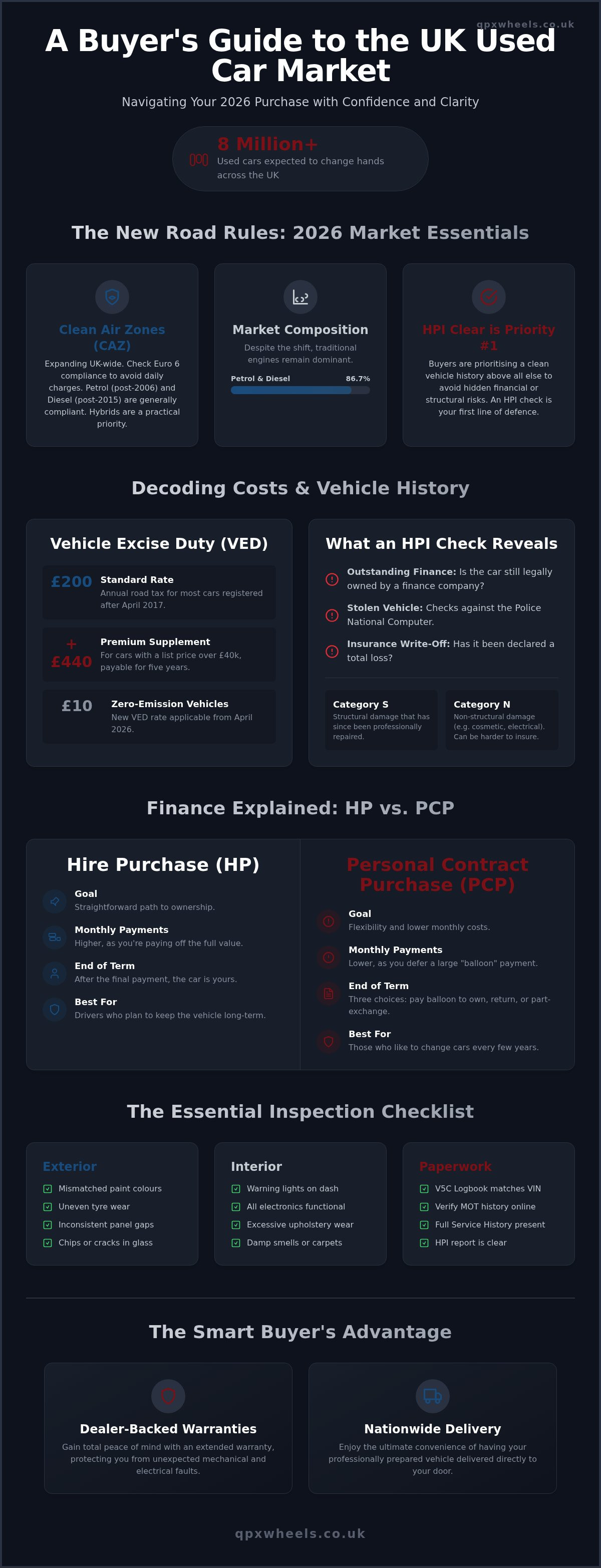
Clean Air Zones (CAZ) have expanded across most major UK cities, making your choice of engine more critical than ever. To avoid daily charges, most petrol cars registered after 2006 and diesels from late 2015 typically meet the necessary Euro 6 requirements. For city dwellers, petrol models or hybrids often prove more cost-effective as they avoid the diesel premium and potential future restrictions. With zero-emission vehicles now subject to a £10 VED rate as of April 2026, the transition to electric is accelerating, though petrol and diesel still account for 86.7% of the market. Checking compliance before you buy is one of the most vital used car buying tips UK motorists should follow to protect their car's future resale value and daily running costs.
The Importance of an HPI Check
An HPI check is your first line of defence against expensive mistakes. It verifies if a vehicle has outstanding Hire Purchase (HP) finance, has been reported stolen, or has an insurance write-off against its name. Within the UK market, you'll often encounter Category S and Category N write-offs. Category S refers to structural damage that has been repaired, whereas Category N involves non-structural issues like cosmetic or electrical faults. While Cat N vehicles might appear as bargains, they can be harder to insure and slower to sell later. Always insist on a vehicle that has been professionally cleared. This simple step ensures that the car you see is the car you actually own, providing the peace of mind that defines a successful purchase.
Budgeting and Securing the Right Finance for Your Vehicle
Success in the second-hand market starts with a realistic budget that looks beyond the initial sticker price. To avoid future financial strain, you must calculate the total cost of ownership, which includes insurance, maintenance, and Vehicle Excise Duty (VED). For most cars registered after April 2017, the standard annual road tax rate is now £200. If you're eyeing a premium model with a list price over £40,000 (or £50,000 for zero-emission vehicles), remember to account for the £440 annual supplement payable for five years. Consulting the official government guide to buying a vehicle can help you verify these legal requirements before you commit. Ensuring these costs fit your monthly outgoings is one of the most practical used car buying tips UK buyers can apply to maintain peace of mind.
Maximising Your Part-Exchange Value
Your current vehicle is often your most significant asset when upgrading. To boost your buying power, spend time preparing your car for a professional vehicle valuation service. Simple steps like gathering a complete service history, performing a deep clean, and addressing minor cosmetic scuffs can significantly increase the offer you receive. When you trade in a car that still has outstanding finance, the "equity" is the difference between its current market value and the remaining settlement figure. A positive equity balance can act as a substantial deposit, lowering your future monthly payments and making the transition to your next vehicle much smoother.
HP vs PCP: Which Suits Your Lifestyle?
Securing the right finance plan is just as important as choosing the car itself. Hire Purchase (HP) is a straightforward path to ownership. You pay a deposit followed by fixed monthly instalments; once the final payment is made, the car is yours. It's ideal if you plan to keep the vehicle for many years and don't want to worry about mileage limits. Personal Contract Purchase (PCP) typically offers lower monthly payments because you're essentially deferring a large portion of the car's value to the end of the agreement. At that point, you can pay the "balloon" figure to keep the car, return it, or use any remaining equity for a new deal.
While representative APRs for used car financing often range between 9.9% and 11.9%, dealer-arranged finance provides a level of flexibility that high-street banks often lack. Professional dealers can tailor terms to your specific credit profile and handle the entire administrative process in one go. This often results in a faster approval process, allowing you to drive away in your new car sooner without the stress of managing multiple lenders.
The Essential Used Car Inspection Checklist
Approach the vehicle with a critical eye, ideally in bright daylight where imperfections are hardest to hide. Start by walking around the exterior to look for inconsistent panel gaps or subtle paint colour mismatches, which often suggest previous accident repairs. While you're there, examine the tyres closely. The legal minimum tread depth is 1.6mm, but for safety, you should look for at least 3mm. Uneven wear patterns on the edges of the tread often indicate that the tracking or suspension is misaligned. These physical checks are fundamental used car buying tips UK buyers should never skip, as they reveal how the car has been treated throughout its life.
Before you turn the key, ensure the engine is stone cold. A pre-warmed engine can mask starting issues, unusual rattles, or tell-tale puffs of smoke. Once the engine is running, spend ten minutes testing every interior electronic component. Switch on the air conditioning to ensure it blows ice-cold, test every electric window, and check that the infotainment system connects to your phone without lag. Under the Consumer Rights Act 2015, you have a short-term right to reject a faulty vehicle within the first 30 days, so identifying these "smaller" issues now prevents a larger headache later.
The Mechanical Walkaround
Pop the bonnet and inspect the engine bay for signs of neglect. Look for fresh oil leaks, heavy grime, or any white, mayonnaise-like residue under the oil filler cap, which could signal a head gasket failure. Check that the coolant and brake fluid levels are between the minimum and maximum markers. You can also spot potential "clocking" by looking for a mismatch between the recorded mileage and the physical wear inside the cabin. If a car shows only 30,000 miles but the steering wheel is shiny and the rubber on the brake pedal is worn through to the metal, the odometer may not be telling the full story.
The Test Drive Strategy
The test drive is your best opportunity to feel how the mechanical components work together. Pay close attention to the clutch and gearbox; gear changes should be crisp, and the clutch should bite firmly without slipping. On a straight, safe stretch of road, loosen your grip on the steering wheel slightly to see if the car pulls to one side. Listen for any knocking sounds when driving over speed bumps, as these usually point to worn suspension bushings. Finally, test the brakes. The car should stop in a straight line without any vibration through the pedal or steering wheel, giving you the confidence that the vehicle is as sound as it is stylish.
Verifying Documents and Legal Ownership
The paperwork is just as important as the mechanical state of the vehicle. You should start your review with the V5C logbook. It's vital to check that the Vehicle Identification Number (VIN) on the document matches the one stamped on the car's chassis or engine plate. Also, verify that the seller is the registered keeper listed on the document. A missing or altered V5C is a major red flag that could indicate a stolen vehicle or an undisclosed insurance write-off. Ensuring the paper trail is legitimate is one of the most fundamental used car buying tips UK buyers must follow to avoid legal complications later.
Scrutinising the MOT History
Digital records have made checking a car's past much easier. By using the official UK government website, you can view every MOT test the car has ever had. Look closely at "advisories". These are faults that weren't severe enough to fail the test but will need attention soon. If you see recurring advisories for brake wear or suspension bushes over several years, it suggests the previous owner was reactive rather than proactive with maintenance. Consistent failures for basic safety items like tyres or bulbs are another sign of a neglected vehicle. These records also allow you to verify mileage consistency, ensuring the odometer hasn't been tampered with between tests.
A Full Service History (FSH) adds significant value to any second-hand car. It provides a documented timeline of oil changes, belt replacements, and general health checks. Without these stamps or receipts, you're essentially taking the seller's word that the car has been looked after. Once you're satisfied with the history, ensure you receive a clear sales invoice. This document should detail the date of sale, the price paid, the mileage at the time of purchase, and the details of both the buyer and seller. This proof of purchase is your primary legal protection if a dispute arises regarding ownership.
Warranty and Consumer Rights
Buying from a professional dealer offers a level of protection that private sales simply cannot match. Under the Consumer Rights Act 2015, you have a statutory "short-term right to reject" a faulty vehicle within the first 30 days for a full refund. For the first six months, the burden of proof lies with the dealer to show that a fault was not present at the time of sale. Whilst these rights are powerful, modern vehicles are complex machines with expensive components. Investing in extended warranties through a reputable dealer is a sensible way to protect yourself against unexpected electrical or mechanical failures in the future. This extra layer of security ensures that your investment remains protected long after the initial purchase process is complete.
Why Choosing a Reputable Dealer is the Smartest Move
While private sales might seem like a way to save a few pounds, they often lack the safety net required for a significant investment. Professional dealers provide a layer of security through rigorous multi-point mechanical checks that ensure every vehicle meets a high standard before it ever reaches the forecourt. This is particularly important when searching for specialist stock, such as disabled friendly vehicles or budget automatics, where mechanical reliability is non-negotiable. Following these used car buying tips UK helps you see that a dealer-backed purchase prioritises your long-term satisfaction over a quick, unverified transaction.
The Benefits of Nationwide Delivery
The modern car buying process isn't limited by your local geography. With nationwide delivery, you can secure a quality used van or car from the other side of the country without leaving your home. Distance buying typically begins with a detailed virtual tour, allowing you to inspect the vehicle's condition through high-definition video and close-up photography. Once the vehicle arrives at your doorstep, you have the opportunity to perform a final inspection in a familiar environment before signing the final paperwork. This convenience removes the pressure of long-distance travel and ensures you don't settle for a local car that doesn't quite meet your specific requirements.
Long-Term Support and Warranties
A private seller's responsibility ends the moment you drive away. In contrast, a reputable dealer acts as a partner in your ownership journey. By offering extended warranties that can be tailored to your annual mileage, they provide a financial buffer against future repair costs. This professional support extends to the financial side of the deal. Dealing with an FCA-regulated brokerage ensures that your HP or PCP finance is transparent, with monthly payments and interest rates that are clearly explained from the start. When the time eventually comes to upgrade, having a relationship with a dealer who offers a professional vehicle valuation service makes the transition to your next car simple and stress-free. It's about building a foundation of trust that lasts for the life of the vehicle.
Drive Forward with Confidence
Purchasing a vehicle in 2026 is about more than just a test drive; it's about making a data-led decision that protects your finances and your future mobility. By focusing on HPI-clear status, verifying MOT histories, and understanding the latest emission standards, you've already taken the most important steps toward a successful purchase. These used car buying tips UK motorists need most will help you navigate the market without the usual stress or uncertainty.
At QPX Wheels, we bring over 16 years of industry expertise to every transaction. As an FCA-regulated finance specialist, we ensure your monthly payments are as transparent as our vehicle histories. Whether you're looking for a luxury car or a budget automatic, our team is here to support you with nationwide delivery available for all vehicles. Browse our latest range of quality used cars and vans with nationwide delivery today. We're ready to help you find a vehicle that delivers total peace of mind for years to come.
Frequently Asked Questions
What are the most important things to check when buying a used car?
You should focus on the "big three": mechanical integrity, legal history, and environmental compliance. Ensure the engine is cold-started and check for a consistent service history that matches the recorded mileage. In 2026, verifying the vehicle's battery health for hybrids or Euro 6 compliance is just as critical as checking for rust or oil leaks. Following established used car buying tips UK wide ensures you don't overlook these essential safety and value markers.
Is it better to buy a used car from a dealer or a private seller in the UK?
Buying from a reputable dealer is generally the safer choice because of the legal protections provided by the Consumer Rights Act 2015. Dealers are required to ensure vehicles are of satisfactory quality and fit for purpose. While private sales might offer lower initial prices, they lack the multi-point inspections, extended warranties, and regulated finance options that professional showrooms provide. This security is often worth the modest premium for long-term peace of mind.
How much deposit do I typically need for used car finance?
Most lenders suggest a deposit of around 10% of the vehicle's purchase price, though zero-deposit finance options are often available for those with a strong credit profile. A larger deposit is beneficial as it reduces your monthly instalments and the total interest paid over the term. Whether you choose HP or PCP, professional dealers can help tailor a payment structure that suits your monthly budget whilst maximising the future equity in your vehicle.
Can I get a used car delivered to my house if I buy it online?
Yes, nationwide delivery is now a standard service offered by professional national specialists. This process allows you to browse, secure finance, and purchase your vehicle entirely online before having it transported directly to your driveway. Most delivery services include a full handover process where you can inspect the car at your own home before finalising the paperwork. This modern approach makes it simple to find the perfect vehicle regardless of where you live.
What documents should I receive when I buy a second-hand car?
You must receive the V5C logbook, a valid MOT certificate, and a comprehensive sales invoice detailing the transaction. It's also highly beneficial to obtain the full service history and any receipts for recent mechanical work or parts. If the vehicle is still under a manufacturer or dealer-backed warranty, ensure you have the relevant policy documents. These papers are vital for proving legal ownership and maintaining the future resale value of your new investment.
How do I know if a used car is ULEZ compliant?
You can verify compliance by entering the vehicle's registration number into the official government online checker. Generally, petrol cars registered after 2006 and diesel cars registered after September 2015 meet the necessary Euro standards to be exempt from daily charges. With Clean Air Zones expanding across the country in 2026, confirming this status before purchase is one of the most vital used car buying tips UK buyers should remember.
Is a high-mileage car a bad investment if it has a full service history?
High mileage is not necessarily a red flag if the vehicle has a meticulous full service history. A car that has covered 100,000 miles on the motorway is often in better mechanical health than one that has done 30,000 miles of stop-start city driving. Regular maintenance, such as timely oil changes and cambelt replacements, is a far more reliable indicator of future longevity than the number on the dashboard, especially when backed by professional valuations.
What happens if I find a fault with my used car after I buy it?
If you purchase from a dealer, you're protected by the Consumer Rights Act 2015. You have a legal right to a full refund if a significant fault appears within the first 30 days. Between 30 days and six months, the dealer is usually entitled to one attempt at a repair or replacement. If you bought from a private seller, your rights are much more limited, which is why professional dealer-backed warranties are such a sensible investment.


