
A used car’s automatic transmission should engage promptly, change gear without harsh jolts and downshift smoothly as you slow down. When checking automatic transmission smoothness on a used car, watch for a delay of more than a second after selecting a gear, or engine revs rising without a matching increase in speed. Both are signs that need attention.
Be cautious: an expensive problem can be easy to miss on a short test drive. You can assess gear changes, downshifts and possible slipping with simple checks during a calm, controlled drive.
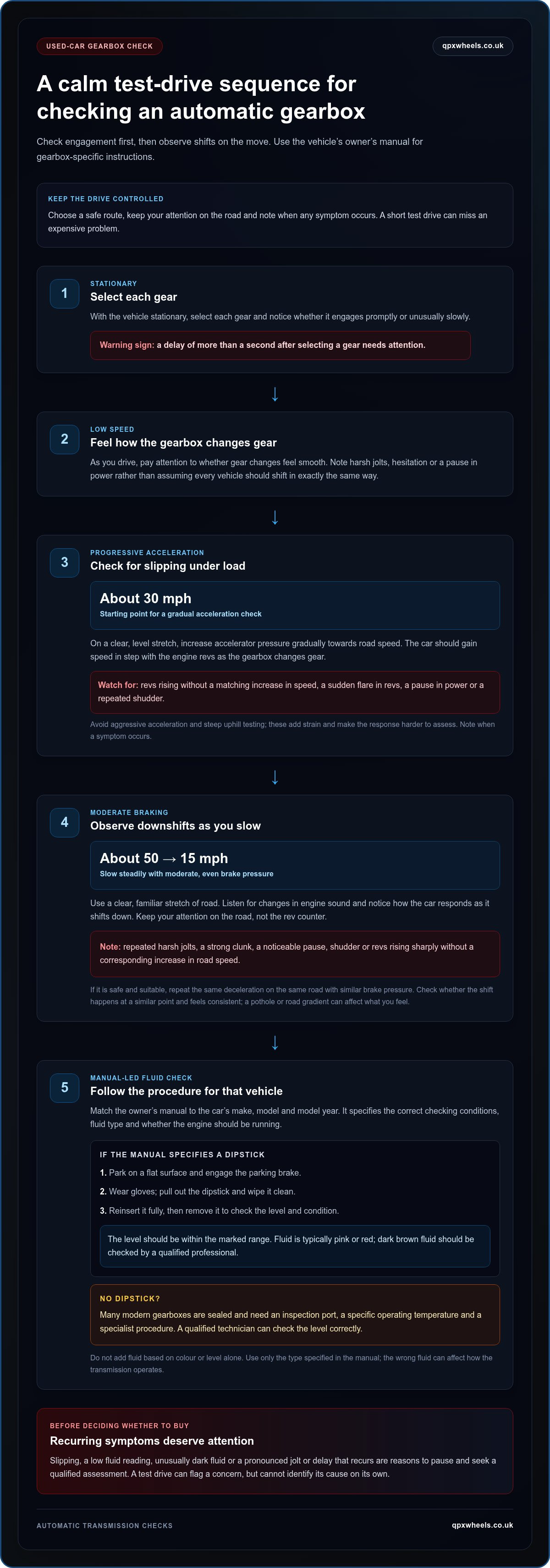
Start by checking gear selection, then observe how the transmission behaves at low speed, during acceleration and under moderate braking. These checks can help you spot warning signs before deciding whether to proceed with the car.
Key Takeaways
- Select each gear while stationary and notice whether engagement is prompt or unusually delayed.
- Accelerate progressively from around 30 miles per hour and watch for engine revs rising without a matching increase in speed.
- Assess downshifts with moderate braking, paying attention to jolts, hesitation or unexpected changes in engine speed.
- Use the owner’s manual to find the correct transmission-fluid checking procedure, as it can vary between vehicles.
Acceleration under load and transmission slipping
Check for slipping by accelerating progressively from about 30 miles per hour towards road speed. Watch whether the vehicle gains speed in step with engine revs, rather than revving without a matching response.
-
Check acceleration under load
Choose a clear, level stretch of road and increase pressure on the accelerator gradually from approximately 30 miles per hour. The automatic should change gear as speed builds, without a sudden flare in engine revs, a pause in power or a repeated shudder. Avoid aggressive acceleration or testing on a steep uphill road, which adds strain and makes the response harder to assess. Note when any symptom occurs.
-
Check fluid condition and level
To check transmission fluid, park on a flat surface, engage the parking brake and follow the vehicle owner’s manual. If the car has a dipstick, wear gloves, pull it out, wipe it clean, reinsert it fully, then remove it to check the level and condition. The fluid should be within the marked range; a level at or below minimum may need attention. It is typically pink or red, while dark brown fluid should be checked by a qualified professional.
- Use the manual to locate the dipstick, which is often near the back of the engine bay, and confirm whether the engine should be running during the check. Automatic transmission fluid lubricates gearbox components and helps the transmission shift smoothly. Don’t add fluid based on colour or level alone: the manual specifies the required type, and using the wrong fluid can affect how the transmission operates.
- If there’s no dipstick, don’t assume you can check the fluid level by sight. Many modern gearboxes are sealed and require an inspection port, a specific operating temperature and a specialist procedure. A qualified technician can check the level correctly. Treat slipping, a low fluid reading or unusually dark fluid as reasons to pause before deciding whether to buy.
Consulting the owner’s manual
Use the manual for the exact vehicle before relying on a generic transmission check. It explains which procedures apply to that gearbox and helps you avoid using the wrong fluid or checking under the wrong conditions.
- Match the manual to the car. Check the vehicle’s make, model and model year against the manual, then find the section on its automatic transmission. If the car has a different engine or gearbox variant, don’t assume the same fluid-checking steps apply. A manual for a similar model may specify different operating conditions or fluid.
- Read the fluid-checking procedure before opening the bonnet. The manual identifies the dipstick location and whether the engine should be running. Some vehicles require the engine to run during the check. Follow the stated sequence and conditions rather than copying another car’s procedure, as an incorrect reading can make the fluid level seem misleading.
- Check the specified fluid before topping up or replacing it. Transmission fluids differ in specification and viscosity, so use the type specified for that vehicle. The manual may also describe operating temperatures and the correct filling procedure. Don’t assume two fluids are interchangeable just because they look similar or the vehicles share a badge.
- Look for gearbox-specific instructions. Modern transmission checks can depend on temperature, defined operating conditions and scan-tool guidance. Service procedures may also include adaptation or calibration requirements. If the manual describes an inspection port and specialist steps, don’t substitute a dipstick check. The instructions require a different method.
- Use the manual to interpret your test drive. Note any stated driving conditions for checking shift behaviour, then compare them with what you experience. If you’re considering another vehicle, used-car buying options can help you continue your search with the relevant details in mind.
Downshifts during deceleration
Assess downshifts with moderate braking from about 50 miles per hour to about 15 miles per hour. Focus on how the vehicle responds as its automatic gearbox shifts down while slowing.
- Choose a clear, familiar stretch where you can slow steadily without holding up traffic. Build to about 50 miles per hour, then apply moderate, even brake pressure until reaching about 15 miles per hour. Keep your attention on the road, not the rev counter, and avoid abrupt braking that could obscure the gearbox’s response.
- Notice changes in engine sound and speed as the vehicle decelerates. You may feel a downshift, but repeated harsh jolts, a strong clunk or a noticeable pause deserve attention. If a symptom occurs, note the speed and conditions so you can describe the behaviour clearly.
- If it’s safe and suitable, repeat the same deceleration on the same road using similar brake pressure. Compare whether the shift happens at a similar point and feels consistent. A pothole or change in road gradient can affect what you feel, so distinguish a road impact from a symptom that recurs during braking.
- Listen for engine revs rising sharply without a corresponding increase in road speed. Also note any shudder or hesitation as the gearbox selects a lower ratio. These signs may involve a transmission component or clutch operation, but the test alone cannot identify the cause.
- Compare your observations with the owner’s manual and the manufacturer’s guidance for that vehicle, where available. Gearbox behaviour varies by design, so don’t judge every model by the same shift feel. If a pronounced jolt or delay recurs, factor it into your purchase decision and seek a qualified assessment before proceeding.
Testing automatic gear changes during a drive
Test the gearbox on a safe route, noting how it responds from cold and after driving. Compare engagement and shifting with the expected operation for that vehicle’s transmission type.
-
Test shifts from cold and when warm
Arrange to start the vehicle after it has been sitting for several hours, then note how each shift feels. Repeat your observations once the engine and transmission are warm from driving. Shift feel can vary with operating conditions, but recurring harsh shifts, hesitation or slipping deserve attention. Compare both checks rather than judging the car from one brief moment.
-
Test Drive and Reverse engagement
With the vehicle stationary and your foot firmly on the brake, select Drive, pause, then select Reverse. Engagement should respond promptly, with no pronounced clunk or extended delay; the expected response is no more than a second. In a clear, level area, move forwards about 20 feet, stop, then reverse about 20 feet. Repeat the forward-and-reverse sequence four or five times, noticing any delay, jolt or inconsistent response.
- Drive through the gearbox’s stages up to 60 mph where road conditions allow. Apply steady acceleration and observe whether shifts feel consistent, without engine revs rising sharply while speed barely changes. A CVT typically varies its ratio rather than shifting through fixed gears, so assess smooth acceleration and response instead of expecting distinct gear changes. A dual-clutch automatic may feel different; note hesitation or repeated jolts rather than assuming every shift should feel identical.
- Compare the cold and warm behaviour, then write down the conditions and symptoms. A vehicle history check may show recorded information, but repair details depend on what has been recorded. Ask to see available service or repair records, especially if gearbox work is mentioned. A cleared transmission fault code can return within one or two drive cycles, so a quiet dashboard alone doesn’t prove the transmission is working correctly.
- If the vehicle has frequent transmission repairs, an unclear gearbox history or symptoms during your drive, factor those points into your decision. A test drive can reveal changes in engagement and shifting, but it cannot establish the cause of a fault. Note the selected gear, whether the transmission was cold or warm, and what you felt, so the details are clear.
QPX Wheels: Used Vans
QPX Wheels offers used cars and vans for drivers considering another vehicle after a transmission test drive. If you’re comparing automatic options, use the checks above to note how each vehicle engages, shifts and responds before making your decision.
If you’re replacing your current car, QPX Wheels also offers a Vehicle Valuation Service. Hire Purchase (HP) Finance is available if you’re considering that route to vehicle ownership. These options can help with your next step once you’ve decided what type of vehicle suits your needs.
To explore used cars or vans, contact QPX Wheels or visit qpxwheels.co.uk.
Make your next decision with confidence
Checking automatic transmission smoothness on a used car is most useful when it informs a considered decision, rather than serving as a simple pass-or-fail test. Think about how the vehicle fits your everyday driving, and weigh any concerns against the information available about its history and condition. If something felt inconsistent, take time to understand its significance before committing.
Keep your priorities in view, too. A car that suits your routine and budget matters as much as how it feels on a test drive. If you’re still comparing options, use what you’ve learned to guide your next conversation and focus on the questions that matter to you.
Discuss your next vehicle choice with QPX Wheels and take the next step at a pace that feels right for you.
Frequently Asked Questions
How Do You Know If a Car Has a Bad Transmission?
Repeated slipping, delayed engagement, harsh shifts or fluid leaks are warning signs of transmission trouble. Note whether symptoms appear in particular situations, such as pulling away from a junction or climbing a hill. One symptom alone doesn’t identify the cause, but a pattern across different driving conditions is useful information to record and discuss before buying.
How to check automatic transmission smoothness during a used car test drive
Checking automatic transmission smoothness on a used car means observing how it behaves across a varied route, not just during one gear change. Drive on low-speed streets and open roads where conditions allow, and note the selected gear and any symptoms. For example, record whether a jolt occurs while pulling away or after slowing for a junction. These details make your assessment more specific than simply describing the drive as rough.
What are signs of a slipping or failing automatic gearbox in a used car?
A slipping gearbox may cause engine revs to rise without a matching increase in speed, or a pause before power reaches the wheels. Other warning signs include repeated jolts, inconsistent gear changes and difficulty engaging Drive or Reverse. Note whether the behaviour recurs in similar conditions, rather than treating one unusual moment as proof of a particular fault.
What automatic transmission noises, vibrations or jolts indicate a problem?
Repeated clunks during gear changes, a persistent whine or judder under acceleration deserve attention. Note when the noise or vibration occurs, such as when moving off, changing direction or slowing down. A rough road can cause a bump that feels like a jolt, so compare the symptom on a smoother surface and listen for whether it coincides with a gear change.
Should a used car buyer get an automatic transmission inspected by a mechanic?
Yes. A specialist inspection adds a useful layer to checking automatic transmission smoothness on a used car, even if the test drive seems uneventful. A qualified transmission specialist can assess the gearbox beyond its behaviour on the road and consider its condition alongside available service records. Share notes about recurring symptoms and when they occurred to help focus the inspection.


