
Did you know that over 2 million used cars were sold in the UK in just the second quarter of 2026? With such a massive volume of data available, you'd think it would be simple to get car valuation online and receive a straight answer. Instead, most drivers find themselves staring at three different websites offering three wildly different prices. It's exhausting to manage the gap between a trade-in estimate and a private sale value, especially when you're worried about being low-balled during a final inspection.
We believe the process should be transparent and grounded in reality. This guide will help you understand exactly why those digital figures fluctuate and how to identify the most reliable sources for your specific make and model. You'll learn how to transform an initial estimate into a firm, guaranteed sale price whilst avoiding hidden transaction fees. We'll also explore the latest market shifts, including how the 2026 VED rates for zero-emission vehicles might influence your car's desirability. By the end, you'll have a clear path from clicking a button to completing a stress-free sale.
Key Takeaways
- Understand the role of industry data from CAP HPI and Glass’s Guide in determining the base "book price" of your vehicle.
- Learn how to get car valuation online by comparing classified sites, buying services, and independent dealers to find the most accurate figure.
- Discover the five critical factors, including the "condition gap", that cause digital estimates to fluctuate between different platforms.
- Follow a simple five-step process to organise your service history and valet your car, ensuring you achieve the highest possible offer.
- Bridge the gap between a digital estimate and a physical sale with a transparent appraisal process that considers your car's unique story.
What is an Online Car Valuation and How Does it Work?
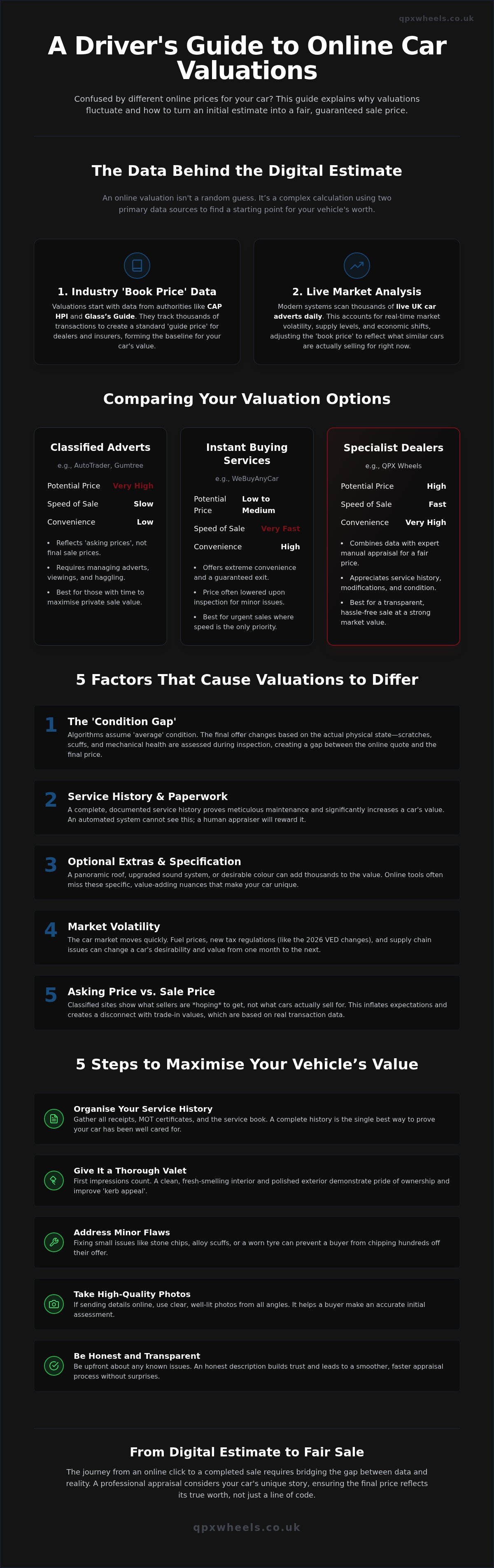
A digital Car valuation is an automated estimate of what your vehicle might be worth in the current UK market. It isn't a random guess; instead, it's a calculation based on millions of data points including live market trends, historical auction results, and DVLA records. When you get car valuation online, the system uses your Vehicle Registration Mark (VRM) to instantly identify the exact make, model, engine size, and original factory specifications of your car. This allows the software to cross-reference your vehicle against thousands of similar listings across the country.
In the UK, most of these tools rely on "book prices" provided by industry authorities like CAP HPI and Glass’s Guide. These organisations track thousands of transactions every week to provide a benchmark for dealers and insurers. However, it's vital to remember that these figures represent a "guide price." This is a helpful starting point for your research rather than a "firm offer," which can typically only be finalised after a physical inspection of the vehicle's condition and service history.
The Data Behind the Screen
Modern valuation algorithms are incredibly sophisticated. They scan thousands of live UK car adverts daily to see what similar vehicles are actually selling for in real-time. This helps account for the current state of the industry. Market Volatility refers to the rapid fluctuation of vehicle prices driven by economic shifts and supply levels, directly impacting your 2026 valuation as buyers react to new tax regulations and fuel trends. Because the market moves so quickly, an estimate you received last month might not be accurate today.
Your car's specific trim level and optional extras also play a massive role. A vehicle with a panoramic roof, upgraded leather interior, or a premium sound system will often command a higher price than a base-model equivalent. Automated systems attempt to pull this data from the original manufacturer build sheets. They sometimes miss the specific value-adding nuances that a human buyer would spot instantly, which is why your initial digital figure is just the first step of the journey.
Automated vs. Manual Appraisals
While computers are excellent at crunching numbers, they struggle with subjective qualities like "kerb appeal" or the specific scent of a well-maintained cabin. An algorithm can't see the tiny scuff on an alloy wheel or appreciate the pristine condition of a ten-year-old engine bay. This is why many drivers feel frustrated when they get car valuation online only to see the price drop significantly during a physical handover. The computer assumes "average" condition, but your car might be exceptional.
Professional buyers, such as the team at QPX Wheels, bridge this gap by combining data-driven estimates with a manual, expert-led appraisal. We look beyond the screen to identify value in performance modifications or exceptionally documented service histories. By using our 16 years of industry experience, we provide a fair alternative to automated aggregators. We ensure that the final price reflects the true story of your car or van rather than just a line of code, allowing for a more transparent and rewarding transaction.
Comparing the Best Ways to Get a Car Valuation Online
The internet is flooded with tools promising an instant price for your vehicle, but not all platforms serve the same purpose. To effectively get car valuation online, you must understand which category of service aligns with your goals. Whether you're looking for a quick cash exit or trying to squeeze every pound of value from a cherished motor, the tool you choose will dictate your experience. Choosing the wrong platform can lead to unrealistic expectations or a significant loss of potential profit.
Classified Aggregators (e.g., AutoTrader)
These platforms are the gold standard for broad market research. They allow you to see what similar vehicles are currently listed for across the UK, which is helpful for setting a "private sale" benchmark. However, there's a significant catch. These figures reflect "asking prices" rather than actual transaction values. They don't account for the time you'll spend managing enquiries, the cost of advertising, or the inevitable haggling with "tyre kickers." Using these figures to determine a car's true market value can be misleading because they represent a retail dream rather than a trade reality.
Direct Buying Services (e.g., WeBuyAnyCar)
If speed is your absolute priority, these services offer a "guaranteed" exit. They're designed for extreme convenience, but the trade-off is almost always financial. Because these businesses operate on high volume and rapid turnover, their initial valuations are often the lowest in the market. Once you arrive at a physical centre, you'll often face "admin fees" or deductions for minor imperfections that were ignored during the digital phase. These services are tactical hunts for profit margin, frequently leaving you with much less cash than a fair market appraisal would provide.
Independent Dealerships (e.g., QPX Wheels)
For many, a specialised independent dealer provides the most balanced outcome. Unlike automated systems, dealers like QPX Wheels can offer personalised service and fair trade-in prices based on their current inventory needs. If a dealer is looking for your specific model, they might pay a premium that an aggregator would miss. A major gap in many online tools is the lack of specific data for commercial vehicles. When you get car valuation online for a van, generic sites often fail to appreciate the value of specific racking or high-spec security features. We specialise in both cars and used vans, providing a fair alternative that handles the complexities of settling outstanding HP or PCP finance whilst organising nationwide collection.
Why Online Valuations Differ: 5 Factors That Change Your Price
It's a common frustration for many UK drivers. You spend an evening trying to get car valuation online, only to find that one website offers you £1,000 more than the next. This discrepancy isn't usually a mistake; it's a reflection of how different algorithms weigh specific data points. Understanding what a pre-owned vehicle is worth requires looking past the initial number and examining the variables that drive these shifts.
The "Condition Gap" is often the biggest culprit for price swings. Algorithms are notoriously binary: they often categorise cars as "Clean," "Average," or "Poor." A single scuffed alloy or a minor supermarket door ding can automatically trigger a "Poor" rating in a strict system, leading to heavy financial penalties. Similarly, your service history carries immense weight. A car with a "Full Manufacturer Service History" (FMSH) is far more desirable than one with a "Partial" history. If your service book is missing stamps, a buyer must budget for the risk of unknown mechanical issues, which can slash hundreds off your valuation.
Regional demand also plays a quiet but significant role. A rugged 4x4 SUV, for instance, is likely to command a higher price in areas where its utility is highly valued, compared to densely populated urban centres where smaller, more fuel-efficient vehicles are often preferred. While national aggregators try to level this out, local market appetite often dictates what a dealer is actually willing to pay on the day.
The "Optional Extra" Trap
Not all modifications or extras are created equal. Factory-fitted options like leather seats, a panoramic sunroof, or an integrated Sat-Nav system generally add tangible value. Conversely, aftermarket additions like loud stereos or non-standard spoilers often have the opposite effect, as they limit the car’s appeal to a niche audience. Even your choice of paint matters; "desirable colours" like metallic grey, black, or white tend to sell faster in the UK, whilst eccentric shades might result in a lower offer. Additionally, the number of previous owners is a key metric. A one-owner vehicle suggests stability and care, whereas a car that has changed hands four times in three years raises red flags for potential buyers.
Settling Outstanding Finance
A significant gap in many generic guides is how they handle modern finance. If you have an active Hire Purchase (HP) or Personal Contract Purchase (PCP) agreement, the valuation you see online is your "gross" value, not what you'll actually take home. Negative Equity occurs when the outstanding finance balance on your vehicle is higher than its current market value, meaning you may need to pay the difference to settle the agreement. Because QPX Wheels specialises as an HP and PCP finance brokerage, we can handle these complex settlements directly with your lender. This streamlines the transition to your next vehicle, ensuring you don't have to manage the paperwork or the stress of clearing the debt yourself before you can sell.
5 Steps to Maximise Your Vehicle’s Online Valuation
To get the best result when you get car valuation online, you shouldn't just leave it to chance. While the software does the initial calculations, the quality of information you provide directly influences the final figure. Following a methodical approach ensures you present your vehicle in the best possible light, bridging the gap between a generic estimate and a premium offer. By taking these steps before you get car valuation online, you position yourself as a serious seller with a well-maintained asset.
Step 1: Organise your paperwork. Ensure you have the V5C logbook, current MOT certificates, and every service stamp or receipt. A paper trail is the strongest evidence of a car's health. Step 2: Conduct a thorough valet. A clean car suggests a careful owner. Vacuum the carpets, wipe down the dashboard, and wash the exterior to make the paintwork pop. Step 3: Fix small, low-cost issues. Replacing a £5 blown bulb or a cracked £15 hubcap can prevent a buyer from assuming the car has been neglected, which could otherwise lead to a much larger deduction.
Step 4: Research your specific model’s "Forecourt Value". Look at what dealers are asking for similar cars on classified sites. This provides a realistic anchor point, even if you know you'll receive a trade-in price. Step 5: Be honest about the condition. If there's a dent, say so. Transparency prevents "price shock" during the final physical appraisal and builds trust with the buyer.
The Power of Documentation
Digital tools often assume a vehicle comes with two keys. If you only have one, expect a significant deduction, as modern transponder keys can cost upwards of £200 to replace. Similarly, a "Long MOT" with at least six months remaining provides peace of mind for the next owner and suggests the car is roadworthy. Presenting a neatly organised service history proves the vehicle has been well-maintained, often allowing a professional buyer to justify a higher offer than the standard "book price" found in automated systems.
Visual Presentation for Online Quotes
If the valuation tool allows for uploads, take honest but flattering photos in natural daylight. Avoid harsh shadows or cluttered backgrounds that distract from the car. Cleaning the engine bay or the boot might seem excessive, but it signals to a professional appraiser that the vehicle is "cherished." For a deeper dive into preparing your car for a physical inspection, see The 39-Point Checklist: What to Inspect Before Selling. Taking these small steps helps ensure your digital estimate translates into a firm, fair offer.
To ensure you receive a fair and transparent price based on your car's true condition, we recommend using our expert Vehicle Valuation Service to start your journey with confidence.
Beyond the Screen: Turning Your Valuation into a Fair Sale
Once you have taken the time to get car valuation online, the next step is often the most daunting. Moving from a digital estimate to a physical appraisal can feel like a hurdle, particularly if you've been burned by "quick sale" sites that slash their offers upon arrival. At QPX Wheels, we approach this transition differently. We understand that a car or van is a significant asset, and the valuation should reflect its true market standing rather than a generic algorithm's best guess.
Our process focuses on bridging the gap between data and reality. Whilst many aggregators simply want to move units, we prioritise building a foundation of trust. This means taking the time to understand the specific history of your vehicle. A well-documented service book or a recent set of premium tyres tells a story of care that a computer often ignores. By focusing on transparency and long-term reputation, we ensure that the final sale price is one you can accept with total confidence.
The QPX Wheels Difference
With over 16 years of industry experience, we have refined our vehicle acquisition service to be as supportive and stress-free as possible. We don't just buy cars; we have extensive expertise in the van market, meaning we have a deep understanding of diverse market niches. If you're looking to upgrade, our part-exchange service allows you to transition seamlessly into a quality used model from our current inventory. This eliminates the need for a gap between selling and buying, keeping you on the road without the typical administrative headache.
We also recognise that your time is valuable. This is why we offer nationwide collection and delivery across the UK. Whether you are in the Northwest or London, we can organise the logistics to suit your schedule. This hands-off experience is designed to alleviate the anxieties of the secondary market, positioning us as a partner that handles the complexities of the transaction so you don't have to. We value the "story" of your vehicle, ensuring that every detail is considered before we make our offer.
Start Your Valuation Today
The first step toward a fair sale is simple. When you use our tool to get car valuation online, you aren't just sending data into a void. Within the first 24 hours of submitting your details, a member of our expert team will review the information to provide a realistic, market-reflective figure. We'll guide you through the next steps, from settling outstanding finance to arranging a final inspection at your convenience. Our reputation is built on ethical conduct and high standards, ensuring every customer feels heard and valued throughout the process.
Get an expert car valuation online from QPX Wheels today and discover a more transparent way to sell your vehicle.
Ready to Secure a Fair Price?
Identifying your car’s true market value doesn't have to be a guessing game. By understanding the data that drives digital tools and preparing your vehicle’s documentation, you can turn a vague estimate into a solid transaction. Remember that while algorithms provide a useful starting point, it's the human element and attention to detail that ultimately secure the best deal in a fluctuating market. A well-presented car with a clear history will always stand out to professional buyers who value quality.
When you are ready to get car valuation online, choosing a partner that values transparency and long-term satisfaction is essential. QPX Wheels brings over 16 years of industry experience to every appraisal, offering a fair alternative to automated aggregators. Whether you're selling a car or a van, we handle the complexities for you, including settling outstanding HP or PCP finance agreements. With our nationwide collection and delivery service, the entire process is designed to be as stress-free as possible, regardless of where you are in the UK.
You now have the tools and knowledge to navigate the 2026 market with confidence and clarity. Get your professional car valuation online with QPX Wheels today and see how simple an expert-led sale can be when you have a seasoned guide by your side.
Frequently Asked Questions
Is an online car valuation 100% accurate?
No, an online valuation is not 100% accurate because it is a data-driven estimate rather than a firm offer. While it provides a helpful benchmark, the final price depends on a physical inspection of the car's condition and service history. Algorithms struggle to account for minor scuffs or mechanical nuances that a professional appraiser will identify in person.
Can I get a valuation for a van or commercial vehicle online?
Yes, you can certainly get a valuation for a commercial vehicle, although many generic tools are tailored specifically for cars. It is often better to use a specialist service when you want to get car valuation online for a van. We specialise in used vans, ensuring that commercial-specific features like racking or security upgrades are considered during the appraisal process.
How much does an online car valuation cost?
Most reputable online car valuation tools are free to use. However, you should always check the terms and conditions because some websites have been known to charge hidden fees. For example, some platforms have historically charged fees around £70 that were not clearly disclosed. Our valuation service is entirely free and transparent to help you make an informed decision.
What happens if my car has outstanding finance like PCP or HP?
You can still sell your vehicle if it has outstanding finance, but the balance must be settled as part of the transaction. If you choose to get car valuation online through us, we can act as a broker to clear your HP or PCP agreement directly with the lender. This simplifies the process and ensures all legal requirements are met before the final sale is completed.
Will modifications to my car increase its online valuation?
Most modifications don't increase a car's online valuation and can sometimes decrease its appeal to a wider audience. Algorithms typically value vehicles based on their original factory specifications. Whilst high-quality factory options like leather seats add value, aftermarket changes like loud exhausts or non-standard body kits are often viewed as liabilities that require costly restoration to original condition.
How long does a car valuation remain valid?
A car valuation typically remains valid for seven days. This short window is necessary because the UK used car market is highly volatile, with prices fluctuating based on supply, demand, and seasonal trends. If you wait longer than a week to proceed, you'll likely find that the market data has shifted, requiring a new quote to reflect the current trade value.
Do I need to clean my car before getting an online valuation?
You don't need to clean your car to receive an initial digital estimate, but a thorough valet is essential before the physical appraisal. First impressions matter when a professional buyer inspects the vehicle. A clean, well-presented car suggests that it has been cherished by its owner, which can help you secure the highest possible figure within the estimated price range.
Can I sell my car immediately after receiving a valuation?
Yes, you can often sell your car almost immediately after receiving a valuation and completing a physical inspection. Once we've verified the vehicle's condition and checked the paperwork, the transaction can move very quickly. We aim to make the process efficient, handling the logistics of nationwide collection so you can transition to your next vehicle without any unnecessary delays.


