
A lower monthly payment can leave the largest bill until the end. This guide explains personal contract purchase balloon payments: the optional lump sum you pay to keep the car when a PCP agreement ends. You can instead return the car, subject to the agreement’s mileage and condition terms, or choose another finance deal.
It’s easy to focus on monthly instalments when comparing finance, but the final payment matters just as much if you want to own the car. Learn how the car’s estimated future value affects the balloon payment, why this can lower monthly payments, and what choices you have when the agreement ends. Then weigh the lower monthly commitment against the larger final sum.
Key Takeaways
- Understand how a car’s make and model, expected mileage and agreement length can shape its estimated value at the end of a PCP deal.
- Know the choices available when your agreement ends, including paying the final sum to keep the car or returning it under the agreed terms.
- See why holding back a larger amount until the end can lower monthly instalments, while leaving a larger payment to plan for.
- Consider whether lower monthly payments suit your budget and plans, or whether a finance option without a final balloon payment may be a better fit.
What factors are considered to calculate my car’s Residual Value?
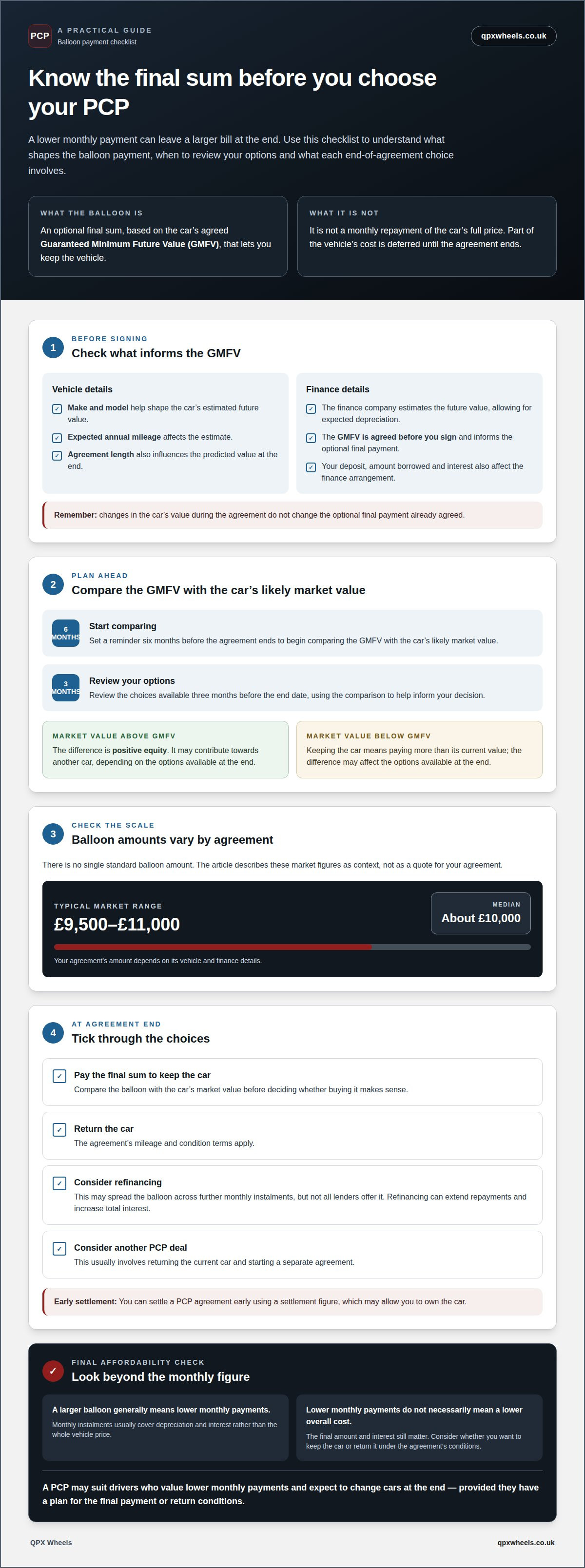
A PCP balloon payment is based on the car’s estimated future value, called its Guaranteed Minimum Future Value (GMFV). The finance company estimates what the car will be worth at the agreement’s end, allowing for expected depreciation. The make and model, expected annual mileage and agreement length all influence the estimate. The GMFV is agreed before you sign.
That figure becomes the GMFV and informs the optional final payment. The deposit, amount borrowed and interest also affect the finance arrangement, but the car’s predicted value helps determine how much is left for the final payment.
Compare the GMFV with the car’s likely market value well before the agreement ends. Set a reminder six months ahead to start comparing the figures, then review your options three months before the end date. If the car is worth more than the GMFV, the difference is positive equity. It may contribute towards another car, depending on the options available at the end of the agreement.
Yes, you can settle a PCP agreement early using a settlement figure, which may allow you to own the car. The optional final payment is agreed before you sign, and changes in the car’s value during the agreement don’t change that amount. At the end, compare the car’s value with the GMFV before deciding whether to buy it.
There’s no single standard balloon amount. On the market, PCP balloon payments typically range from £9,500 to £11,000, with a median of about £10,000. Your agreement’s amount depends on its own vehicle and finance details.
Refinancing may spread the balloon payment across further monthly instalments, although not all lenders offer this option. A new PCP deal is another possibility, usually involving returning the current car and starting a separate agreement. If the car’s value is lower than its GMFV, this may affect the options available at the end of the agreement.
What does Balloon payment mean?
A PCP balloon payment is the large optional final sum that lets you keep the vehicle. It represents the agreed guaranteed minimum future value, rather than instalments paying off the car’s full price.
Balloon payments and standard loan repayments
With a standard loan, regular payments repay the amount borrowed over the agreed term. With PCP, part of the vehicle’s cost is deferred until the end, so monthly payments usually cover depreciation and interest instead. The final sum matters if you want to own the car outright. Compare it with the car’s market value before deciding whether paying it makes sense.
PCP and vehicle lease balloon payments
PCP gives you the option to pay the final balloon and keep the car, or return it under the agreement’s conditions. Lease arrangements differ: an operating lease may include a substantial final amount that the lessee isn’t contractually obliged to pay. However, a vehicle lease with a balloon doesn’t necessarily let you return the vehicle and walk away. Your contract determines the end-of-term choices.
HP works differently: its regular payments cover the amount borrowed, with no balloon in the example comparison. A personal loan also involves repaying borrowed money through scheduled payments, rather than setting a guaranteed future value for returning the car. Personal contract hire (PCH) is a lease, not a route to buying the vehicle outright through a PCP-style optional final payment.
Monthly payments can therefore differ. These are illustrative figures, not universal quotes.
At agreement end, compare the car’s market value with the balloon. If its value exceeds the final amount, you may have equity; if it falls below, keeping it means paying more than its current value. For context, used vehicle options can help you consider alternatives to buying your current car.
How balloon payments affect monthly instalments
A PCP divides the car’s cost between monthly instalments and a final payment. For drivers comparing agreements, having personal contract purchase balloon payments explained alongside the monthly figure can make the overall commitment clearer.
How PCP monthly payments are structured
A PCP payment reflects the amount financed, interest, agreement length and the car’s estimated value at the end. Your deposit reduces the amount borrowed, while the expected future value is set aside as the optional final payment. This means monthly instalments don’t repay the entire vehicle price. A lower monthly figure doesn’t show the full cost of keeping the car.
Why balloon payments lower monthly costs
Deferring part of the amount borrowed means monthly instalments cover less of the car’s value than standard repayments. Expected mileage affects the car’s estimated future value, changing the balance between instalments and the final payment. Understanding personal contract purchase balloon payments in this context shows why mileage and monthly costs are connected.
A larger balloon generally means lower monthly payments, not necessarily a lower overall cost. Interest and the final amount still matter. Refinancing can extend repayments and increase total interest, so consider the full agreement rather than judging affordability by the monthly figure alone.
Advantages of lower repayments
Lower monthly repayments can make a vehicle fit more comfortably within a household budget, leaving room for other regular costs. They may also make a car accessible when higher standard repayments would stretch your budget. This benefit is most useful when the monthly commitment works for you and you have a plan for the agreement’s end.
Before signing, decide whether you want to keep the car or return it under the agreement’s conditions. If you want to keep it, plan for the final payment or consider refinancing. If you return it, the mileage and condition terms apply. Thinking through these choices puts the lower monthly figure in context.
Suitability of balloon-payment finance
PCP finance may suit drivers who value lower monthly payments and expect to change cars when the agreement ends. It can also suit someone who wants the option to keep the vehicle without paying its full price through monthly instalments. The trade-off is a final amount to plan for if you decide to own the car.
Consider how you use a car before choosing this finance. Expected mileage and the vehicle’s condition matter if you plan to return it. The lender uses factors such as make, model, agreement length and mileage to estimate depreciation and set the guaranteed minimum future value. A mileage allowance that doesn’t match your driving can affect whether the agreement suits you.
PCP may be less suitable if you need certainty that monthly payments will leave you owning the car outright. The balloon remains due if you choose to keep the vehicle, even if its market value has fallen below that amount. In that case, paying the final sum could mean spending more than the car is worth. If its value exceeds the balloon, the difference may create equity towards another car.
Think about the end options before signing: returning the car under the agreement’s conditions, paying the balloon, or arranging new finance. Refinancing can extend repayments and increase total interest, while approval depends on the lender’s assessment. The Financial Conduct Authority says refinancing a PCP balloon payment might not be appropriate in some circumstances. Include the new agreement’s costs and your credit commitments in your decision.
PCP is most suitable when the lower monthly commitment fits your budget and you’re comfortable with the end-of-term choices. If you want regular payments to lead to ownership, compare HP finance, which has no balloon payment in the example covered earlier. If you expect to return the vehicle, focus on realistic mileage, condition requirements and a clear plan for the agreement’s end.
QPX Wheels: Hire Purchase (HP) Finance
QPX Wheels offers Hire Purchase (HP) finance for people who prefer a repayment structure without a PCP-style balloon payment. HP may suit you if you want regular instalments to repay the amount borrowed, rather than lower monthly payments followed by an optional final sum. Make sure the agreement and its costs fit your budget.
Explore QPX Wheels’ used cars and vans alongside its HP and PCP finance options. If you’re weighing a PCP balloon against finance without one, consider how each option affects your monthly budget and plans for owning the vehicle. QPX Wheels also offers a vehicle valuation service if you’re considering your current car as part of your next decision.
For help considering used vehicles and finance options, contact QPX Wheels.
Choose the finance that fits your next step
Before choosing a car finance agreement, decide what matters most to you: managing monthly costs, owning the vehicle or keeping flexibility at the end. With personal contract purchase balloon payments explained, the next step is matching those priorities with a car and finance arrangement that fits your plans. Consider what you need from your next vehicle and how you want to manage its cost over time.
QPX Wheels offers used cars and vans, as well as a vehicle valuation service if you’re considering selling your current vehicle. These options can help you plan your next move, whether you’re replacing a car or exploring a different vehicle type. Think through your priorities, then speak with the team about what you’re looking for.
Contact QPX Wheels to discuss your next vehicle and finance options. A clear understanding of your priorities can help you take the next step with confidence.
Frequently Asked Questions
How does it work?
A PCP lender finances the car, and you repay part of the cost through instalments during the agreement. The contract sets an optional final amount for keeping the vehicle. At the end, you can pay that amount, return the car under the agreement’s terms, or move to another finance deal. Returning the car means you don’t pay the optional final amount, but mileage and condition requirements still apply.
Is it worth paying the balloon?
Paying the balloon can make sense if you want to keep the car and its market value compares favourably with the amount due. Consider how long you intend to keep the vehicle and whether the final sum fits your budget. If you’d need new borrowing to pay it, include that finance’s interest and costs in your decision. Keeping the car isn’t automatically the best-value choice for every driver.
What could go wrong?
Costs can arise if you exceed the agreed mileage or return the car in a condition that falls outside the contract terms. If its market value drops below the final amount, buying it may cost more than its current value. Refinancing isn’t guaranteed, and a new agreement can add interest. If you can’t meet payments, the lender may repossess the car, which could affect your credit score.
What if my car has appreciated or depreciated over the course of my finance deal?
If the car is worth more than its agreed final value, the difference may create positive equity. You may be able to put that equity towards another car, but it can’t be exchanged for cash if you choose not to buy the vehicle. If the car has depreciated below the final amount, you may have negative equity. The agreed final payment itself doesn’t change as the car’s value changes.
What is a balloon payment in a UK personal contract purchase (PCP) agreement?
In a UK PCP agreement, the balloon payment is the optional final sum payable if you want to keep the car. It’s linked to the vehicle’s estimated value at the agreement’s end, rather than being another ordinary monthly instalment. Paying it makes you the car’s owner outright. If you don’t want to keep the car, you can return it subject to the contract’s terms.
How is the PCP balloon payment or optional final payment calculated?
The lender estimates the car’s value at the end of the agreement, known as its Guaranteed Minimum Future Value (GMFV). The estimate takes account of the make and model, expected mileage and agreement length, including anticipated depreciation. The car’s purchase price, your deposit and the finance interest also affect the overall arrangement. The GMFV and optional final payment are set out before you sign the agreement.


