
Buying from a dealer gives you stronger legal protection than buying privately, but the remedy depends on the fault and when you raise it. According to UK Parliament, under the Consumer Rights Act 2015 you have 30 days from buying a car to reject it for being unsatisfactory, unfit for purpose or not as described and receive a full refund. Understanding your consumer rights when buying a used car from a dealer also means knowing what may apply after those first 30 days, and how the rules differ for private sales and auctions.
It’s understandable to feel uncertain when a newly bought car develops a problem, especially if you’re unsure whether it’s a fault, fair wear and tear, or something disclosed before purchase. The key is to understand what the law expects from the seller and explain your concern clearly.
This guide explains the standards a dealer-sold car must meet, the remedies that may apply at different stages, and the protections available when buying privately or at auction. It also shows how to raise a complaint and keep useful records, so you can approach the issue calmly and know what to expect next.
Key Takeaways
- According to UK Parliament, you have 30 days from buying a car to reject it for certain faults and receive a full refund.
- After the first 30 days, the remedy may depend on when the fault appears and whether repair or replacement is appropriate.
- Dealer, private-sale and auction purchases offer different levels of protection, so identify who legally sold you the car.
- Keep the advert, sales paperwork and messages, and report a fault to the seller promptly.
- Age, mileage, condition and what the seller disclosed all matter when assessing whether a used car meets the required standard.
Repair or replacement after the first 30 days
After the first 30 days, a faulty car bought from a dealer may qualify for repair or replacement rather than an immediate refund. The timing of the fault and the seller’s response affect which remedy applies.
Repair and replacement rights
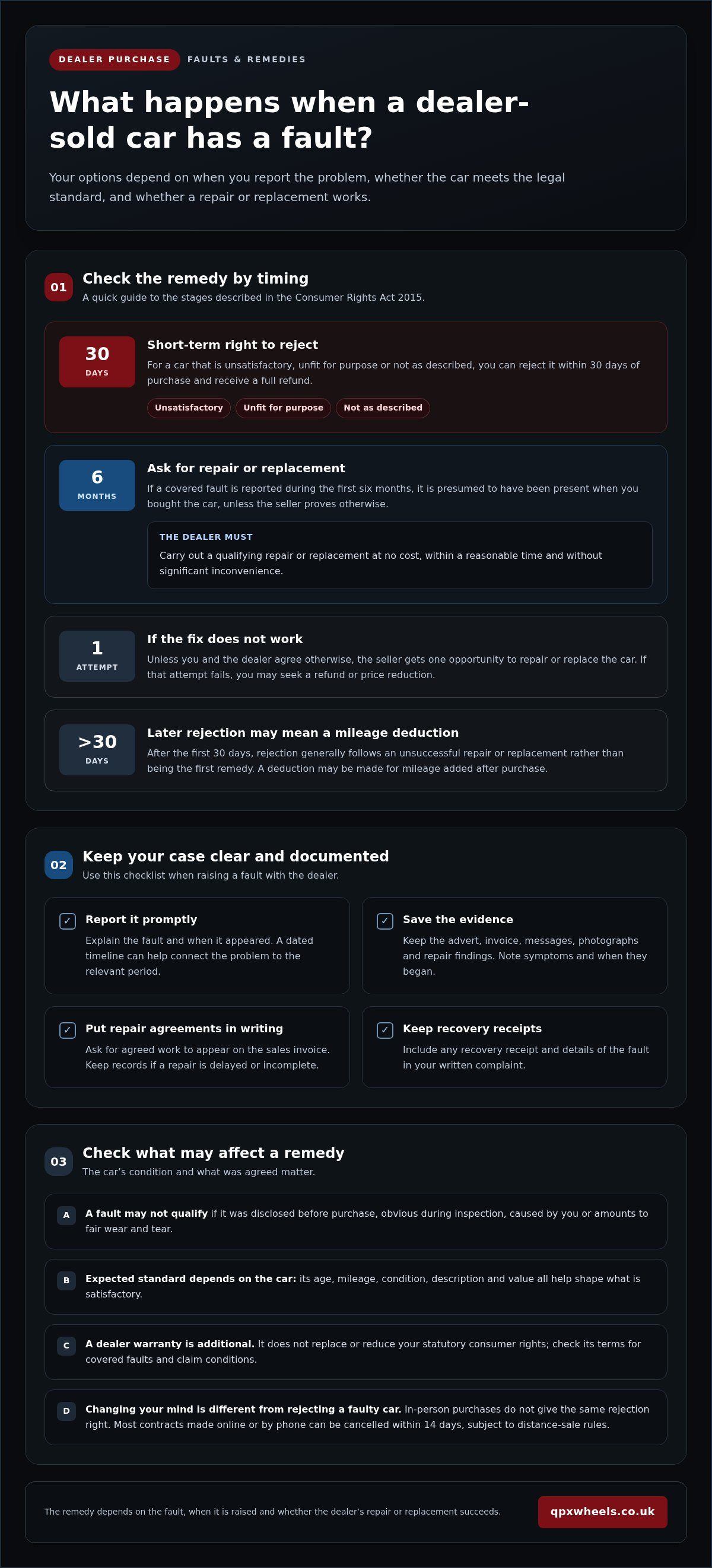
During the first six months, you can request a repair or replacement if the car has a fault covered by consumer rights. According to UK Parliament, a fault reported within this period is presumed to have existed when you bought the car, unless the seller proves otherwise.
A dealer must carry out a qualifying repair or replacement at no cost, within a reasonable time and without significant inconvenience. Unless you and the dealer agree otherwise, the seller gets one opportunity to repair or replace the car. If that attempt fails, you may seek a refund or price reduction.
How long do you have to reject a faulty car? The short-term right to reject lasts 30 days from purchase for a car that is unsatisfactory, unfit for purpose or not as described. After that, ask for repair or replacement first; a later refund may be available if the remedy fails.
Refunds, contract terms and limitations
The 30-day short-term right to reject lets you return a qualifying faulty car for a full refund. After 30 days, rejection generally follows an unsuccessful repair or replacement, rather than being the first remedy. If you reject outside the first 30 days, a deduction may be made for mileage added to the car.
A dealer warranty is additional to your statutory consumer rights; it doesn’t replace or reduce them. Check its terms for covered faults and claim conditions, but rely on your legal rights if the car fails the required standard. A fault disclosed before purchase, obvious during inspection, caused by you or amounting to fair wear and tear may not qualify for a remedy.
Put agreed repairs in writing and ask for them to appear on the sales invoice. Across the UK, this records what the dealer promised to do and helps show whether the car matched your agreement. Keep the advert, invoice and messages together if a repair is delayed or incomplete.
Who pays for repairs or recovery? The dealer must provide a qualifying repair or replacement at no cost. Keep any recovery receipt and include it in your written complaint, alongside details of the fault and your repair request.
Can you return a car because you changed your mind? An in-person purchase doesn’t give you the same right to reject as a faulty car. For most contracts made online or by phone, UK Parliament says consumers have 14 days to cancel, subject to the rules for distance sales.
What are a consumer’s legal rights when buying a car?
A dealer must provide a car that meets legal standards, and its condition and description matter. Mileage records, adverts and sales documents can help show what was promised and whether the car matched it.
Checking a car’s condition and history
Review the car’s condition, mileage and available history to compare its actual state with the dealer’s description. Note discrepancies in the advert, invoice or messages, such as mileage that differs from the dashboard reading.
Keep a copy of the advert and purchase documents, then record any fault as soon as you notice it. For example, photograph a warning light and note when it appeared. These records can help explain the problem and when it began.
Mileage verification and deductions
Mileage is part of a car’s description, so an inaccurate figure can support a complaint that the vehicle was misdescribed. Compare the dashboard reading with the paperwork and any service records supplied with the car. Mileage discrepancies may be relevant when assessing whether a car was accurately described.
If you reject a car under the Consumer Rights Act 2015 after the first 30 days, the seller may deduct for mileage added after purchase. Keep dated service or repair records showing how much the car was used. The deduction rule concerns additional mileage, not simply the mileage already on the car when sold.
Proving a fault at purchase
Evidence can include the original advert, sales invoice, messages, photographs, repair findings and a dated record of symptoms. Together, these can show what the dealer represented, when the issue appeared and how it affects the car.
According to UK Parliament, a fault reported within the first six months is presumed to have been present at purchase unless the seller proves otherwise. After that period, the buyer must prove the fault existed when the car was bought. A clear timeline helps connect your evidence to the relevant period.
Consumer Rights Act requirements
According to UK Parliament, the Consumer Rights Act 2015 protects UK consumers if a car is not of satisfactory quality, fit for purpose or as described by the seller. For a used car, age, mileage, condition, description and value help shape the expected standard.
For example, a fault disclosed before purchase is treated differently from an undisclosed defect. A car must also be suitable for a particular purpose you told the dealer about before buying. Most contracts made online or by phone can be cancelled within 14 days, according to UK Parliament; this differs from an in-person purchase and from rejecting a faulty car.
Differences between trader, private and auction purchases
The protections for a used-car purchase depend on whether you buy from a trader, an individual or at auction. Identify the legal seller in your paperwork, because the same fault can lead to different rights.
Buying from a trader
A consumer buying from a motor trader has protections under the Consumer Rights Act 2015. The car must meet standards for description, satisfactory quality and fitness for purpose. A trader can’t avoid those protections simply by describing a car as “sold as seen” or limiting its warranty.
For example, if a dealer’s advert gives incorrect mileage, that description may matter when you raise a complaint. Keep the advert and invoice, and identify the statement or feature that doesn’t match the car. The trader’s identity matters too: a private seller doesn’t become a dealer just because the transaction happened at a forecourt.
Buying privately
A private seller’s car must be as described, and the seller must have the legal right to sell it. In the UK, it must also be roadworthy and safe for public roads unless the seller explicitly says otherwise. In England, private buyers generally can’t expect satisfactory quality or fitness for purpose unless the seller previously stated that standard.
This makes accurate descriptions important. If a seller says the car has had one previous owner but the documents show otherwise, keep that claim and the paperwork. A private buyer generally has fewer rights than someone buying from a trader and can’t rely on the Consumer Rights Act protections described for dealer sales.
Buying at auction
Auction purchases can offer less consumer protection than purchases through a trader, and the auction terms can affect what protection applies. Read the sale conditions before bidding, including how the vehicle is described and whether it is sold “as seen”. In England, a seller’s description must still be correct, even when the car is sold at auction.
Check who the seller is, not only who runs the auction. An auction house may be selling on behalf of a private owner or a trader, and that distinction affects which protections apply. Keep the listing and sale terms, as they record the description and conditions attached to your purchase.
Private sales and business purchases
The consumer protections described for dealer purchases don’t apply to business-to-business car sales. The Sale of Goods Act 1979 continues to apply to sales to business buyers, whilst consumer sales are governed by the Consumer Rights Act 2015.
Before paying, record whether you’re buying as an individual or for a business, and name the seller on the paperwork. That distinction can determine which legal framework applies if the car later fails to match its description or develops a fault. Buying privately also differs from buying from a trader, even if both sellers advertise similar cars.
Satisfactory quality, fitness for purpose and description
These standards help establish whether a dealer-sold car matches the agreement and what a buyer could reasonably expect. The car’s age, mileage, condition, description and value all help shape that assessment.
Satisfactory quality
According to UK Parliament, the Consumer Rights Act 2015 protects UK consumers if a car is not of satisfactory quality, fit for purpose or as described by the seller. Satisfactory quality means the car meets the standard a reasonable person would expect, considering factors such as its age, mileage, condition and price.
A used car isn’t judged like a new one. Wear consistent with an older car’s mileage may be expected, while a serious undisclosed engine fault could point to a quality problem. A scuffed bumper noted in the advert is different from a hidden defect that affects how the car works.
Consider the whole picture: the advert, purchase price and what the dealer explained before sale. A fault clearly disclosed before purchase may not give you a remedy for that issue. In England, fair wear and tear also doesn’t generally entitle a buyer to a remedy.
Fitness for purpose
Fitness for purpose means the car must be suitable for a particular use you told the dealer about before buying. This matters if you relied on the dealer’s advice or description when choosing a vehicle for a specific need.
For example, if you explain that you need a car to tow a particular trailer and the dealer recommends a vehicle for that purpose, its suitability may matter. Keep the advert or messages recording the conversation. A general expectation that any car will meet an unmentioned requirement is different from a purpose communicated to the seller.
The dealer’s advertised claims and discussions can help show what purpose was understood. If a car was promoted as suitable for a stated use, compare that claim with the problem you encounter. A written record of your requirement and the dealer’s response can make the issue clearer.
“As described” is a separate standard. Details such as mileage, previous owners, model, equipment and condition should match the dealer’s statements. If the advert says a car has a reversing camera but it doesn’t, save the advert and note the missing feature on the invoice or in your complaint.
These standards can overlap. A car with an undisclosed fault might fail the satisfactory-quality test, while incorrect mileage could mean it wasn’t as described. Set out the specific issue, the relevant dealer statement and your evidence, such as a dated advert, invoice or photograph. This helps distinguish a legal concern from ordinary wear or a defect explained before purchase.
Consumer rights when buying from a motor trader
Buying from a motor trader gives you legal rights that don’t usually apply to a private purchase. Identify the seller named on your invoice, because the trader responsible for the sale is the person to approach about a problem. Understanding consumer rights when buying a used car from a dealer starts with establishing who sold the vehicle and when the contract was made.
According to UK Parliament, the Consumer Rights Act 2015 applies to cars bought after 01 October 2015. For earlier purchases, the Sale of Goods Act 1979 applies to consumer sales. The date and your status as a consumer help establish which rules cover the transaction.
According to UK Parliament, under the Consumer Rights Act 2015, a buyer has 30 days from buying a car to reject it for being unsatisfactory, unfit for purpose or not as described and receive a full refund. Tell the seller clearly that you’re rejecting the car, explain the fault and keep a dated copy of your message. These are central consumer rights when buying a used car from a dealer, so state the remedy you’re seeking.
After that initial period, the usual route is to request a repair or replacement. If the remedy fails, you may be able to seek a refund or price reduction. For a fault raised within the first six months, it is presumed to have existed at purchase unless the seller proves otherwise. This can matter if the trader argues that the problem developed after delivery.
Not every defect gives you the same remedy. A problem disclosed before purchase, an obvious defect you should have spotted, damage you caused or fair wear and tear may not qualify. Compare the fault with the advert, invoice and any explanation the seller gave before you bought the car.
Raise concerns promptly and keep your evidence together. Save the advert, sales paperwork, messages and photographs; note when the fault appeared and how it affects the vehicle. Describe the issue in writing and state whether you’re seeking a repair, replacement or rejection. If the car appears unsafe, don’t drive it; report the concern to the seller.
A warranty doesn’t replace statutory rights, and a “sold as seen” label doesn’t remove the Consumer Rights Act protections described for consumer purchases. If the seller refuses to address a complaint, your records help set out the disagreement and the remedy requested. Keep the complaint factual, with dates and copies of relevant documents.
If you’re comparing cars before buying, review used-car buying options alongside the seller’s description and paperwork. Clear records of what you were promised make it easier to raise a concern if the car doesn’t match the agreement.
QPX Wheels: Used Vans
QPX Wheels offers used vans for buyers comparing vehicle options after learning about dealer protections. If you need a car instead, its used cars provide another category to consider. Review the vehicle description and purchase documents carefully, and keep the advert and agreed details with your records.
For a purchase plan, Hire Purchase (HP) finance is available. QPX Wheels also provides a Vehicle Valuation Service if you’re considering the value of a vehicle you own. These services support different points in the buying or selling process, but they don’t replace your statutory rights if a purchased car has a fault.
Browse QPX Wheels online for details about its used vans and other vehicle options.
Make your next vehicle decision with clarity
Understanding your consumer rights when buying a used car from a dealer is one part of a confident purchase. The next is choosing a vehicle that suits your needs and keeping the transaction clear from the outset. Before proceeding, decide what you need from your next vehicle, which details matter most, and what you want recorded in the advert and sales paperwork.
If you’re weighing up a car, a van or selling a vehicle you already own, QPX Wheels offers used cars, used vans and a Vehicle Valuation Service. These options can help you explore a purchase or consider your vehicle’s value while keeping your priorities central. The right next step depends on your circumstances and the transaction details.
For a straightforward conversation about your vehicle options, contact QPX Wheels for help. Take your time, ask for clear information and move ahead when you feel ready.
Frequently Asked Questions
How can I report my concerns?
Send the seller a written complaint describing the fault, when you noticed it and the outcome you want. Attach relevant evidence, such as the advert, invoice, photographs or repair findings, and keep a copy of your message and any reply. If the vehicle appears unsafe, don’t drive it; report the concern to Trading Standards. A clear timeline helps distinguish the fault from later damage or changes in the car’s condition.
What legal rights apply when buying a used car from a dealer in the UK?
Your rights include receiving a car that is satisfactory in quality, fit for purpose and as described. According to UK Parliament, the Consumer Rights Act 2015 applies to cars bought after 01 October 2015. These consumer protections concern purchases from traders, not private individuals or business-to-business sales. Keep the sales invoice showing who sold the car and whether you bought it as a consumer, as these details help identify which legal rules apply.
What remedies can I claim if a dealer-sold used car develops a fault after 30 days?
After 30 days, you can usually request a repair or replacement for a qualifying fault. The trader must provide an eligible remedy without cost, within a reasonable time and without significant inconvenience. If the repair or replacement fails, you may seek a refund or price reduction. For a fault reported during the first six months, it’s presumed to have existed at purchase unless the seller proves otherwise. Describe the fault and requested remedy in writing.
What are my rights if a dealer misdescribes a used car or hides damage or mileage?
If the car doesn’t match the dealer’s description, you may have a remedy under consumer law. Save the advert, messages and paperwork, then identify the exact discrepancy, such as mileage recorded differently or damage omitted from the description. A disclosed or obvious defect may affect your claim. If false claims were used to sell the car, you may be entitled to cancel the contract, seek a refund or claim compensation. Keep evidence of what you were told.


