
What if the highest offer for your car doesn’t leave you better off? When choosing between part exchange and private sale, it’s easy to focus on the headline figure. But the amount you keep is only part of the decision: your time, the work involved and how quickly you need to move all matter too.
A private sale may seem attractive if you’re hoping to achieve more, but it can mean preparing the car, answering enquiries and arranging viewings. Part exchange can make changing cars more straightforward, although you need to consider the value offered for your current vehicle alongside the replacement car’s price. The right choice depends on the whole transaction and what matters most to you.
This guide compares both routes in terms of potential proceeds, effort, timing and certainty, so you can judge whether a private sale is worth the extra work. You’ll also find practical points to consider before selling. QPX Wheels’ Sell My Vehicle tool lets you start with a valuation using your registration, and its vehicle buying service offers another route to explore.
Key Takeaways
- Part exchange combines your current car’s value with a replacement purchase, while a private sale means selling directly to an individual buyer.
- When choosing between part exchange and private sale, compare the likely net outcome, effort, timing and certainty, not just the headline figure.
- A private asking price isn’t a guaranteed sale price, so weigh potential proceeds against the practical work involved.
- Set your priorities, gather comparable valuations and assess how much time and control you want before choosing a route.
- Use a vehicle valuation as a starting point, then consider whether a private sale or a vehicle buying service better fits your priorities.
Choosing between part exchange and private sale: what is the real difference?
The difference is how the sale is organised. With part exchange, you trade your current car towards a replacement bought from a dealership. With a private sale, you find an individual buyer and agree the sale directly with them. The first route links selling and buying; the second treats them as separate transactions.
A useful distinction is this: part exchange prioritises transaction convenience; private sale involves managing the buyer directly. Neither route guarantees a particular outcome. A car advertised at a certain price hasn’t necessarily sold for that amount, so compare realistic proceeds rather than treating asking prices as completed-sale values. For a general introduction to the term, see What is part exchange?
What does part exchange mean when changing cars?
A dealer assesses your current car and gives it a valuation as part of a replacement-vehicle transaction. That figure is taken into account when working out what you need to pay for the car you’re buying. This can bring the two transactions together, but the exact arrangements and terms can vary between dealers.
Keep the figures distinct. A valuation for your car is not the same as the price of the replacement, so it’s useful to understand each separately. If a dealer discusses both figures together, ask for a clear breakdown. You can then compare the part-exchange value and replacement price with other options, rather than judging the deal by one number alone.
What happens when you sell your car privately?
With a private sale, you take the lead: you prepare an advert, respond to enquiries and arrange viewings with potential buyers. You and the buyer discuss the car and negotiate directly. This gives you more control over how you present and market the vehicle, but also means you manage the contact and sale process yourself.
Distinguish between an advertised price and the amount you might actually receive. A similar car listed online can provide a point of comparison, but differences in condition, mileage, specification and the seller’s expectations affect how useful that comparison is. An asking price doesn’t show that a buyer has agreed to pay it.
For a clearer starting point, QPX Wheels’ Sell My Vehicle valuation tool accepts your registration. It can help you consider your car’s value before deciding how to sell, while QPX Wheels’ vehicle buying service offers another route. A valuation is useful context, but it isn’t a confirmed private-sale price or part-exchange offer.
Choosing between part exchange and private sale starts with understanding what each route asks of you. One combines the car sale with a replacement purchase; the other leaves you to find and manage a buyer directly. The sections that follow compare their practical trade-offs in more detail.
Part exchange vs private sale: compare value, effort and certainty
A useful comparison looks beyond the offer for your current car. With part exchange, consider the vehicle valuation alongside the replacement car’s price and the amount you’d need to pay. With a private sale, start with the amount a buyer actually agrees to pay, then consider the time and work involved in completing the sale and arranging your next vehicle.
The best route depends on what you value most, not one headline figure. Use this table to weigh up the main trade-offs:
| Factor | Part exchange | Private sale |
|---|---|---|
| Potential proceeds | Assess the valuation alongside the replacement-car price and overall deal. | The agreed amount depends on the buyer; an advert’s asking price isn’t a confirmed sale value. |
| Seller effort | Combines the car sale with a replacement purchase through a dealer. | You manage the advert, enquiries and viewings directly. |
| Timing control | Can align the sale with changing cars, subject to the dealer’s process and agreed arrangements. | You control how you advertise and respond, but the sale depends on finding and agreeing terms with a buyer. |
| Transaction certainty | Offers a route to discuss both vehicles in one transaction, although terms vary. | You negotiate directly with an individual, so the outcome depends on reaching an agreement. |
Which option could leave you with more after the transaction?
Compare like with like. For a private sale, use the amount a buyer agrees to pay, then account for any preparation and advertising you choose to undertake. For part exchange, compare the dealer’s vehicle valuation with the replacement car’s price and the total amount payable. A similar car’s advertised price can help you understand the market, but it doesn’t show what that car eventually sold for or what yours will achieve.
How much time and responsibility are you willing to take on?
A private sale gives you control over the advert and buyer conversations, but you’ll need to make time for enquiries and viewings. A dealer transaction may bring the sale and replacement purchase together, though the timing depends on the arrangements. Consider your work commitments, how soon you need to change cars and how comfortable you are with uncertainty. Neither route guarantees a particular sale speed.
It can help to write down the complete figures and practical demands before deciding. A private offer may look appealing until you include the effort of preparing the car and managing viewings. On the other hand, convenience may matter more than pursuing a possible difference in proceeds if coordinating separate transactions doesn’t suit your schedule.
If you want a starting point for comparison, QPX Wheels’ vehicle valuation service accepts your registration. Use a valuation as one reference point, then weigh it against the full replacement deal or the work involved in finding a private buyer.
Is private sale really better than part exchange? Addressing the headline-price objection
No, a private sale isn’t automatically better. A higher advertised price can look appealing, but it doesn’t show what a buyer will agree to pay or how much time and effort you’ll spend completing the sale. A dealer’s part-exchange valuation may look lower by comparison, yet convenience can matter more if you want to coordinate selling and replacing your car with less direct buyer management.
There’s no single route that suits every seller. The useful question is whether a possible difference in proceeds is worth the work and uncertainty for you. Consider your circumstances, rather than assuming dealers always offer less or private buyers always pay more.
When might a private sale suit your circumstances?
A private sale may suit you if you’re comfortable writing an advert, responding to prospective buyers and arranging viewings. You have more direct control over how you present the car and discuss the sale. That control comes with responsibility: you’ll need to find a buyer, make time for conversations and accept that interest doesn’t necessarily lead to an agreed sale.
Think about the practical demands before committing. Could you respond to enquiries around work or family commitments? Are you comfortable discussing the vehicle with potential buyers and arranging to show it? If so, you may find the direct approach manageable. If not, the extra involvement could outweigh the appeal of a hoped-for higher price.
When might part exchange feel like the better fit?
Part exchange may appeal if you’re already planning to buy a replacement from a dealership and prefer to link the two transactions. Instead of finding an individual buyer yourself, you discuss your current car’s valuation as part of the replacement purchase. The arrangement and terms depend on the dealer, so assess the whole deal rather than assuming every process is identical.
This route can make sense when reducing the number of separate tasks matters more to you than pursuing an uncertain difference in proceeds. If you have limited time to manage enquiries or want to keep your current and replacement-car plans connected, a combined transaction may feel more straightforward. That doesn’t make it automatically better value; it makes convenience a factor worth weighing.
To decide, picture the full process you’d be taking on. With a private sale, you manage the search for a buyer and the conversations directly. With part exchange, you consider your car’s value alongside the replacement purchase and the dealer’s terms. Ask yourself what matters most: more control, less effort, keeping plans together or avoiding uncertainty. Choosing between part exchange and private sale becomes clearer when you rank those priorities honestly.
If you’re unsure what your current car may be worth, QPX Wheels’ vehicle valuation service can provide a useful starting point before you choose a selling route. A valuation won’t settle the decision on its own, but it can help you compare your options with greater clarity.
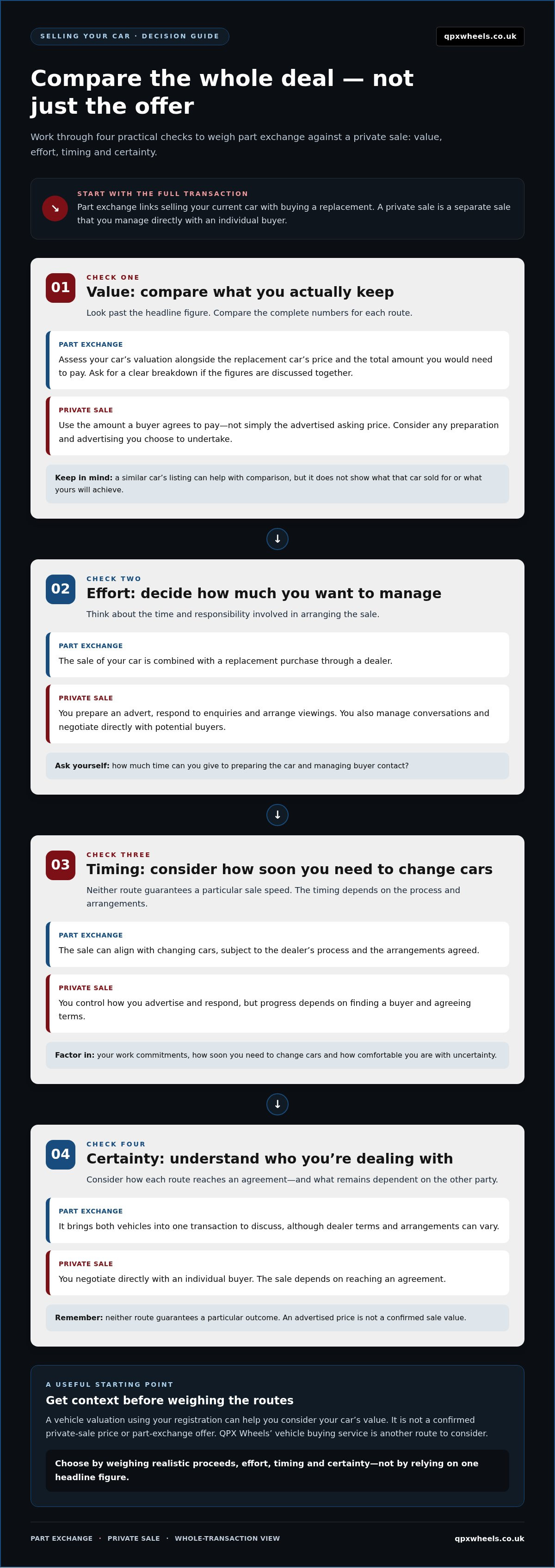
How to choose between part exchange and private sale in four practical steps
A simple comparison can make the decision feel less subjective. Before choosing between part exchange and private sale, rank what matters most to you: net outcome, convenience, timing and control. Then use the same priorities to assess each route, keeping confirmed figures separate from estimates and hopes.
- Set your priorities. Put the four factors in order, rather than treating them as equally important. If convenience comes first, you may accept less control over the sale process. If net proceeds matter most, consider whether the extra work of a private sale is manageable. Your priorities give you a consistent way to assess each option.
- Gather comparable valuations. Get a valuation for your current car and, if you’re considering a replacement, record its price and purchase terms separately. For a private sale, treat advertised prices for similar cars as reference points, not confirmed offers. Keep any actual buyer offer distinct from an asking price or estimate.
- Assess the practical effort. Note what each route requires from you: time to prepare information, handle enquiries, arrange viewings or coordinate a replacement purchase. Consider your work commitments and how much uncertainty you’re comfortable managing. Don’t assign an invented cash value to your time; simply decide how much of it you’re willing to spend.
- Choose the route that fits. Review the figures and demands against your original ranking. Compare the private buyer’s agreed amount, where you have one, with the complete replacement transaction, including the part-exchange valuation and purchase terms. If one route clearly fits your priorities better, use it as your next step. If not, gather the missing information before deciding.
What should you compare before deciding?
Keep a short record with separate entries for the vehicle valuation, replacement purchase terms, any agreed private-buyer offer and relevant conditions. Label each figure as confirmed, estimated or an asking price. Add practical considerations too: the time you can set aside, how you’ll organise viewings and whether managing buyer enquiries feels comfortable. This makes gaps and assumptions easier to spot.
How can a valuation help you make a confident choice?
A valuation gives you a useful starting point for considering the available routes, but it isn’t the same as a completed private sale or a part-exchange agreement. QPX Wheels’ Sell My Vehicle tool uses your vehicle registration to provide a valuation, giving you a reference point as you weigh your priorities and next steps.
To begin that comparison, explore a vehicle valuation. Use the result alongside the full terms of any replacement purchase and the practical work you’re prepared to take on. That way, your choice reflects the whole decision, not a single headline figure.
Your next step: get a vehicle valuation and choose how to sell
The right route balances potential proceeds with the effort, timing and certainty you need. Before deciding, look back at your priorities and separate firm information from estimates: a valuation gives you a reference point, while an advertised price or hoped-for buyer offer isn’t a confirmed sale. Consider the whole change of vehicle, not just what your current car might be worth.
If you’re still weighing up your options, start with information you can use. QPX Wheels has over 16 years’ experience in the used-car market and offers a vehicle valuation and vehicle buying service. These give you practical ways to explore your car’s value and a possible selling route, without assuming you have to decide immediately.
What to have ready before requesting a vehicle valuation
The QPX Wheels Sell My Vehicle tool starts with your vehicle registration, so have it ready. Provide accurate information about your car when requested. Clear, correct details make the valuation a more useful starting point for comparing your options. A valuation isn’t a guaranteed sale amount or promise of an offer, so consider it alongside your priorities and any terms you’re given.
It can also help to note what you want from the next step. Are you mainly trying to understand your car’s value, looking for a buyer, or considering a replacement? Knowing this makes it easier to decide what to do with the valuation information and whether you want to explore a private sale, a dealer transaction or a vehicle buying service.
How QPX Wheels supports your next vehicle decision
QPX Wheels’ vehicle buying service gives sellers another route to consider if they value a supported process. It’s separate from part exchange: use the valuation as a reference, then consider whether selling your car through a buying service better fits your circumstances. Don’t judge any route on an estimate alone; take account of the amount offered, the process involved and how it fits your plans.
If you’re also looking for a replacement, QPX Wheels’ used cars are HPI-clear and undergo a 39-Point Inspection by qualified professionals. Every car sold includes a Free 3-Month Warranty. These details can help inform your replacement-car research, while the selling decision remains based on your own priorities.
Choosing between part exchange and private sale doesn’t require chasing a single “best” answer. Start with a clear valuation, compare the available routes against what matters to you, and take the next step at a pace that suits your plans. Start your vehicle valuation, or explore the used cars available through QPX Wheels.
Take the next step with confidence
Choosing between part exchange and private sale doesn’t mean committing before you have enough information. Make the decision clearer by noting what you need from the sale, getting a useful valuation and deciding whether each route fits your finances, schedule and comfort with managing the process.
QPX Wheels has over 16 years’ experience in the used-car market. Its Sell My Vehicle tool starts with your vehicle registration, giving you a practical place to explore your options. If you’re also considering a replacement, every car sold by QPX Wheels includes a Free 3-Month Warranty.
There’s no need to chase a headline figure that doesn’t suit your circumstances. Choose a next step that helps you move forward with greater clarity, and take the time you need to weigh up the decision.
Start your vehicle valuation with QPX Wheels and take a confident first step towards your next decision.
Frequently Asked Questions
Can I sell my car privately if it has outstanding finance?
It depends on the finance agreement and who owns the car. With hire purchase or PCP, the finance provider generally retains ownership until the agreement is settled, so don’t sell without first discussing it with the lender. Ask for a settlement figure and clarify the steps required to clear the finance. If you used an unsecured personal loan, the car may be yours to sell, but the loan repayments remain your responsibility.
Do I need to tell the DVLA when I sell my car privately?
Yes. As the seller, you must tell the DVLA when the car changes keeper. Follow the instructions for the V5C logbook, either online or using the relevant section, and keep confirmation that you’ve notified them. Vehicle tax doesn’t transfer to the buyer: the DVLA cancels it after notification and refunds any full months remaining. The buyer must tax the vehicle before driving it.
Which documents do I need to sell a car privately in the UK?
Have the V5C logbook available to complete the keeper-change process, along with the MOT certificate if applicable, service history and any spare keys. These help you give the buyer relevant information about the vehicle and its records. Check that the details you provide, including mileage and condition, are accurate. Keep your own records of the sale and DVLA notification, and don’t hand over documents that belong to you.
Can I part exchange a car that is not yet paid off?
Possibly, but the outstanding finance must be addressed as part of the transaction. Ask your lender for a settlement figure, then discuss the situation with the dealership before agreeing to the replacement purchase. The amount offered for your car may not cover the settlement balance, so establish how any shortfall would be handled and what you would owe before signing. Don’t assume the dealer will settle the finance or cover a difference automatically.
Can I change my mind after agreeing to sell my car privately?
Don’t assume you can cancel without consequences. An agreement may be legally binding once both parties have agreed its essential terms, even if it was made verbally; the position can depend on the circumstances and where in the UK you live. Private sales generally don’t come with the same cooling-off rights as some consumer purchases. If you need to withdraw, tell the buyer promptly and get independent legal advice if there’s a dispute.
Is a vehicle valuation the same as a guaranteed offer?
No. A valuation is an estimate to help you understand your vehicle’s potential value, not a promise that someone will buy it for that amount. The final figure may depend on the information provided and an assessment of the car. QPX Wheels’ Sell My Vehicle tool starts with your registration, giving you a useful reference point as you consider your options. Treat it separately from a confirmed offer or completed sale.


