
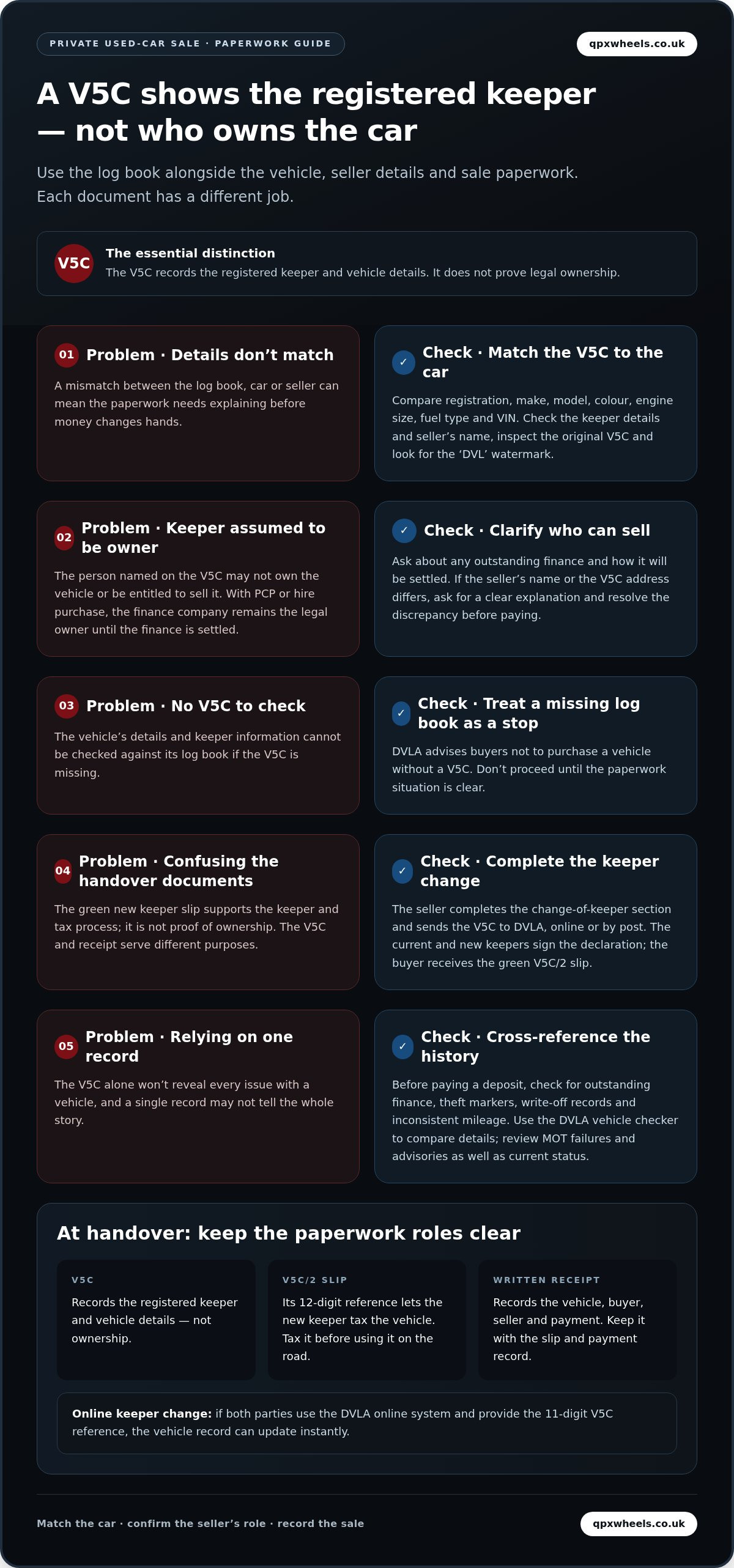
Understanding vehicle registration documents when buying a used car starts with checking the V5C log book: it records key vehicle details and identifies the registered keeper, but it doesn’t prove who owns the car. DVLA advises buyers not to purchase a vehicle without a V5C. For a private sale, check that the document matches the car, then get the green new keeper slip and a written receipt.
It’s understandable to want clear paperwork before handing over money. The documents should help you confirm that the car and seller match the details provided, and understand what needs to happen when the vehicle changes hands.
This guide explains which details to compare on the V5C, how registered keeper differs from owner, and what paperwork to expect in a private used-car sale. You’ll also learn how the receipt, MOT record and service history fit into your checks, so you can approach the purchase with greater clarity.
Key Takeaways
- Compare the V5C details with the car itself, including its vehicle identification number, before agreeing to buy.
- Remember that the V5C identifies the registered keeper, not necessarily the legal owner; use a written receipt to document the sale.
- For a private purchase, check the seller’s details and make sure the paperwork clearly records the vehicle and the change of keeper.
- Review the MOT history and service records for a fuller picture of the car’s past and any points that need closer attention.
- If the V5C is missing, understand the steps for registering the vehicle before proceeding with the purchase.
What Important Vehicle Documents Do I Need When Buying Or Selling A Used Car?
Before agreeing to buy or completing a private sale, compare the paperwork with the car, its seller and DVLA records.
-
Check the vehicle’s history
Run a vehicle history check before paying a deposit. Look for outstanding finance, theft markers, write-off records and mileage that appears inconsistent. Consider accident information alongside the car’s condition and service history, rather than treating any single record as a complete account.
A check can reveal risks that the V5C alone won’t show. If finance remains outstanding, the finance company may still own the car; if it’s recorded as stolen, police can take it from a buyer. Pause the purchase if the results conflict with the seller’s account, and ask for a clear explanation before proceeding.
-
Verify the V5C and keeper details
Inspect the original V5C and compare its registration number, make, model, colour, engine size, fuel type and VIN with the vehicle. Check the registered keeper’s details and whether the seller’s name matches. The V5C may record previous registered keepers, but that information does not establish ownership.
For a private sale, compare the address on the V5C with the place where the car is being offered. If they differ, ask the seller why and consider whether the explanation makes sense. A clear mismatch between the seller, document and vehicle needs resolving before money changes hands.
-
Compare vehicle details with DVLA records
Use the DVLA’s free online vehicle information checker to compare the seller’s claims with the vehicle record. Enter the registration number and check that the displayed make, model, colour and other identifying details match the car and V5C. A mismatch can point to an error or a more serious concern.
You can check tax and MOT information using the registration number through online vehicle records. MOT history is available back to 2005, using the registration number and the document reference on the V5C. Read past failures and advisories as well as the current MOT status, since advisories can flag areas needing attention.
-
Check the V5C for inconsistencies
Examine the V5C for alterations, damaged details or information that doesn’t match the car. Check for the ‘DVL’ watermark, then compare the VIN on the vehicle with the number printed on the document. Ask the seller to explain discrepancies before continuing; don’t rely on a document that appears changed or inconsistent.
If the log book doesn’t match the car in DVLA records, report the seller to the police. Incorrect or altered details can make it harder to establish which vehicle the paperwork refers to and may conceal theft or finance issues. UK Parliament states that the Consumer Rights Act 2015 gives buyers protection when purchasing a car from a dealer in the UK.
Registered Keeper vs Owner: What’s the Difference?
- Separate the registered keeper from the legal owner before arranging payment. The V5C records the vehicle’s registered keeper, the person responsible for keeping its details up to date with the DVLA. It doesn’t prove that person owns the car. A sales receipt records the purchase and helps show who bought it, so make sure the seller’s role and the paperwork are clear.
Finance can affect ownership. With PCP or hire purchase, the finance company remains the legal owner until the finance is settled. The person named as registered keeper may therefore not be entitled to sell the car outright. Ask how any outstanding finance will be settled before completing the purchase.
- Complete the keeper-change paperwork with the seller when the vehicle changes hands. For a vehicle with a V5C, the seller completes the change of keeper section and gives the buyer the green V5C/2 new keeper slip. The current and new keepers sign the declaration as part of the transfer. Check that the registration number and vehicle details match the car before signing.
The seller must send the completed V5C to the DVLA, either online or by post. If both parties use the DVLA online system and provide the 11-digit reference from the V5C, the vehicle record can update instantly. Keep the new keeper slip safe: it is the part of the log book intended for the buyer.
- Use the V5C/2 slip to handle vehicle tax, not as proof of ownership. Its 12-digit reference number lets a new keeper tax the vehicle. A used vehicle must be taxed before it is used on the road, so arrange tax before driving it away. The V5C itself identifies the registered keeper; the sales receipt documents the purchase.
Check that the slip belongs to the vehicle by matching its registration number with the number displayed on the car. Keep the receipt and payment record with the slip. These documents have different purposes: the slip supports the keeper and tax process, while the receipt records the transaction between buyer and seller.
- Confirm the transfer has been reported and retain your purchase records. Make sure the change of ownership is reported and retain your purchase records. In a private sale, confirm the seller has completed their part and submitted the V5C, then keep the V5C/2 and signed receipt together. The receipt should identify the car and record the buyer, seller and payment.
If the V5C names someone other than the person selling the car, establish the reason before proceeding. A keeper’s name alone doesn’t prove ownership, especially where finance is involved. Resolve who legally owns the vehicle and how the sale is authorised before handing over payment.
Documents that support proof of ownership
A V5C proves registration, not ownership, so keep purchase evidence as well. If the seller has no V5C, DVLA advises buyers not to buy the vehicle; a buyer who needs to register it must send form V62 to DVLA and pay a £25 fee, according to the Driver and Vehicle Licensing Agency (DVLA).
-
Gather proof of ownership and purchase
Get a written receipt from the seller and make sure it describes the transaction clearly. Record the purchase date, place, agreed cost, vehicle registration number, mileage, buyer’s details and seller’s details. Include proof of payment and ask both parties to sign. Keep a copy alongside the V5C paperwork, rather than relying on a bank transfer record alone.
These details help connect the payment to a specific car and sale. For example, a receipt stating the registration number and mileage can help distinguish the vehicle from another car if a question arises later. Check the names against the seller’s identity details and the V5C. If a dealer sells the car, retain the dealer’s invoice and any documents describing the agreed sale.
Keep the seller’s contact details with the receipt. If any information needs correcting, ask for an updated document before completing payment. This gives you a clearer record of what you bought, who sold it and the terms of the sale.
-
Keep evidence for ownership disputes
Store the signed receipt, payment confirmation and relevant sale messages together. The V5C is an official DVLA-issued registration certificate, but it identifies the registered keeper rather than proving legal ownership. A receipt supports the purchase record; finance paperwork may also matter if the car was bought through hire purchase or PCP.
Keep records of how the sale was arranged, including written statements about the car’s previous ownership or finance status. If a dispute arises, a consistent timeline linking the seller, vehicle, payment and transfer can help explain the transaction. Don’t alter original records. Save copies of digital messages and store the original paperwork securely.
Ask for the owner’s manual and any spare keys at handover, then note on the receipt or collection checklist whether they were supplied. These items don’t prove ownership, but recording their delivery can prevent later disagreement about what came with the car. Keep the manual with the vehicle documents for future reference.
-
Address a missing V5C
Pause before paying if the seller cannot provide the V5C. Ask why it’s missing and compare the seller’s identity and vehicle details with DVLA records. A missing log book leaves you without the usual registration document and makes the sale harder to verify. Don’t treat a receipt or spare keys as a substitute for the V5C.
If you proceed and need to register a used vehicle without a V5C, the Driver and Vehicle Licensing Agency (DVLA) says you must send form V62 and pay a £25 fee. Keep the application paperwork and proof of purchase together, since they document your steps and the transaction. If the seller says a replacement document is on its way, wait for the paperwork rather than relying on that assurance.
If you’re buying with finance, read the agreement carefully and keep its documents with the receipt. The payment method and finance terms affect the transaction record, while the registration certificate serves a separate purpose. Clear paperwork makes it easier to keep track of both.
The V5C registration certificate and log book
Use the V5C to confirm the vehicle’s registration details and complete the keeper transfer correctly. Then review the MOT record separately, as it shows test results rather than ownership.
- Read the V5C before completing any change. Check the registration number, make, model, VIN, engine size, fuel type and colour against the car. The certificate also records the registered keeper, but it isn’t proof of legal ownership. Keep the V5C separate from the sales receipt, since each document serves a different purpose.
Check that the document reference and keeper details are legible. If a vehicle detail is wrong, don’t copy it onto another form or leave the error unresolved. Make sure the change of keeper information refers to the car you’re buying, not another vehicle with a similar make or colour.
- Complete the relevant change-of-keeper fields with the seller. For a V5C registration certificate, the seller completes section 6, and the buyer and seller sign the declaration in section 8. Check each entry before signing, particularly the registration number and the new keeper’s details. The seller sends the completed certificate to the DVLA.
The buyer must notify the DVLA as soon as the vehicle changes owner. If both parties use the DVLA online system and provide the 11-digit reference from the V5C, the vehicle record can update instantly. Keep the V5C/2 new keeper slip and purchase receipt until the new certificate arrives.
- Track the new V5C after the seller submits the change. If it hasn’t arrived, contact DVLA before 6 weeks have passed to avoid having to pay £25 for another one, according to the Driver and Vehicle Licensing Agency (DVLA). Keep the new keeper slip, receipt and any transfer confirmation together while you wait.
Keep the V5C with the vehicle paperwork and check what documents are needed for tax or MOT arrangements. Arrange the required paperwork before driving, and don’t mistake an MOT pass for evidence that every issue has been fixed. The MOT record includes past failures and advisories, which can help identify items needing attention.
- Review the MOT certificate and online history alongside the V5C. The Driver and Vehicle Standards Agency (DVSA) states that cars require an annual MOT test after three years. Check the latest MOT result, its remaining validity and the next test date, then read any advisories instead of relying only on the pass status.
Compare recorded mileage across MOT entries with the car’s displayed mileage and service records. A sudden inconsistency needs an explanation before purchase. An MOT certificate documents a test result; it doesn’t replace the V5C, prove ownership or confirm the car’s full mechanical condition.
Documents needed for a private used-car purchase
For a private sale, collect the original vehicle paperwork and make your own written record of the transaction. Before paying, check that the seller, car and documents tell a consistent story.
- Ask to see the original V5C registration certificate and compare it with the car. Match the registration number, make, model and VIN, then check that the seller’s details are consistent with the document. DVLA advises buyers not to buy a vehicle without a V5C. If it’s missing, don’t treat a receipt or photocopy as a substitute.
Check the seller’s name and address against their driving licence, passport or a recent utility bill. If the V5C address differs from where the car is offered for sale, ask why. A clear explanation matters because the paperwork should connect the seller to the vehicle and the proposed sale.
- Review the original MOT documents and service history before agreeing to buy. Compare mileage recorded on MOT entries with the dashboard and service-log entries. Look for gaps, inconsistent readings and service stamps that don’t fit the car’s claimed age. An MOT certificate records a test result; service records help show its maintenance history.
Check the MOT history online for past failures and advisories, then ask the seller about any unresolved items. Keep the original MOT test document with the paperwork for your used-car purchase. Note any explanations from the seller so you can compare them with the records later.
- Arrange a vehicle history check using the registration number before paying. It can help identify whether the car is stolen, has outstanding finance, has been written off or shows an implausible mileage history. Compare its findings with the V5C, MOT record and seller’s account. Stop to resolve any inconsistency rather than relying on verbal assurances.
Ask for the service book, invoices and available maintenance records. Compare dates, mileage and vehicle details across the documents. A gap in the service history doesn’t prove there’s a fault, but it means there’s less evidence of past maintenance. Record the seller’s explanation for any missing paperwork in your notes.
- Write and sign a receipt with the seller before completing payment. Include the purchase date and place, buyer and seller details, registration number, mileage, agreed cost, payment method and both signatures. Keep a copy with the V5C/2 new keeper slip and any transfer confirmation. These records link the payment to the specific car and sale.
If you need to register a used vehicle without a V5C, send form V62 to DVLA and pay a £25 fee, according to the Driver and Vehicle Licensing Agency (DVLA). Keep the application evidence with your receipt. Once the paperwork is in order, continue exploring your car-buying options with the records close at hand.
QPX Wheels: Used Vans
QPX Wheels offers used cars and vans for buyers ready to move from paperwork checks to choosing a vehicle. Whether you need a van for work or a car for everyday use, compare its condition, documented history and registration details with your requirements before deciding.
For a purchase using Hire Purchase (HP) Finance, read the agreement carefully and understand how finance relates to ownership. The V5C still records the registered keeper, so keep the finance documents and sales paperwork with your purchase records.
Once you’ve decided what type of vehicle suits your needs, you’re welcome to contact QPX Wheels to discuss your next step.
Make your next vehicle decision with confidence
Understanding vehicle registration documents when buying a used car is one part of making a considered choice. Next, decide what you need the vehicle to do, then compare suitable options against practical priorities such as everyday use, work needs and the space you require.
QPX Wheels offers used cars and vans to suit different needs. If you’re selling your current car before buying, the Vehicle Valuation Service can help you plan your next step. Consider which type of vehicle fits your circumstances, then browse QPX Wheels’ stock and keep your paperwork organised as you move from research to purchase.
For a considered next step, contact QPX Wheels about your vehicle requirements. A clear plan can help you approach your next purchase with confidence.
Frequently Asked Questions
What does a V5C look like?
A V5C is a paper vehicle registration certificate issued by the DVLA, commonly called the log book. It has labelled sections for vehicle and keeper information, along with a document reference. Inspect the original for the ‘DVL’ watermark and look for alterations, damage or inconsistent details. A photocopy isn’t a substitute for viewing the original document during a used-car sale.
What information is on a V5C?
A V5C records details including the vehicle’s make, model, registration number, VIN, engine size, fuel type and colour. It also identifies the registered keeper and may record previous registered keepers if that information is available. Compare these entries with the car and its other records. The certificate helps identify the vehicle, but it doesn’t establish who legally owns it.
What is a V5C logbook?
The V5C log book is the vehicle registration certificate issued by the DVLA. Understanding vehicle registration documents when buying a used car means recognising that this certificate records vehicle and registered keeper details, rather than the terms of the sale. Keep it distinct from the receipt and any finance agreement, which document the purchase and financing arrangements respectively.
What paperwork should I ask the seller for?
Ask to see the original V5C, MOT test documents and service history. Request a written receipt recording the vehicle, mileage, purchase details, buyer and seller, payment and signatures. Compare maintenance invoices with dates and mileage in the MOT history. Keep the new keeper slip and relevant finance paperwork with your purchase records so you can refer to them after the transaction.
What information is shown on a UK V5C vehicle registration certificate?
A UK V5C includes the vehicle’s registration number, make, model, VIN, engine size, fuel type and colour. It names the registered keeper and may show the number of previous registered keepers if recorded. Use these entries to distinguish the vehicle from another car with a similar model or colour. Check the details against the vehicle and its available records before completing the sale.
How can I check that the V5C matches the used car and seller?
Compare the V5C’s registration number, VIN, make and model with the car, then use the DVLA vehicle information checker to compare the records. Check the seller’s identity details against the keeper information and ask about any address difference. A practical part of understanding vehicle registration documents when buying a used car is spotting mismatches early. Resolve discrepancies before paying or signing paperwork.
What does the registered keeper on a V5C mean, and does it prove ownership?
The registered keeper is the person recorded with the DVLA for the vehicle. Their name on the V5C doesn’t prove legal ownership or, by itself, establish authority to sell. For example, a car on PCP or hire purchase may remain the finance company’s property until the finance is settled. A signed receipt provides a separate record of the purchase between buyer and seller.
How can I verify a car's registration, VIN, make and model using the V5C?
Read the registration number, VIN, make and model from the V5C, then compare them with the vehicle’s number plates and VIN. Enter the registration number in the DVLA’s free vehicle information checker and compare the returned details. Check the VIN character by character. If a number or description differs, pause the transaction and establish the reason before proceeding with the purchase.


