
An MOT advisory is a warning about a vehicle issue that isn’t serious enough to fail the test at that time. A car can pass with advisories, but that doesn’t prove the issue can safely be ignored. Understanding advisory notes on a vehicle MOT history means knowing what the tester observed and whether the fault may need attention.
A pass can feel reassuring, while a long list of notes may be concerning. An advisory’s significance depends on the part involved, its condition and whether the same issue appears in earlier MOT records.
This guide explains how advisories differ from minor defects and failures, where to find them in an online MOT history, and what notes about tyres, brakes, lights, corrosion and wear can indicate. It also covers how to assess advisories as a car owner or when deciding whether to buy a used vehicle.
Key Takeaways
- An advisory flags a potential issue, so read the description carefully rather than treating it as either a failure or a clean bill of health.
- Use the vehicle’s MOT history to spot recurring notes and changes in recorded mileage that may need closer consideration.
- Give safety-related advisories, particularly those involving tyres or brakes, prompt attention as their condition can worsen.
- When considering a used car, weigh the advisories alongside its wider MOT and service history before making a decision.
- QPX Wheels offers used cars and vans, plus a Vehicle Valuation Service for people considering their next vehicle or a sale.
Common advisory issues: tyres, brakes, lights, corrosion and wear
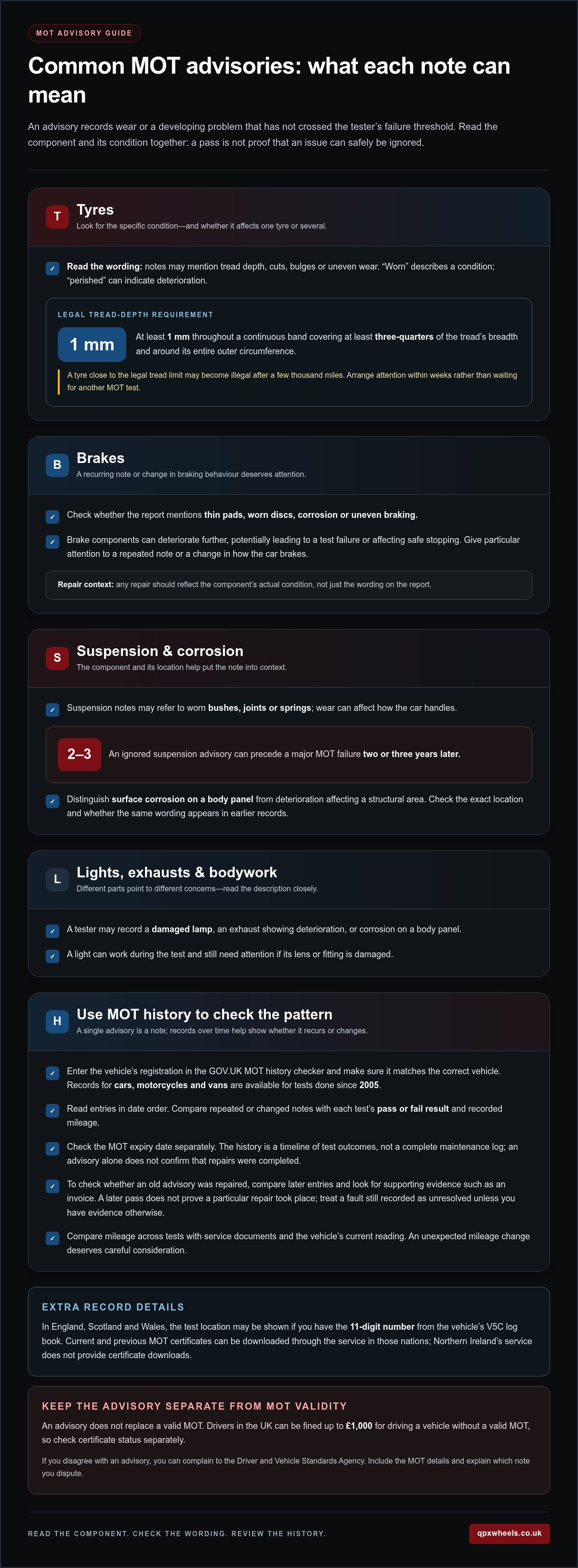
An advisory identifies a component with wear or a developing problem that hasn’t crossed the tester’s failure threshold. The wording matters: “worn” describes a condition, while “perished” or “corroded” may point to deterioration that needs closer attention. An advisory about one tyre, for example, differs from a note describing damage across several tyres.
Tyre notes often mention tread depth, cuts, bulges or uneven wear. According to the Driver and Vehicle Standards Agency, tyre grooves must have a depth of at least 1 mm throughout a continuous band measuring at least three-quarters of the tread’s breadth and around its entire outer circumference. A tyre described as close to the legal tread limit may become illegal after a few thousand miles. Treat an advisory about tyre condition as a reason to arrange attention within weeks, rather than waiting for another MOT test.
Brake advisories may refer to thin pads, worn discs, corrosion or uneven braking. These components can deteriorate further, potentially leading to a test failure or affecting safe stopping. A recurring note about the same brakes deserves attention, especially if you notice a change in braking behaviour. Any repair should reflect the component’s actual condition, not just the wording on the report.
Suspension notes may describe worn bushes, joints or springs. Such wear can affect how the car handles, and an ignored suspension advisory can precede a major MOT failure two or three years later. Corrosion advisories need context too: surface corrosion on a body panel differs from deterioration affecting a structural area. Check the exact location and whether the description appears in earlier records.
Lights, exhausts and bodywork can also appear in advisory notes. A tester might record a damaged lamp, an exhaust showing deterioration or corrosion on a body panel. Each points to a different concern, so read the component and condition together. A light that works during the test may still need attention if its lens or fitting is damaged.
In England, Scotland and Wales, the Driver and Vehicle Standards Agency says MOT history can show the test location if you have the 11-digit number from the vehicle’s V5C log book. This can add context when reviewing a particular test record alongside its advisories.
If you disagree with an advisory, you can complain to the Driver and Vehicle Standards Agency. Include the MOT details and explain which note you dispute.
An advisory doesn’t replace a valid MOT. The Department for Transport says drivers in the UK can be fined up to £1000 for driving a vehicle without a valid MOT, so check the certificate status separately from any advisory notes.
Can advisories appear on my online MOT history?
Yes. Online MOT records include advisories recorded by the tester, alongside test results and mileage. When buying, start by matching the registration to the correct vehicle.
Checking a vehicle’s MOT advisory history
An MOT advisory history is the record of notes attached to a vehicle’s past tests. Use the GOV.UK MOT history checker and enter the vehicle’s registration. According to the Driver and Vehicle Standards Agency, MOT history results for cars, motorcycles and vans are available for tests done since 2005. Older entries can help you trace recurring concerns.
Read each report in date order. Compare a note about a tyre or suspension component with later results to see whether it reappears or changes. Records also show whether the vehicle passed or failed and the mileage recorded at each test. This can distinguish a one-off note from a pattern, but an advisory alone doesn’t confirm that repairs were completed.
Checking MOT dates and repaired advisories
The online record shows when the next MOT is due, so you can check the expiry date before using or buying a vehicle. Compare it with the test result and certificate details rather than relying on someone’s recollection. In England, Scotland and Wales, current and previous MOT certificates can be downloaded through the service. Northern Ireland’s service doesn’t provide certificate downloads.
To see whether an old advisory was repaired, compare its wording with later entries and look for supporting evidence, such as an invoice. A later pass doesn’t prove that a specific repair took place. If the same fault remains recorded, treat it as unresolved unless you have evidence otherwise.
The MOT history checker can help you review more than advisories. Compare recorded mileage across tests and note changes in pass or fail status. An unexpected mileage change, for example, deserves careful consideration alongside service documents. MOT entries provide a timeline of test outcomes, not a complete maintenance log.
Testers’ advisories appear in the online history and can’t be removed by sellers. Use the record as a starting point when assessing a used vehicle. Don’t dismiss an older note: compare its date and wording with later results. A tread-depth advisory, for instance, should be considered alongside subsequent test findings and the tyre’s current condition.
Check the registration carefully, particularly when comparing vehicles. Then review the MOT expiry date, mileage sequence, failures and advisories together. This gives you a clearer view of what each test recorded and which issues may need further investigation.
Why MOT history matters when buying or owning a car
An MOT history records test outcomes, mileage and advisories, which you can consider alongside a car’s service records. For buyers, it may reveal patterns that a single test result doesn’t show.
Using MOT history when buying a used car
MOT history provides a chronological record to help you assess how a used car’s condition has changed. Compare mileage at each test with the service history and the vehicle’s current reading. Odometer tampering is a risk, even when service documents appear to match the displayed mileage, so look for a consistent sequence rather than relying on one document.
Compare pass and failure results across the vehicle’s MOT tests too. A failure followed by a pass shows that the test outcome changed, but doesn’t explain every repair or establish the car’s overall condition. Read the accompanying notes and consider how they fit the maintenance history.
Checking advisories before buying
Advisories can help identify issues that were recorded but didn’t cause a test failure. Look for the same item appearing in consecutive years, as this may indicate that attention was deferred. Repeated notes about brake pad or suspension wear, for example, deserve more scrutiny than an isolated note that doesn’t recur.
Use each advisory to guide your questions and review relevant garage invoices or service entries. A later MOT report may show whether the note remains, changes or disappears, but the record alone doesn’t confirm what work was completed. Repair documents can help explain the timeline.
Patterns matter more than a single entry. A tyre advisory that disappears from later reports tells a different story from recurring corrosion notes, particularly when they describe the same area. Compare the component, description, test date and mileage. This helps distinguish a developing concern from an issue recorded once that didn’t reappear.
For an owner, MOT history can serve as a useful maintenance timeline. Match an advisory to your repair records, then note whether the same component appears at a later test. If a garage invoice records work on a suspension part, a later report offers another point of comparison. MOT history complements service records but doesn’t replace them.
Before deciding, list unresolved advisories and group them by component, such as brakes, tyres or bodywork. This helps you discuss the vehicle’s condition clearly and consider possible repair needs. Outstanding advisories can inform your decision and a price discussion, but assess them alongside the car’s age, mileage, service evidence and overall condition.
Consider the whole record. An isolated advisory doesn’t tell the same story as a repeated issue, and a pass doesn’t erase earlier entries. Comparing MOT history with maintenance documents gives you a firmer basis for judging whether a used car suits your needs or whether its recorded issues need further attention.
How Should Advisories Affect a Used Car Buying Decision?
An advisory doesn’t mean a vehicle failed its MOT, but it can point to a developing issue. When considering a used car, weigh the note alongside the car’s current condition, service records and earlier test results.
A passed MOT with advisories allows the vehicle to be driven for the next twelve months after the test. That doesn’t mean every item will remain safe for that period. Some advisories may become failures within 6 to 12 months, depending on the component and its condition. For example, a tyre or brake note deserves attention if wear is progressing.
There’s no legal obligation to repair an advisory immediately, and an advisory alone doesn’t itself result in a fine or legal consequence. Still, the test records the tester’s observation at a particular time. A fault can worsen after the test, so assess the component’s current condition rather than relying only on the recorded result.
Look at repeated notes as well as new ones. If the same suspension or corrosion advisory appears in consecutive years, attention may have been deferred. Compare the wording, date and mileage across reports. A changed description may indicate progression, while a repeated note signals that the concern remains in the vehicle’s history.
For a buyer, treat an advisory as a prompt to gather evidence, not an automatic reason to reject the car. Match the note to service records, repair invoices and the vehicle itself. An invoice for brake work after a brake advisory provides useful context; a later pass alone doesn’t establish what repair, if any, took place.
An advisory alone doesn’t affect car insurance. However, an insurer may refuse a claim arising from an actual roadworthiness defect described in an advisory. If a problem develops during the 12-month period of the MOT certificate, get the item checked, particularly if it affects braking, steering, tyres or visibility.
Before buying, list outstanding advisories and distinguish safety-related concerns from less urgent wear. Consider whether each note still applies, whether supporting records explain it, and whether the vehicle’s condition matches its MOT history. This helps you assess the car on evidence rather than treating a pass as a guarantee or every advisory as an immediate failure.
For an owner, the same approach supports sensible maintenance decisions. Keep repair records and compare them with future MOT results. If a serious fault becomes apparent, prioritise its condition and safe use rather than waiting for the next test. An advisory is a useful warning, but the vehicle’s current roadworthiness matters most.
How Testers Decide What Counts as an Advisory?
An MOT tester assesses each component against the test requirements and records its condition. The report distinguishes a warning from defects serious enough to cause a failure.
An advisory warns of a potential issue, while a minor defect is present but not serious enough to fail the test; both receive a pass. Dangerous and major faults cause an automatic failure. For example, a tester may record worn brake pads as an advisory if they haven’t reached the failure threshold.
The same core categories apply across England, Scotland, Wales and Northern Ireland. The MOT history services differ in their records: for example, Northern Ireland results are available for tests done since 2017, whilst car, motorcycle and van results in Great Britain cover tests since 2005.
Testers can issue advisories about any of the 22 points of the MOT test. Their judgement determines whether to record an advisory, while the standard report gives a complete account of the test result. This means wording can vary with the component and its observed condition. A note about an exhaust showing wear, for instance, identifies a concern without classifying it as a failure.
Deciding when to arrange repairs depends on the item, its condition and whether it affects safe use. Tyre or brake advisories deserve prompt attention, ideally within weeks rather than waiting for another MOT. A developing problem may worsen between tests, and some advisories become failures within 6 to 12 months. Keep the MOT certificate and repair invoices together, then compare later test reports with the original warning.
Repair costs vary depending on the part and work required. Market estimates for UK repairs include:
- Brake pad and disc replacements ranging from £150 to £400 depending on the vehicle make and model
- Tyre replacements averaging between £70 and £150 per corner for standard cars
- Suspension component repairs such as anti-roll bar links costing £90 to £200 including labour
These examples show why the exact advisory matters: “worn brakes” could mean the pads, discs or both. The report identifies the affected components, while an inspection establishes what repair is needed. If a tyre is already due for replacement, an owner may plan the work accordingly, but shouldn’t ignore a safety concern.
Use the advisory wording to understand what the tester recorded, then prioritise repairs by safety and deterioration. If you’re considering a vehicle after reviewing its MOT notes, explore used car options with those concerns in mind.
QPX Wheels: Used Vans
QPX Wheels offers used vans for buyers weighing their options after reviewing MOT advisories. Use the vehicle’s MOT history to understand recorded issues, then consider how those notes fit your needs and budget. If a van has recurring advisories, factor the outstanding concerns into your decision instead of relying on a pass alone.
QPX Wheels also offers used cars, Hire Purchase (HP) Finance and a Vehicle Valuation Service. These options may suit you if you’re comparing vehicle types, considering finance or valuing a car you own. Keep your MOT findings in mind as you explore your next step, and contact QPX Wheels to discuss your requirements.
Make your next vehicle decision with clarity
Understanding advisory notes on a vehicle MOT history can help you make a more considered choice, whether you’re replacing your car or planning a sale. Use what you’ve learned to identify the questions that matter, then consider how a vehicle’s condition and history fit your needs.
QPX Wheels offers used cars and vans, as well as a Vehicle Valuation Service for people considering selling their vehicle. If you’re weighing up your next step, explore these options and discuss what you’re looking for while keeping the MOT information you’ve reviewed in mind.
Contact QPX Wheels for help as you consider your next vehicle decision. A clear view of the information, paired with a choice that suits your needs, is a sound place to start.
Frequently Asked Questions
What is an MOT advisory?
An MOT advisory is a tester’s recorded warning about a vehicle component that may need attention. It identifies the part and observed condition, such as a lamp with a damaged lens or an exhaust showing deterioration. The note isn’t a repair estimate or a prediction of exactly when the item will need replacing. Read it carefully, as the component and location help determine appropriate follow-up.
Does having an advisory mean a failed MOT?
No. A vehicle can pass its MOT with an advisory on the result. A failure means the tester found a defect classed as dangerous or major, while an advisory flags a concern that hasn’t reached that threshold during the test. A note about a worn component, for example, doesn’t mean it has already failed, but its condition may change after the test.
What Action Is Required?
Start by identifying the affected part and whether the note describes wear, damage or corrosion. Then consider how the issue could affect the vehicle’s use. A warning about a lamp, for example, differs from one involving braking. Arrange attention based on the condition and safety implications, and keep any repair paperwork. It can help explain what was done if the issue appears again.
What does an MOT advisory notice mean?
An MOT advisory notice records an issue observed by the tester during the inspection, without classifying it as a failure. It gives you a useful description to compare with later test results or maintenance records. If it mentions a particular side or component, retain that detail when discussing the vehicle’s condition. The wording describes the test finding, not necessarily the full cause of the wear.
How can I find advisory notes on a vehicle's MOT history in the UK?
Use the GOV.UK MOT history checker and enter the vehicle’s registration. The Driver and Vehicle Standards Agency says records for cars, motorcycles and vans cover tests done since 2005. Select the relevant test entry to see its result and recorded advisories. Check the registration carefully, particularly if comparing several vehicles, so you don’t mistake one car’s test history for another’s.
Do MOT advisories affect whether a vehicle passes its MOT?
An advisory doesn’t prevent a pass by itself. The tester records one when the observed condition hasn’t reached the failure threshold at that test. If the component’s condition worsens, a later inspection may classify it differently. A note about a worn tyre, for instance, records its condition on test day, not its condition later.
Do MOT advisory notes have to be repaired by law?
There’s no legal requirement to repair an advisory solely because it appears on an MOT record. However, the vehicle must remain roadworthy, and an advisory may concern a part that can deteriorate. If a fault develops or the vehicle becomes unsafe, don’t rely on the advisory’s original status. Consider the item’s current condition and address any safety concern promptly rather than waiting for another test.
How urgent are common MOT advisory items, such as worn tyres or brakes?
Tyre and brake advisories need prompt attention because wear can progress and affect control or stopping. Arrange repairs within weeks rather than leaving these warnings until the next MOT, especially if you notice changes while driving. A tyre near the legal tread limit can become illegal after a few thousand miles. The urgency depends on the recorded condition and how the vehicle is being used.


