
A car that looks immaculate may still have a history worth investigating. If you’re wondering how to check if a used car has been in an accident, don’t rely on a polished advert, a seller’s reassurance or a brief viewing alone. A vehicle history check can reveal a recorded insurance write-off, but it may not show every collision or repair, so no single check gives you the complete picture.
It’s understandable to want clear answers before committing to a purchase, particularly if you’re concerned that damage has been concealed. A careful, considered approach can help you make a more informed decision without rushing or relying on guesswork.
This guide explains which vehicle records and details to check, how to look for possible repair or structural damage during a viewing, and what to ask the seller. You’ll also learn when a report or visual check leaves questions unanswered, and when it may be sensible to pause or arrange an independent inspection. Bringing these steps together gives you a clearer basis for deciding whether to proceed.
Key Takeaways
- To learn how to check if a used car has been in an accident, combine vehicle-history records, a careful viewing and clear questions for the seller.
- Compare similar body panels in daylight and look for several possible repair clues together, rather than relying on one mismatch.
- Use the V5C and registration details to check the vehicle’s identity, but don’t treat them as proof of an accident-free history.
- If a report, paperwork or the car’s condition raises questions, note the details, ask for an explanation and consider an independent inspection.
- Before deciding, request vehicle-specific history information and clarify which records are available.
How to check whether a used car has been in an accident: start with the evidence
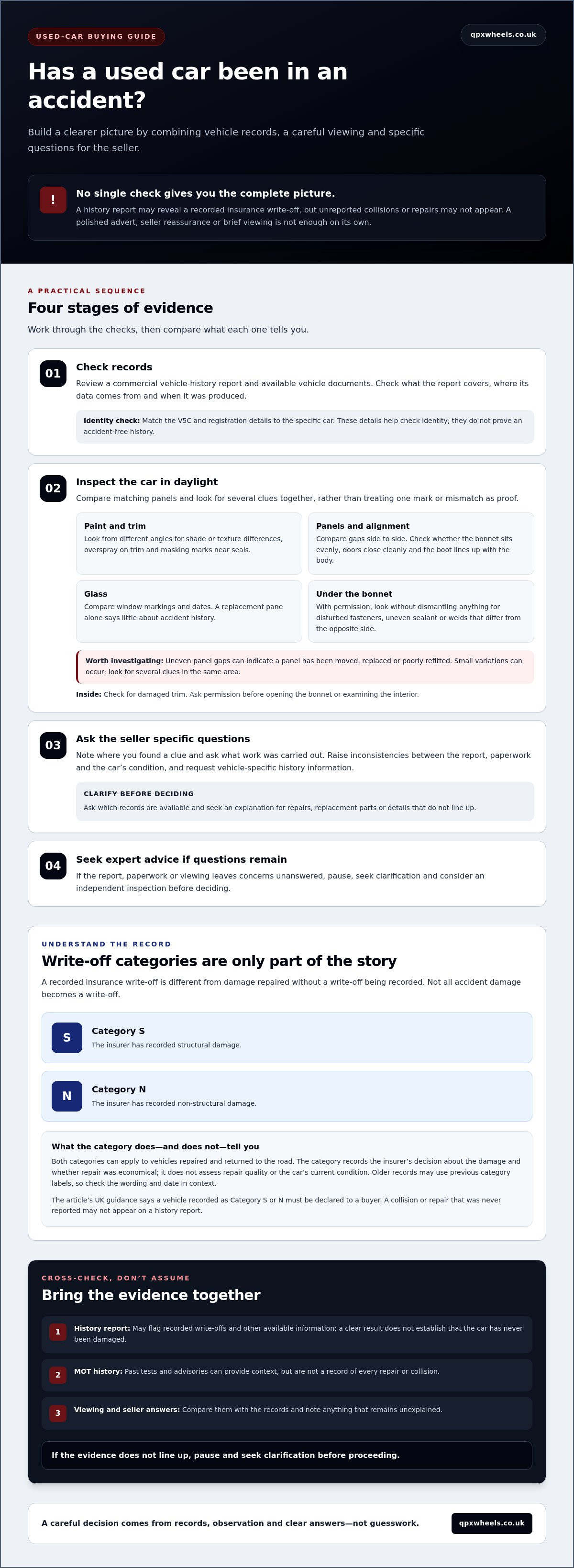
Several checks can reduce uncertainty, but no report, viewing or conversation can prove a car’s complete history on its own. If you’re learning how to check if a used car has been in an accident, work through the evidence in a few stages:
- Check the records. Review a commercial vehicle-history report and available vehicle documents.
- Inspect the car. Look for signs of repair or damage, comparing similar panels and details.
- Ask the seller. Raise specific questions about anything that appears inconsistent.
- Seek expert advice. If concerns remain, consider an independent inspection before deciding.
Accident damage can mean anything from a repaired scratch or dent to damage affecting the vehicle’s structure or safety systems. A cosmetic repair may have little bearing on how the car drives, but structural damage or poorly repaired safety-related parts deserve closer attention. A recorded insurance write-off is different from damage that was repaired without an insurance write-off being recorded. A collision or repair that was never reported may not appear in a history report.
What can a vehicle-history check actually tell you?
Commercial vehicle history reports may flag recorded insurance write-offs and other available history information. Their findings depend on the records and data sources accessible to the provider, so a clear result doesn’t establish that a car has never been damaged. Before relying on a report, check what it covers, where its data comes from and when it was produced. Make sure the details match the specific car you’re considering.
What do UK write-off categories mean?
Category S means an insurer has recorded structural damage; Category N means non-structural damage. Both categories can apply to vehicles repaired and returned to the road, but the category alone doesn’t assess the quality of those repairs or the car’s current condition. It records the insurer’s decision about the damage and whether repair was economical. Older records may use previous category labels, so check the wording and date rather than comparing labels without context.
A vehicle recorded as a Category S or N write-off must be declared to a buyer, according to the UK guidance in the research for this article. But not all accident damage becomes a write-off. Treat records as one part of your assessment, then compare them with the car’s condition and the seller’s answers. If the evidence doesn’t line up, pause and seek clarification before proceeding.
How to spot possible accident repairs during a used-car inspection
A careful viewing can reveal clues that a history report won’t show. If you’re working out how to check if a used car has been in an accident, view it in daylight and ask permission before opening the bonnet or examining the interior. Compare matching panels, such as the two front wings or both doors on one side. Look for patterns rather than treating a single mark as proof: a panel may have been repainted for reasons unrelated to a collision.
Uneven panel gaps can warrant further investigation because they may indicate that a panel has been moved, replaced or poorly refitted.
Check paint, panels, glass and body alignment
Walk around the car slowly, viewing the paint from different angles. Differences in shade or texture, overspray on trim, and masking marks near seals can suggest repainting. Compare panel gaps from side to side, and check whether the bonnet sits evenly, doors close cleanly and the boot lines up with the body. Small variations can occur, so look for several clues in the same area.
Check window markings and dates for differences between panes. A replacement window can result from a chip or break and, by itself, says little about accident history. If you want to compare the car’s recorded MOT results with its current condition, the official GOV.UK MOT history checker can help you review past tests and advisories. MOT history is another source of context, not a record of every repair or collision.
Look for signs of repairs beneath the bonnet and inside the car
With the seller’s permission, look without removing covers or dismantling anything. Disturbed fasteners, uneven sealant or welds that appear different from those on the opposite side may merit questions. These clues aren’t conclusive; previous repairs or replacement parts can have other explanations. Note where you saw them and ask the seller what work was carried out.
Inside, check for damaged trim and pay attention to warning lights when the ignition is switched on. If an airbag warning remains illuminated or doesn’t behave as expected, don’t try to investigate the system yourself. Airbags and structural components are safety-critical, so ask a qualified professional to assess suspected repairs.
Take clear photographs of concerns, with permission, and record their locations. This makes it easier to ask focused questions and compare the seller’s answers with paperwork or a professional’s findings. If explanations are unclear or several clues appear together, pause before making a decision and consider arranging an independent inspection.
Once you know what to look for, you can browse QPX Wheels’ used cars and request vehicle-specific information before deciding.
Compare vehicle records, seller answers and independent checks
To understand how to check if a used car has been in an accident, compare several sources rather than relying on one reassuring result. Each can answer different questions, and gaps between them deserve attention. Use this table as a guide to what the evidence can and can’t establish.
| Evidence | What it may reveal | What it can’t prove |
|---|---|---|
| Commercial history check | Recorded insurance write-off details and other information held by the provider. | That every collision or repair has been recorded. |
| MOT history | Test dates, mileage readings, pass or fail results and recorded advisories. | A complete accident or repair history. |
| Seller’s records | Available invoices, repair details, photographs or insurer documents. | That no other work or damage has occurred, particularly if records are incomplete. |
| Independent inspection | A professional’s assessment of the vehicle’s current condition and visible repair concerns. | Every past incident or repair, especially if evidence is unavailable. |
Use MOT history and vehicle documents as supporting evidence
The DVLA’s free online MOT history service shows recorded test results, including mileage, pass or fail outcomes and advisories. Compare the entries over time: an unexpected mileage change or a failure followed by a quick pass may be worth asking about, but neither proves accident damage. The Citizens Advice guide on what to check also explains how official checks fit into a used-car purchase.
Check that the registration and vehicle identification number (VIN) match across the car, its V5C registration certificate and any history reports. The V5C and registration help confirm you’re checking the right vehicle; they don’t certify that it’s accident-free. If a number is hard to locate or doesn’t match, ask the seller to clarify before proceeding.
Ask the seller specific questions and assess the answers
Ask directly whether the car has sustained damage, been repaired or received an insurance write-off category. If repairs are mentioned, ask what was done and whether invoices, photographs or insurer documentation are available. A seller may not hold every document, so consider the answer alongside the other evidence rather than treating missing paperwork alone as proof of a problem.
Consistent documents and clear answers support confidence, but they can’t guarantee a complete history. If the seller’s account conflicts with a report, the MOT timeline or the car’s condition, pause and ask for an explanation. If uncertainty remains, consider an independent inspection before making a decision.
What to do if accident damage clues mismatch paperwork
A clear vehicle-history report doesn’t prove a car has never been damaged. Some collisions and repairs may not appear in the records, so if the paperwork doesn’t seem to match the vehicle, take time to establish why. A measured process is more useful than either dismissing a concern or assuming the worst.
If you’re considering how to check if a used car has been in an accident, use these steps when something doesn’t add up:
- Document what you noticed. Record the location of uneven gaps, paint differences, warning lights or other clues. Take photographs with permission.
- Ask the seller clearly. Describe the specific concern and ask what work, if any, was carried out. Request any relevant records they have.
- Verify the details. Recheck the vehicle’s identity and compare the available paperwork, history report and seller’s explanation.
- Arrange an independent inspection. If questions remain, ask a suitably qualified professional to assess the points causing concern.
When should you arrange an independent inspection?
Consider an independent inspection if possible structural clues, warning lights or inconsistent repair evidence remain unresolved. Agree the scope with the professional beforehand: explain what you’ve found and ask whether the assessment covers those areas. Request written findings, including any limitations or components that couldn’t be assessed. An inspection can offer an informed view of the car’s condition, but it can only speak to the checks carried out and evidence available.
When is it sensible to walk away?
Pause if the VIN or registration details conflict, important questions go unanswered, or safety concerns remain unresolved. Cosmetic clues alone don’t establish that a car is unsafe, so seek a competent assessment before drawing that conclusion. If the explanation and evidence still leave you uncomfortable, you don’t have to proceed. Compare what you’ve found with your needs, and don’t let pressure to decide quickly replace a considered choice.
Once you’ve resolved your questions, or decided to look for another option, you can browse QPX Wheels’ available used vehicles. For any specific car, ask what history information and documentation is available before making a decision.
Make an informed used-car decision with QPX Wheels
A considered purchase brings the evidence together rather than relying on one report or a seller’s assurance. Use this final checklist before deciding:
- Identity: Match the registration and VIN on the car with the V5C and any checks or documents.
- Records: Review the available vehicle-history information, MOT history and repair paperwork, noting gaps or inconsistencies.
- Condition: Revisit any physical clues you’ve spotted and ask for an explanation.
- Answers: Check that the seller’s account makes sense alongside the records and the car’s condition.
- Inspection: If concerns remain, consider an independent professional assessment before committing.
Questions to settle before agreeing to buy
Confirm that the documents relate to the vehicle you’re viewing. Ask what history checks and repair information are available for that specific car, and whether the seller can provide relevant invoices, photographs or other records. Don’t assume every seller will have a full repair file; instead, clarify what is available and what remains unknown.
If something doesn’t match, such as a VIN detail, an unexplained repair clue or a seller’s account that differs from the paperwork, ask for clarification. Where an answer doesn’t resolve a concern about the car’s condition, an independent inspection may help. Make sure the assessment covers the areas you’re concerned about, and understand what it can’t determine. You can then weigh the findings against your needs rather than making a decision under pressure.
Explore your options without rushing the decision
QPX Wheels has more than 16 years of experience in the used-vehicle industry and sells pre-owned cars and vans, with nationwide delivery. That background may be useful as you explore your options, but it isn’t evidence that a particular vehicle has been accident-checked or is accident-free. Ask for vehicle-specific details, and confirm what documentation is available before deciding. Optional extended warranties are also available; ask about the terms for the vehicle you’re considering.
Understanding how to check if a used car has been in an accident means combining records, careful observation, clear questions and professional advice when needed. No single source can provide a complete picture, so take the time to resolve uncertainties before you proceed.
If you’re ready to consider another vehicle, explore QPX Wheels’ available used cars and vans, or get in touch with questions about the information available for a specific vehicle. There’s no need to rush: choose once you have the detail you need to make an informed decision.
Take your next step with confidence
Knowing how to check if a used car has been in an accident means weighing the available records alongside the car’s condition and the seller’s answers. If details conflict or safety concerns remain, pause and seek clarification or an independent assessment before committing. A clear report can help, but it shouldn’t replace careful questions about the specific vehicle.
A considered purchase starts with information you can verify. Check that the documents match the car, ask what history and repair records are available, and take time to decide whether the answers give you confidence.
QPX Wheels is an independent used-vehicle dealership with more than 16 years of industry experience. It offers used cars and vans with nationwide delivery, as well as optional extended warranties. Ask about the terms available for the vehicle you’re considering, and request vehicle-specific information before making a decision.
Ready to explore your options? Browse QPX Wheels’ used cars and vans, and take the next step at a pace that feels right for you.
Frequently Asked Questions
Can you tell if a used car has been in an accident from its history check?
A history check can reveal recorded information, such as an insurance write-off category, depending on the provider and records available. If you’re researching how to check if a used car has been in an accident, treat the report as one part of the process, not a complete account. Some incidents may never have been reported or recorded. Compare the result with the vehicle, its documents and the seller’s answers.
What are the signs that a used car has had accident repairs?
Possible clues include mismatched paint, overspray, uneven panel gaps, disturbed fasteners or welds that look inconsistent. One clue alone doesn’t prove accident damage: a panel or window may have been replaced for another reason. Look for several signs together, note their locations and ask the seller about them. If concerns relate to the structure or safety systems, arrange an assessment by a qualified professional rather than drawing conclusions from appearance alone.
Does a clear vehicle-history check mean a car has never been in an accident?
No. A clear result means the check found no relevant recorded information within the provider’s coverage. It isn’t proof that the car has never been damaged, as unreported incidents or repairs may not appear. Check what the report includes, then compare it with the car’s condition, MOT history and available repair documents. Ask the seller about anything that doesn’t match, and investigate unresolved inconsistencies before deciding whether to proceed.
What do Category S and Category N mean on a used car?
Under current UK write-off classifications, Category S relates to structural damage, whilst Category N relates to non-structural damage. These labels record an insurer’s decision; they don’t describe every repair or confirm the vehicle’s present condition. If you’re considering a car with a recorded category, check the date and terminology, request any available repair evidence and consider an independent professional assessment to understand its current state.
Can an MOT history show whether a car has been in an accident?
MOT history can show recorded test dates, results, mileage and advisories through the DVLA’s online service. It may help you spot inconsistencies or identify questions to raise, but it isn’t a complete accident record and doesn’t confirm the quality of repairs. Compare the dates and mileage with the car’s documents and the seller’s account. Follow up on unexpected changes or relevant advisories using other available evidence.
Should I buy a used car that has been repaired after an accident?
It depends on the damage, the available repair evidence and the vehicle’s current condition. Don’t decide based only on a write-off category or the seller’s assurance. Ask what work was done and whether invoices, photographs or other records are available. If questions remain, arrange an independent inspection and consider its written findings. If important concerns can’t be resolved, taking more time or choosing another car may be the more comfortable decision.
Is an independent inspection worth arranging before buying a used car?
It can be helpful if you’ve noticed possible repairs, received conflicting information or want a professional view before committing. Choose an independent, suitably qualified inspector and agree the scope beforehand, including any specific clues you want assessed. Ask for written findings and details of anything that couldn’t be checked. An inspection provides an assessment of the vehicle’s condition at that time, but it can’t reconstruct every event in its history.


