
What if the ten-minute drive you just took was actually a missed opportunity to save thousands of pounds? Most buyers treat a test drive like a simple joyride, but learning how to test drive a used car properly is the only way to avoid inheriting someone else's mechanical nightmares. It is perfectly natural to feel a bit of pressure from a seller or to worry that you might miss a hidden fault because you aren't a trained technician. We understand those anxieties, and we believe that every driver deserves to feel completely certain about their next purchase.
In this guide, we have condensed 16 years of industry expertise into a clear, logical framework that helps you spot red flags before they become your problem. We are going to walk you through a comprehensive pass-or-fail checklist for 2026, explaining the difference between standard wear-and-tear and major engine or gearbox issues. By following our professional "Cold-to-Hot" protocol, you will gain the confidence to either negotiate a fair price or walk away from a bad deal without a second thought.
Key Takeaways
- Learn why the "cold start" ritual is vital and how to check for signs of head gasket failure before you even turn the key.
- Discover how to test drive a used car properly by assessing mechanical performance, including how to identify a slipping clutch or notched gear changes.
- Understand the three-stage road test strategy, ranging from low-speed urban manoeuvring to high-speed motorway stability checks.
- Master the "hot restart" technique to reveal engine issues that only appear once the vehicle has reached its operating temperature.
- Gain a clear pass-or-fail framework for inspecting interior electronics and climate control systems to avoid expensive future repairs.
The Pre-Drive Ritual: Inspections Before the Engine Starts
Most buyers believe the test drive begins the moment they pull away from the kerb. In reality, the most revealing part of the process happens whilst the vehicle is stationary. Part of understanding the used car market involves recognising that a car's condition is often hidden in plain sight. Learning how to test drive a used car properly starts with a rigorous pre-drive ritual designed to catch issues before they are masked by a warm engine or road noise.
Always try to arrive ten minutes early for your viewing. This allows you to perform the "bonnet touch" test. Place your hand on the bonnet to ensure the engine is stone cold. Sellers sometimes pre-warm a vehicle to hide a struggling battery, faulty glow plugs, or a rough idle. If the engine is already warm, you should ask why. Once you open the bonnet, remove the oil filler cap and look for a thick, creamy substance often called "mayonnaise." This typically indicates that coolant is leaking into the oil, which is a classic symptom of head gasket failure.
Before you get behind the wheel, verify the vehicle's identity. Check that the V5C logbook details match the Vehicle Identification Number (VIN) stamped on the chassis and visible through the bottom of the windscreen. You should also inspect the tyres across their entire width. If the tread is worn unevenly, it usually points to poor wheel alignment or worn suspension bushes rather than just simple "wear and tear."
Fluid Checks and Ground Leaks
Take a moment to look underneath the car for any fresh puddles. Dark, greasy spots suggest oil leaks, whereas brightly coloured fluids like pink, blue, or green are usually signs of a coolant leak. Check the coolant expansion tank itself; the liquid should be clear and at the correct level. If the coolant looks murky or has oily beads floating in it, walk away. Finally, run your finger along the edge of the brake discs. A heavy "lip" or deep grooves suggest the discs are nearly spent and will require a costly replacement soon.
The Cold Start Test
This is a critical step in learning how to test drive a used car properly. Ask the seller to start the engine whilst you stand near the exhaust pipe. Watch for blue smoke, which indicates burning oil, or persistent thick white smoke, which suggests a coolant leak. Listen closely for any heavy metallic rattling or "clacking" sounds. These often point to a stretched timing chain or worn hydraulic lifters. Finally, check the dashboard. Every warning light must illuminate when you turn the ignition and then extinguish once the engine is running. A light that stays on, or one that never appears at all, is a major red flag.
Interior Ergonomics and Electronic Functionality
Once you've completed the exterior and cold-start checks, it's time to step inside. The cabin tells a story that the paintwork might hide. If you want to know how to test drive a used car properly, you must be methodical with the electronics. Test every window individually to ensure they roll up and down without hesitation. You should also adjust the mirrors to confirm the motors operate smoothly without grinding sounds. If the electric seats are jerky or unresponsive, these are often expensive repairs that sellers hope you won't notice until after the paperwork is signed.
Switch the air conditioning to its lowest setting. It should blow ice-cold within a minute. Then, flip it to the highest heat setting to check for heater matrix issues or unpleasant, damp smells. Whilst the cabin reaches temperature, pair your phone via Bluetooth and verify the satellite navigation is accurate. A glitchy infotainment system can be a sign of deeper electrical gremlins that are difficult to diagnose. At QPX Wheels, we perform a 39-point vehicle inspection on all our stock to ensure these systems are fully functional, but you should always verify them yourself during a private viewing.
Finally, look closely at the high-traffic touchpoints. A steering wheel that is shiny and worn smooth, or rubber pedals worn down to the metal, usually suggests a car has covered significant mileage. If the odometer shows a low figure but the gear stick gaiter is shredded and the seat bolsters are collapsed, the car's history might not be as transparent as it seems. Trust your instincts when the physical wear doesn't match the story you're being told.
The Dashboard and Safety Tech
Check the odometer against the service records and MOT history you've already researched. Any discrepancy here is a reason to walk away immediately. Test the horn and the wipers on all speed settings. Ask the seller to stand outside whilst you cycle through the indicators, brake lights, and fog lamps. Finally, pull every seatbelt to its full length. They must retract quickly and show no signs of fraying or cuts, as these are automatic safety failures.
The Driving Position and Visibility
Ensure the windscreen is free from chips or cracks, especially in the driver’s field of vision. Adjust the seat and steering column to find a comfortable position; if the controls are stiff or broken, it will affect your control of the vehicle. Finally, test the central locking and child locks from the driver’s seat. A door that won't lock or unlock correctly is a security risk that requires immediate attention.
On the Road: Assessing Mechanical Performance
Once you're satisfied with the static checks, it's time to see how the vehicle handles the stress of the road. This is the heart of learning how to test drive a used car properly. You aren't just looking for a comfortable ride; you're listening for the mechanical "conversation" the car has with you. Start by finding a quiet, flat stretch of road where you can focus on the feedback from the pedals and steering wheel without distraction.
If you're driving a manual, pay close attention to the clutch. A clutch that "bites" right at the top of the pedal travel is a classic sign of wear. To test this further, try accelerating firmly in a high gear, such as fourth, while at a relatively low speed. If the engine revs rise but the car's speed doesn't increase proportionally, the clutch is slipping. For the gearbox, shift through every gear, including reverse. It should feel smooth and precise. If it feels "notchy" or you hear a crunching sound, the synchronisers or the clutch release mechanism might be failing.
Safety checks are equally important during this phase. On a safe, straight road with no other traffic, loosen your grip on the steering wheel slightly whilst maintaining a slow speed. The car should track perfectly straight. If it pulls to one side, the tracking is likely out, or there's an underlying issue with the suspension or tyres. When it comes to braking, apply firm pressure when it's safe to do so. You shouldn't feel any juddering through the pedal or the steering wheel. Any vibration here suggests warped brake discs, which will require immediate replacement.
Engine and Gearbox Harmony
Accelerate steadily through the rev range to check for any hesitation or "flat spots" in the power delivery. In a car equipped with a turbocharger, the power should build consistently without a long delay or a sudden, violent surge. If you're testing an automatic, the shifts should be almost imperceptible. Watch out for "hunting," where the car shifts up and down rapidly because it can't decide on the right gear. Listen for a high-pitched whine from the transmission, as this often signals a failing differential or gearbox bearing.
Suspension and Steering Feedback
Don't avoid the bumps. Driving over speed bumps or uneven surfaces is the best way to reveal suspension issues. Listen for sharp knocks, hollow "thuds," or rubbery creaks. These usually point to worn bushes, ball joints, or leaking shock absorbers. The steering should feel tight and responsive with no "play" or dead zone in the centre. Finally, listen for a rhythmic humming or droning noise that gets louder as you speed up. This is a telltale sign of a worn wheel bearing, which is a common but essential repair.
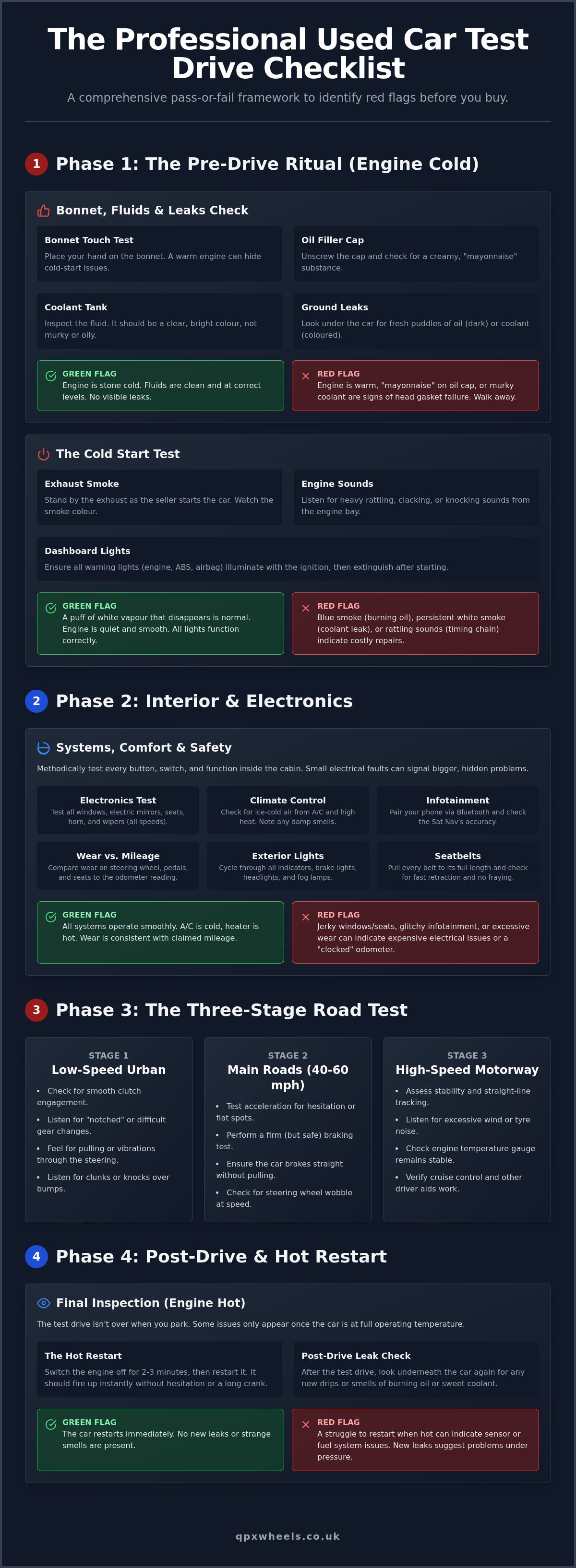
Varied Road Testing: The Three-Stage Route
A common mistake many buyers make is simply driving around the block and calling it a day. To truly understand how to test drive a used car properly, you need to subject the vehicle to three distinct environments. Each stage reveals different potential faults that a simple lap of the neighbourhood will inevitably miss. Before you set off, kindly ask the seller for a few minutes of silence. Switch off the radio and stop talking. This isn't a social occasion; it's a technical evaluation. You need to hear every whir, click, and hum the car makes without distraction.
Planning your route in advance ensures you cover urban streets, faster dual carriageways, and a quiet area for low-speed manoeuvres. If the seller insists on a specific, short route, treat it as a red flag. A healthy car should be able to handle twenty minutes of varied driving without any issues appearing on the dashboard or under the bonnet.
Low-Speed Manoeuvres
Stage one is the urban test. Focus on frequent gear changes and constant clutch work in stop-start traffic. Find a quiet car park or a wide cul-de-sac to perform a three-point turn. As you turn the steering wheel to its full extent, known as full lock, listen for a rhythmic clicking or popping sound. This usually indicates a failing Constant Velocity (CV) joint. Test the reverse gear and ensure any parking sensors or rear-view cameras activate immediately without glitches. Finally, find a slight incline to test the handbrake. It should hold the car firmly without requiring you to pull the lever to the very top of its travel or pressing an electronic button multiple times.
High-Speed Stability
Stage two takes you onto a motorway or dual carriageway. Safely accelerate to the national speed limit. At 60 or 70mph, listen for excessive wind whistling around the door seals or annoying trim rattles that only appear at pace. The steering wheel should remain perfectly still. Any vibration at high speed often suggests the wheels are out of balance or the tyres have developed flat spots from sitting idle. Keep a close eye on the temperature gauge whilst the engine is under load. It should sit steadily in the middle of the range. If it starts to creep towards the red zone, the cooling system is likely failing. If you'd rather avoid the stress of these technical checks, you can buy cars from our vetted selection, where every vehicle has already passed our professional 39-point inspection.
Final Checks and the Post-Drive Inspection
The test drive has finished, but your evaluation isn't quite over. Many mechanical faults only reveal themselves once the metal components have expanded and the fluids have reached their full operating temperature. This final phase is just as important as the drive itself. It's the moment when a car that seemed perfect on the road might finally show its true colours.
One of the most overlooked steps in learning how to test drive a used car properly is the "hot restart." Turn the engine off, wait for a minute or two, and then fire it up again. A car that starts perfectly when cold but struggles to fire when warm often has underlying issues with its starter motor, fuel injectors, or crankshaft sensors. It's a simple test that can save you a significant amount of money and frustration later on.
Whilst the engine is still running, open the bonnet one last time. You are looking for fresh leaks that weren't visible when the engine was cold. Use your nose as much as your eyes. A sweet, syrupy smell points towards a coolant leak, whilst a sharp, acrid scent suggests oil is dripping onto a hot exhaust manifold. Carefully loosen the oil filler cap whilst the engine is idling. If the cap is under heavy pressure or you see significant smoke puffing out, the engine may have "blow-by," which is a sign of internal wear.
The Hot Check
Park the car on a clean patch of tarmac and wait five minutes. Check the ground underneath for any fresh drips of oil or colourful coolant. You should also listen for the cooling fan. It should kick in automatically as the car sits stationary to prevent the temperature gauge from creeping into the red. If the fan fails to engage, you risk a major overheat the first time you are stuck in a traffic jam. Verify that the heater still blows hot air, as a sudden drop in heater temperature can indicate an air lock or a failing water pump.
Buying with Professional Assurance
A DIY checklist is a fantastic tool for filtering out the obvious duds, but it can't replace the depth of a professional evaluation. Some faults are buried deep within the vehicle's electronic control units or hidden behind under-trays that you simply cannot remove during a private viewing. At QPX Wheels, we use our 16 years of industry experience to handle the difficult parts for you. Every vehicle we sell undergoes a rigorous 39-point vehicle inspection to ensure it meets our high standards for safety and reliability. By choosing a specialist who offers nationwide delivery and RAC warranty options, you can skip the anxiety of the "private sale gamble" and buy with total confidence.
Drive Away with Total Certainty
You now possess the technical framework to distinguish a reliable vehicle from a costly mistake. By mastering the cold start ritual, the three-stage route, and the post-drive inspection, you've transformed the test drive from a simple journey into a scientific evaluation. Knowing how to test drive a used car properly is your strongest defence against hidden mechanical faults and seller pressure. It allows you to focus on the facts rather than the sales pitch.
If you would prefer to skip the uncertainty of private sales, we are ready to support you. QPX Wheels brings over 16 years of independent expertise to every transaction. We perform a rigorous 39-point vehicle inspection on all stock to ensure every car meets our high standards. We also offer nationwide delivery across the UK to make your buying journey as smooth as possible. Our goal is to handle the complexities so you can focus on the excitement of your new purchase.
Browse our quality-assured used cars with a 39-point inspection today
Be patient in your search and stay focused on the details. You deserve a car that brings you peace of mind from the very first mile. Happy driving.
Frequently Asked Questions
Do I need insurance to test drive a used car?
You must have valid insurance to drive any vehicle on a public road in the UK. Most dealerships provide blanket cover for customers during a viewing, but private sellers rarely have this facility. Always check if your own policy includes "driving other cars" cover, as this is often restricted to third-party only. For total peace of mind, you might consider a temporary one-day insurance policy to ensure you are fully protected.
How long should a proper used car test drive last?
A thorough test drive should last at least 20 to 30 minutes to ensure you cover enough ground. This duration allows the engine to reach its full operating temperature, which is essential for spotting cooling issues or "hot start" problems. It also gives you enough time to complete a varied route that includes both low-speed urban streets and higher-speed dual carriageways.
What should I do if I hear a strange noise during the test drive?
You should immediately note the specific sound and the conditions under which it occurred. Mention it to the seller straight away and observe their reaction; an honest seller will be open to discussing the issue. Don't ignore a noise just because the car feels good otherwise. If you aren't sure how to test drive a used car properly, use these sounds as a prompt to seek a professional second opinion before committing.
Can I test drive a used car if I only have a provisional licence?
You can legally test drive a car on a provisional licence, but it is often difficult to arrange in practice. You must be accompanied by a qualified driver, display L-plates, and ensure the insurance policy specifically covers a learner. Many private sellers and dealerships will decline these requests due to the higher insurance risks involved, so it's best to call ahead and check their specific requirements.
What are the biggest "red flags" during a test drive?
The most significant red flags include active dashboard warning lights, blue or thick white exhaust smoke, and a slipping clutch. You should also be wary if the seller has pre-warmed the engine before your arrival. These issues often point to expensive mechanical failures. If the car pulls hard to one side or the steering feels loose, it suggests serious suspension or tracking problems that require immediate and costly attention.
Is it okay to test drive a car in the rain?
It is perfectly fine to test drive in the rain, but you must be aware of the limitations. Wet weather is excellent for testing the wipers, demisters, and tyre grip on slippery surfaces. However, rain makes it much harder to spot oil leaks on the ground or imperfections in the bodywork. If it is pouring down, try to inspect the car's exterior under cover or return on a drier day for a final look.
Should I bring a mechanic with me to view a used car?
Bringing a qualified mechanic is a brilliant way to ensure you don't miss hidden faults. Whilst a DIY checklist is a great starting point, a professional has the tools and experience to spot issues like "masked" engine noises or structural damage. If you can't bring a friend, choosing a dealer like QPX Wheels ensures the car has already passed a professional 39-point vehicle inspection before you even see it.
What happens if I damage the car during a test drive?
If you are involved in an accident, the liability depends entirely on the insurance policy in place. If you are driving under a dealer's policy, you may only be responsible for the insurance excess. However, if you are on a private test drive without proper cover, you could be personally liable for the full cost of repairs and any legal consequences. Always clarify the insurance situation and the excess amount before you turn the key.


