
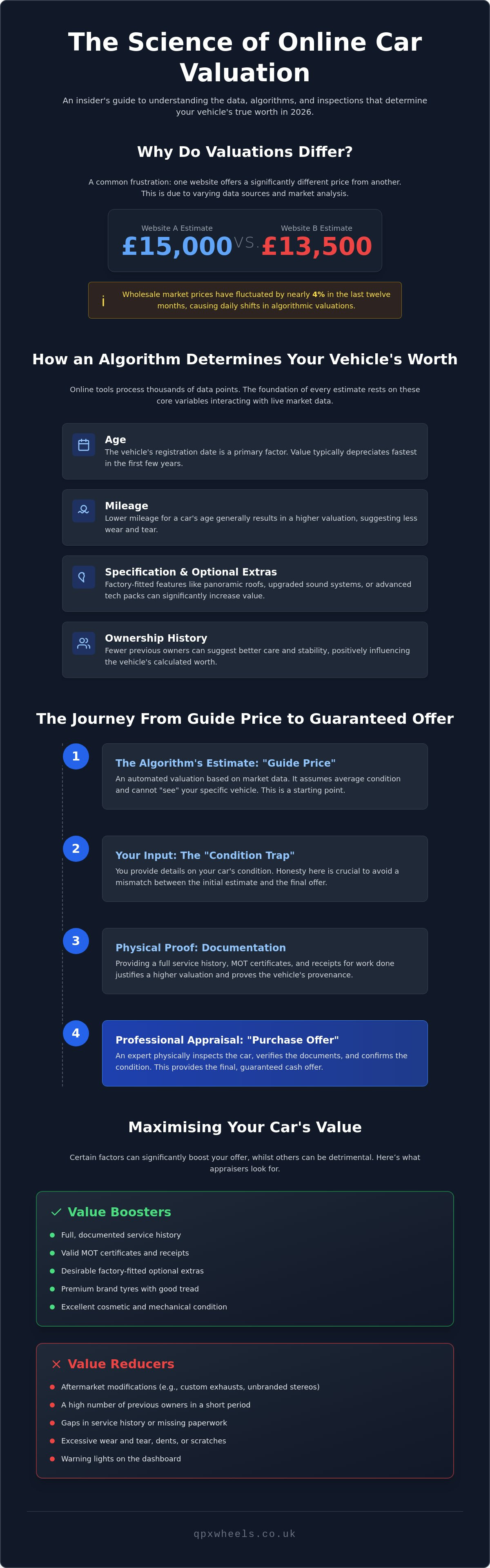
Why does one website tell you your car is worth £15,000 while another insists it's barely £13,500? It's a common frustration for motorists in 2026, especially when wholesale market prices have fluctuated by nearly 4% over the last twelve months. If you feel confused by conflicting estimates or technical jargon like 'CAP clean', you're not alone. Achieving true online car valuation accuracy can feel like a moving target when different digital tools rely on varying data sets, from auction results to local retail trends.
We understand that you want a fair price without the fear of hidden fees or last-minute haggling on your driveway. It's natural to feel anxious about the gap between a screen estimate and the actual money in your bank account. This guide bridges that gap by explaining the science behind digital appraisals and showing you how to prepare for a professional valuation. You'll discover which documents actually increase your car's worth and how to move smoothly from a digital quote to a reliable sale. By the end, you'll have a realistic expectation of your car’s value and the confidence to secure a deal that respects your vehicle's true condition and history.
Key Takeaways
- Understand the factors that influence online car valuation accuracy, including how real-time market data and different data providers cause estimates to vary between websites.
- Learn how algorithms weigh specific variables like mileage, age, and optional factory extras to calculate a digital starting point for your vehicle's worth.
- Avoid the common "condition trap" by providing a realistic assessment of your car or van to ensure your final offer matches the initial estimate.
- Discover why gathering physical documentation, such as MOT certificates and service history, is essential for justifying a higher valuation during the sale process.
- See how a professional human appraisal from an experienced dealer provides the finality and precision that a generic algorithm cannot offer.
Understanding Online Car Valuation Accuracy in 2026
An online car valuation is essentially an algorithmic prediction. It takes thousands of historical sales points and blends them with real-time market demand to estimate what your vehicle is worth. In 2026, online car valuation accuracy isn't a single, unmoving figure; it's a spectrum. You'll often encounter a "guide price" when you first enter your registration number. This is a helpful benchmark, but it differs significantly from a "purchase offer," which is the actual cash amount a buyer is willing to transfer to your bank account.
This distinction is driven by "Live Market Pricing." Technology now allows dealers and valuation platforms to track price shifts on a daily basis. If a specific model suddenly becomes popular or if auction supply drops, the algorithm adjusts instantly. Various Car valuation methods attempt to capture this volatility, but the result is only ever as good as the data fed into it at that specific moment. Understanding that the initial number on your screen is a starting point rather than a final guarantee is the first step toward a successful sale.
The Role of CAP HPI and Glass's Data
Most reputable UK valuation tools are powered by CAP HPI or Glass’s. These are the industry-standard databases that dealers have trusted for decades. They provide three distinct valuation tiers: trade, retail, and private sale. Trade value represents what a dealer expects to pay to stock the car, whilst retail is the price you'd see on a professional forecourt. Whilst these databases are incredibly robust, they have one major limitation: they cannot "see" your car. They know the average value of a 2022 hatchback with 30,000 miles, but they don't know if your vehicle has a full service history or premium brand tyres. This "blindness" to individual vehicle history is why online car valuation accuracy can sometimes waver until a human expert reviews the physical condition and paperwork.
Why Accuracy Matters for Your Next Purchase
Securing a precise valuation is a vital step in your financial planning. If you're looking to buy cars or vans using Hire Purchase (HP) or PCP finance, an inaccurate estimate of your current vehicle can lead to negative equity. This occurs when the remaining loan balance is higher than the car's actual worth, making it difficult to settle the finance or trade up later. A realistic figure also simplifies the part-exchange process. When you have a clear understanding of your car's value, you can negotiate your next deal with confidence. This ensures a smooth transition from your old vehicle to your new one without any hidden financial shocks or last-minute changes to your monthly payments.
How Data Algorithms Determine Your Vehicle's Estimated Worth
Algorithms are essentially digital calculators that process thousands of transactions to find a pattern. The 'Big Three' variables of age, mileage, and specification form the foundation of every estimate. However, online car valuation accuracy relies on how these figures interact with real-time supply and demand. For instance, if wholesale prices for used vehicles rise by 3.8% compared to the previous year, as seen in early 2026, the algorithm must adjust upwards immediately to reflect what buyers are actually paying at auction.
Ownership history also plays a significant role in the final calculation. An algorithm typically assumes a standard number of previous owners for the car's age. If your vehicle has had four owners in just two years, the predicted value often drops because the data suggests a potential underlying issue or a lack of long-term care. For used vans, the criteria shift toward utility. Payload capacity, the presence of ply-lining, and whether the vehicle was used for heavy site work carry more weight than the aesthetic features that a passenger car buyer might favour.
The Importance of Specification and Optional Extras
A 'premium' pack can add hundreds, or even thousands, to a car's worth. Factory-fitted features like panoramic roofs, upgraded sound systems, or advanced driver assistance tools are logged by the algorithm via the car's original build data. It's vital to distinguish these from aftermarket modifications. Whilst a factory-fitted sat-nav improves value, an unbranded stereo or custom exhaust often has the opposite effect, as it narrows the pool of potential buyers. If you're unsure how your car's specific features impact its worth, using a dedicated vehicle valuation service can help clarify the difference between standard and optional equipment.
Market Trends and Seasonal Behaviour
Consumer behaviour follows a predictable, seasonal rhythm that algorithms track closely. Convertibles naturally see a price surge in spring, whilst 4x4s become highly sought after amongst the colder winter months. The release of new registration plates in March and September also creates a ripple effect; as new cars hit the road, the supply of part-exchanged used vehicles increases, often causing a slight dip in used values. External factors like fuel price volatility further complicate the data. In 2026, we've seen used EV values rise faster than traditional petrol models due to shifting demand and environmental regulations. These fluctuations mean an estimate from three months ago is likely outdated today.
The Accuracy Gap: Why Estimates Vary Between Valuation Platforms
It is common to see a £2,000 difference between two websites for the same vehicle. This discrepancy happens because platforms use different data engines to power their tools. Some rely heavily on auction feeds, whilst others integrate retail listing data or proprietary transaction histories from their own dealer networks. These distinct "lenses" mean that online car valuation accuracy is rarely consistent across the web. A tool focused on retail prices might give you a higher figure, but it doesn't always reflect what a buyer will actually pay in cash today.
Then there is the 'Condition Trap'. Almost every automated tool defaults to a 'Good' or 'Clean' condition setting. In the real world, very few used cars are truly perfect. A single alloy scuff or a small dent on a door panel can immediately invalidate an online estimate. If the site assumes your car is showroom-ready, the gap between the screen price and the final offer will naturally be wider. You should also consider the platform's motivation. Independent guides aim for statistical neutrality, but dealer-backed tools are often designed for lead generation. A site might show an optimistic figure just to encourage you to leave your contact details, leading to disappointment when a physical inspection brings the price back to reality.
Subjective Factors Algorithms Can't See
Algorithms are blind to the "smell test." If a previous owner was a heavy smoker or regularly transported wet dogs, the interior can require professional deep-cleaning or even new upholstery. This can knock hundreds off a vehicle's trade value. Tyre quality is another blind spot. A professional appraiser looks for a matching set of premium brands like Michelin or Continental. If your car has a "budget mix" of four different cheap tyres, it signals a lack of maintenance that an algorithm simply won't catch. Minor damage is also a point of contention. A tool might ask if there are "scratches," but it cannot distinguish between a light surface mark that polishes out and a deep gouge that requires a full panel respray.
The Service History Multiplier
Documentation is the most powerful tool for improving online car valuation accuracy. A Full Service History (FSH) proves the vehicle has been cared for according to the manufacturer's schedule, which significantly boosts buyer confidence. For luxury or high-performance models, stamps from a 'Main Dealer' are particularly prized amongst buyers and can be the difference between a quick sale and a car that sits on the forecourt for weeks. The FSH premium is a critical factor in 2026 valuations, representing the significant percentage of value added to a car when its maintenance is fully and professionally documented. Without these records, even the most pristine-looking car is treated as a risk by professional buyers.
Practical Ways to Ensure Your Valuation Is as Precise as Possible
You have more influence over the final figure than you might think. Whilst algorithms do the heavy lifting, the data you provide determines the quality of the output. To maximise online car valuation accuracy, you must be brutally honest about your vehicle's condition. If you overlook a dent or a cracked light, a buyer will surely find it during the physical inspection. This often leads to "price-chipping," where the initial offer is reduced significantly at the point of sale. Entering your mileage to the exact digit, rather than rounding to the nearest thousand, also ensures the algorithm uses the most precise depreciation curve for your specific car or van.
Cleaning the vehicle thoroughly before any professional or digital photo-based appraisal is another vital step. A clean car suggests a careful owner. It allows the buyer to see the true state of the paintwork and interior without the distraction of road grime or personal clutter. When you provide clear, honest information from the start, you build a foundation of trust that makes the transition from an estimate to a bank transfer much faster and less stressful.
Documenting Your Vehicle's Pedigree
Paperwork acts as the physical proof of your car's history. A professional buyer looks for a valid MOT with at least six months remaining; anything less suggests a looming expense for the next owner. You should also present your V5C logbook clearly to prove ownership and verify the number of previous keepers discussed earlier. Don't forget the spare key. In 2026, a missing modern car key can cost hundreds of pounds to replace and reprogramme, so having both sets is essential for securing a top-tier valuation. Collecting every repair receipt and service stamp builds a narrative of care that justifies a higher price.
The 'Curb Appeal' Factor
First impressions matter even in a professional transaction. A vehicle that arrives covered in mud or filled with litter suggests it hasn't been well-maintained mechanically either. A professional valet often pays for itself by increasing the perceived value of the car. Pay special attention to the boot and the engine bay. A clean engine bay allows a buyer to see that there are no active oil leaks or neglected components. When it comes to minor repairs, consider if a small investment in a "smart repair" for a scuffed alloy might prevent a much larger deduction from your offer. Ready to see what your vehicle is worth? Use our vehicle valuation service to get a fair, transparent offer today.
Beyond the Algorithm: The QPX Wheels Professional Valuation Service
An online estimate is a helpful starting point, but it's only the first chapter of the story. To achieve total online car valuation accuracy, you need a human eye that understands the nuances of the current market. At QPX Wheels, we bring over 16 years of industry experience to the table. We don't just rely on cold data; we look at the specific care you've given your vehicle. This transition from a digital estimate to a guaranteed professional offer ensures you aren't left guessing what the final figure will be when it's time to sign the paperwork.
Our service is designed to be as straightforward as possible. Whether you're selling a luxury car or a budget-friendly van, we provide a fair and transparent appraisal that reflects the real-world condition of your vehicle. We also understand that getting your vehicle to a dealership can be a hurdle. That's why we offer a nationwide delivery and vehicle acquisition service. We can collect your car or van from your home or workplace, regardless of your location, making the entire transaction efficient and stress-free.
Settling Finance and Part-Exchange
One of the most complex parts of selling a car is dealing with outstanding debt. Many motorists feel trapped by existing Hire Purchase (HP) or PCP finance agreements. We specialise in simplifying this process. Our team can work directly with your finance provider to settle the remaining balance using your car's value. If there's equity left over, it can go straight into your bank account or serve as a deposit for your next vehicle. This approach removes the administrative burden from your shoulders and ensures a clean break from your old contract.
If you're looking for a replacement, part-exchanging with us is a seamless option. Every vehicle we sell is HPI-clear, giving you peace of mind that your next car or van has no hidden history or legal issues. We pride ourselves on transparency, which means you won't encounter any unexpected 'admin fees' or hidden costs when we buy your vehicle. The price we agree on is the price you receive, allowing you to plan your next purchase with total confidence.
A Trusted Partner for Your Next Move
We view ourselves as more than just a dealership; we're a seasoned guide in your automotive journey. Our commitment to a customer-centric atmosphere is built on a long-term reputation within the local community and across the UK. We handle the complexities of the transaction, from the final V5C transfer to finance settlement, so you don't have to. It's about providing a supportive environment where you feel confident in every decision without the pressure of aggressive sales tactics.
Getting started is simple. If you've already checked your initial estimate and gathered your documents, the next step is a professional appraisal that provides the finality an algorithm cannot offer. We're here to help you move forward with clarity and reliability. Get a fair, professional valuation for your car or van from QPX Wheels today.
Securing Your Vehicle's True Value with Confidence
Achieving online car valuation accuracy is about understanding that a digital estimate is a compass, not a final destination. You've seen how algorithms track market shifts and how being honest about your vehicle's condition prevents disappointment later. By gathering your full service history and presenting a clean car or van, you ensure that the gap between your screen price and a real-world offer remains as narrow as possible.
At QPX Wheels, we use our 16 years of automotive expertise to provide the human element that data alone cannot match. We specialise in both cars and vans, handling everything from finance settlements to nationwide collection with total transparency. Our no-obligation appraisals are designed to give you a fair price without the stress of hidden fees or high-pressure tactics. Whether you're trading in a luxury model or a reliable budget automatic, we're here to support your next move.
Sell your car or van for a fair price with a QPX Wheels professional valuation.
We look forward to helping you move onto your next vehicle with the clarity and professional care you deserve.
Frequently Asked Questions
Why is my online car valuation lower than I expected?
Estimates are often lower because algorithms default to a trade value that accounts for a dealer's preparation costs and eventual profit margin. They also assume your car has some standard wear and tear. If your expectation is based on retail forecourt prices, you'll naturally see a gap. The screen price is a general starting point, whereas a physical appraisal considers the unique maintenance and care you've provided.
How often do online car valuation prices change?
Valuation prices can shift daily in response to Live Market Pricing data. In 2026, wholesale prices have shown volatility, sometimes moving by nearly 4% in a single year. Algorithms track auction results and dealer demand in real time, meaning a quote you received last month may no longer be valid. It's always best to get a fresh estimate when you're actually ready to sell.
Does a car's colour really affect its valuation accuracy?
Colour plays a significant role in market desirability and can influence online car valuation accuracy. Neutral shades like black, grey, and white are easier for dealers to sell and typically hold their value better. Whilst a bright or unusual colour might be your personal favourite, it narrows the pool of potential buyers, which often leads to a lower offer compared to a vehicle with a more conventional finish.
Is a dealer valuation more accurate than an online estimate?
A professional dealer valuation is always more precise because it moves beyond statistical averages to look at the physical reality of the vehicle. Online tools can't detect a smooth engine or a pristine interior. By choosing a professional appraisal, you ensure that the final offer reflects the true condition of your car, bridging the gap between a generic digital estimate and a guaranteed cash price.
Can I get an accurate valuation for a used van online?
You can get a digital estimate for a van, but online car valuation accuracy for commercial vehicles depends on specific utility factors. Algorithms look at payload capacity and wheelbase, but they often miss whether a van has been ply-lined or used for heavy site work. A human expert understands these nuances better, ensuring that a well-maintained work vehicle receives a fair price that reflects its true earning potential.
What documents do I need to confirm my car's valuation?
You'll need the V5C logbook, a valid MOT certificate, and a complete service history to confirm the highest possible value. Receipts for recent repairs or new tyres also help justify a better price. Don't forget to bring any spare keys and the locking wheel nut key. Having this paperwork organised shows a professional buyer that the vehicle has been cared for properly throughout its life.
How does high mileage specifically impact my car's worth in 2026?
High mileage increases the predicted wear on mechanical components, which triggers a steeper depreciation curve in the algorithm. In the 2026 market, whilst there is strong demand for affordable older vehicles, cars that have exceeded the expected annual average are still valued lower. This is because buyers factor in the increased likelihood of upcoming maintenance costs for items like cam belts, clutches, or suspension components.
Will modifications like alloy wheels increase my car's valuation?
Aftermarket modifications rarely increase a car's valuation and can actually decrease it. Whilst you might have spent a significant amount on custom alloy wheels or a loud exhaust, these changes often narrow the vehicle's appeal to a very specific audience. Professional buyers and algorithms generally prefer factory-standard specifications. If you've kept the original parts, it's often better to refit them before seeking a valuation to ensure the widest market appeal.


