
The most advanced cruise control isn’t automatically the best fit for your driving. If you’re searching for used cars with cruise control UK, start with the roads you use most: steady motorway journeys call for different support from mixed town and A-road driving.
Cruise control can make longer journeys more comfortable, but standard cruise control and adaptive cruise control work differently. A listing may not tell the whole story because equipment can vary by model year, trim and optional specification.
This guide explains the differences, helps you match a system to your regular journeys and gives you a practical checklist for verifying that the feature is fitted and works as expected. QPX Wheels offers pre-owned cars to compare, nationwide delivery, HP and PCP finance options, and optional extended warranties. Use the guidance below to build a shortlist based on the car’s actual specification, not guesswork.
Key Takeaways
- Match the cruise-control system to your regular journeys rather than choosing the most advanced option by default.
- Understand how standard cruise control differs from adaptive cruise control, particularly how each handles traffic ahead.
- When comparing used cars with cruise control UK, treat model examples as starting points and verify the specific vehicle’s year, trim and equipment.
- Use a simple check before choosing: review the listing, verify the specification, identify the controls and ask for a demonstration.
- Once you’ve set your priorities, browse QPX Wheels used-car stock and consider nationwide delivery, HP or PCP finance, and optional extended warranties.
What is cruise control in a used car, and who is it for?
Cruise control is a driver aid that keeps the car travelling at a speed you select, when road and traffic conditions allow. It can reduce the need to hold the accelerator down on a steady journey, but it doesn’t make the car self-driving. The driver must stay alert, steer, manage the vehicle and choose a safe speed throughout.
For an overview of the basic system, see What is cruise control? The feature may suit drivers who regularly travel on flowing roads and want help maintaining a consistent speed. It may be less useful if most journeys involve frequent stops, changing speed limits or busy traffic. When looking at used cars with cruise control UK, consider your typical journeys first, then identify the system and controls that fit them.
Cruise control is an aid, not a substitute for judgement. The driver remains responsible for steering, paying attention and keeping to a suitable speed. Be ready to slow down or disengage the system if traffic, weather or the road layout changes. A selected speed won’t necessarily be appropriate for every stretch of road, even if the car can maintain it.
- Regular, flowing journeys: maintaining a chosen speed may reduce the need for constant accelerator adjustments.
- Mixed or stop-start driving: repeated braking and speed changes can leave fewer opportunities to use cruise control comfortably.
- Changing conditions: the driver still needs to respond to traffic, road signs and hazards.
What is the difference between cruise control and speed limiters?
Cruise control maintains a selected speed. A speed limiter sets a ceiling that the car shouldn’t exceed under normal operation. With cruise control, the driver usually selects a target speed and can adjust or cancel it using the vehicle’s controls. With a limiter, the driver continues to control the accelerator, while the system helps keep speed below the chosen maximum. Buttons, switches and cancellation methods vary, so use the handbook to identify the layout in a particular car.
When can cruise control make driving more comfortable?
Cruise control is commonly suited to steady-speed roads where traffic and conditions allow the car to maintain a consistent pace. On a long, flowing journey, this can mean fewer accelerator adjustments. In stop-start traffic, frequent changes in speed may make the system less practical. Follow road signs and remain attentive whilst it’s active. If conditions call for a different speed or more direct control, adjust or cancel the system as appropriate.
Standard cruise control vs adaptive cruise control: what changes?
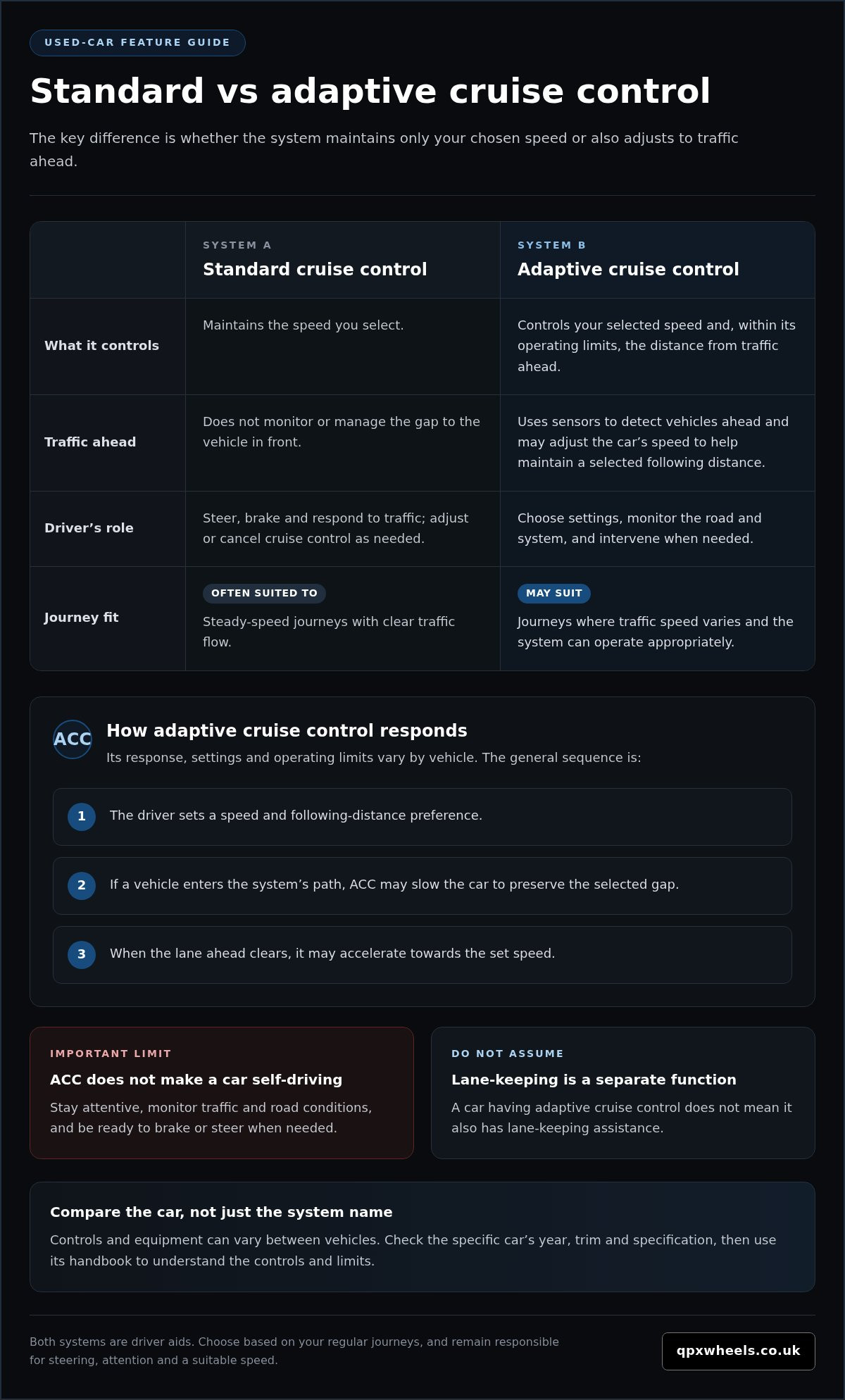
The main difference is whether the system responds only to your chosen speed or also adjusts to traffic ahead. Standard cruise control holds a set speed, but doesn’t monitor or manage the gap to the vehicle in front. Adaptive cruise control (ACC) can change the car’s speed to help maintain a selected following distance, within the system’s operating limits.
| System | What it controls | Driver input | Typical use |
|---|---|---|---|
| Standard cruise control | Maintains the speed you select | Driver steers, brakes and responds to traffic, adjusting or cancelling cruise control as needed | Steady-speed journeys with clear traffic flow |
| Adaptive cruise control | Selected speed and, within its operating limits, distance from traffic ahead | Driver chooses settings, monitors the road and intervenes when needed | Journeys where traffic speed varies and the system can operate appropriately |
ACC uses sensors to detect vehicles ahead and may slow the car if traffic is moving more slowly, then increase speed again as the gap opens. Its response and settings vary by vehicle. The system may not respond to every situation, so the driver needs to assess its behaviour and take control when necessary.
How does adaptive cruise control respond to traffic?
After the driver sets a speed and following-distance preference, sensors help the car identify traffic ahead. If a vehicle enters the system’s path, ACC may reduce speed to preserve the selected gap. When the lane ahead clears, it may accelerate towards the set speed. Controls, settings and operating limits differ between vehicles, so learn how the system works in the specific car.
Does adaptive cruise control mean the car drives itself?
No. Adaptive cruise control assists with speed and following distance; it doesn’t remove the need for an attentive driver. Keep monitoring traffic, road conditions and the system’s behaviour, and be ready to brake or steer as the situation requires. Lane-keeping assistance is a separate function, so don’t assume a car has it just because it has ACC.
That distinction matters when comparing used cars with cruise control UK. A driver who mainly wants to maintain a steady speed may find standard cruise control meets their needs, whilst someone who encounters variable traffic may value ACC’s speed adjustments. Neither system replaces safe driving. The vehicle’s handbook explains the controls and limits for that specific system.
Once you’ve decided which level of assistance suits your journeys, you can browse QPX Wheels used cars as part of your comparison. Check each vehicle’s specification rather than assuming a model or trim always includes the same system.
How to compare used cars with cruise control in the UK
Start with the journeys you make most, then compare individual vehicles against that pattern. A motorway commuter may value steady-speed assistance, while a driver who spends more time in changing traffic may want to investigate adaptive cruise control. Neither system should outweigh practical needs such as cabin space, ease of access, visibility and seating comfort.
Use this table to organise your shortlist. The verification column is important: a model name alone doesn’t establish which equipment a particular used car has.
| System type | Journey fit | Vehicle specification | Verification needed |
|---|---|---|---|
| Standard cruise control | Steady-speed journeys where traffic and road conditions allow | Check the individual car’s year, trim and listed equipment | Confirm it’s fitted and identify the controls |
| Adaptive cruise control | Journeys where traffic speed varies and the system can operate appropriately | Check that ACC is specified for that exact vehicle | Verify its functions and settings for the car |
| No cruise control stated | Compare only if the rest of the vehicle suits your needs | Don’t infer equipment from a model name or appearance | Look for clear specification details before adding it to your shortlist |
Which car types might suit different journeys?
For motorway-heavy travel, consider whether maintaining a steady speed would be useful, then compare cars that also feel comfortable over longer distances. Family buyers might weigh passenger and luggage space; commuters may focus on comfort and how the vehicle feels in their regular traffic. There’s no universally best body style. Treat these as prompts for comparing individual vehicles, not assumptions about a particular car’s capabilities.
Think about the whole driving experience, too. A system that looks appealing on paper may matter less if the seating position, cabin layout or vehicle size doesn’t suit you. If possible, sit in the car and assess whether its controls feel clear and accessible.
Why do trim and model year matter?
Equipment can differ between trims and model years, and optional specifications may affect what an individual car includes. A model name is only a starting point. For instance, cinch’s guide discusses the Hyundai IONIQ 6, Range Rover Velar and Kia Sportage as model examples, but that doesn’t mean every year or trim of those cars has adaptive cruise control. These examples also don’t indicate that any of those cars are in QPX Wheels stock.
For each candidate, compare its registration, model year and trim with the vehicle’s own listing and specification. Record the exact system named, rather than writing simply “cruise control”, and note any details to clarify during your checks. This makes it easier to compare used cars with cruise control UK by verified equipment as well as comfort and suitability. You can browse QPX Wheels used cars when you’re ready to build a shortlist.
How to check cruise control on a used car before choosing it
A listing is a useful starting point, but a few careful checks can establish whether the exact car has the system you want and how it operates. When comparing used cars with cruise control UK, verify the specification before relying on a button, dashboard symbol or model name alone.
- Read the listing closely. Look for precise wording such as “cruise control” or “adaptive cruise control”. If it only says “driver assistance” or uses another broad description, don’t assume which function is included.
- Cross-check the vehicle specification. Compare the car’s registration, model year and trim with its documented equipment. This helps distinguish a feature fitted to that particular vehicle from one offered on other versions of the same model.
- Locate the controls. Check the steering wheel, nearby stalks and dashboard menus for cruise-control settings. Buttons may show a speedometer symbol or labels such as “SET” and “RES”, but layouts differ. Don’t treat an unfamiliar control as proof of a particular function.
- Ask for a demonstration. On a suitable road and in appropriate conditions, have the system demonstrated in line with the vehicle handbook. Observe how it’s set, adjusted and cancelled, and whether its behaviour matches the description. Don’t test it in unsuitable traffic or conditions.
What should you check in the listing and vehicle documents?
Match the feature name against the specific vehicle’s documented specification, including its model year and trim. Standard cruise control and adaptive cruise control aren’t interchangeable descriptions. If the wording is unclear, use the vehicle documentation to establish what that individual car is equipped with before treating it as a match for your shortlist.
What should you test during a viewing or test drive?
Use the handbook to learn how the controls set, adjust and cancel the system, and how to resume it where that function is available. A steering-wheel button or dashboard menu can help identify functions, but symbols vary. A missing symbol or unfamiliar control is a reason to verify the specification, not to guess. Keep your full attention on driving and be ready to take control.
During a safe demonstration, check that the system engages and disengages as described. If it’s adaptive, observe its response only when the road and traffic make this appropriate. Don’t create a situation to test its limits, follow another vehicle too closely or rely on the system to brake for you. The driver remains responsible throughout.
These checks help you compare the advertised feature with the controls and operation of the car itself. Browse QPX Wheels used cars and compare each vehicle’s stated specification with the system you’re looking for.
Find a used car with cruise control and choose your next step
You now have a practical way to compare systems and check a vehicle’s specification. Before deciding, bring the details together: choose the assistance level that suits you, match it to your regular journeys and verify it on the individual car. Then assess the vehicle as a whole. Cruise control is one part of the decision, alongside comfort, space, driving position and overall suitability.
Use this sequence to move from research to a considered shortlist:
- Set your priority: decide whether standard cruise control meets your needs or whether you’re looking for adaptive cruise control.
- Match your journeys: consider the roads and traffic you regularly encounter, and how often you’d realistically use the feature.
- Check each car: compare the specific vehicle’s registration, year, trim and documented equipment rather than relying on its model name.
- Assess the whole vehicle: weigh up comfort, space, condition and suitability alongside the cruise-control system.
How can you move from comparing cars to choosing one?
Keep a shortlist that records the feature stated for each vehicle, how well it suits your journeys and what you’ve verified. This makes differences easier to review without assuming that similar models have identical equipment. Browse QPX Wheels used-car stock, then assess each vehicle against your priorities rather than choosing on a feature label alone.
QPX Wheels has over 16 years of experience in the used-vehicle industry. A clear shortlist can help you focus on cars that meet your broader needs, then compare the exact specification of each candidate. That keeps the decision grounded in the vehicle itself, not simply the appeal of a single driver aid.
What purchase support can you consider?
Once you’ve identified a suitable vehicle, consider how you’d like to approach the purchase. QPX Wheels offers HP and PCP finance options, and nationwide delivery is available. Optional extended warranties are another separate consideration. Review the relevant details for each option as part of your decision, without treating finance or a warranty as a substitute for checking that the car suits you.
For buyers searching for used cars with cruise control UK, a confident choice comes from combining the feature check with the rest of the buying decision. Browse QPX Wheels used-car stock to explore available vehicles, then compare their individual specifications and suitability at your own pace.
Choose a car that fits your everyday life
The cruise-control system matters, but it’s only one part of living with a car. Before settling on a vehicle, consider the routines it needs to support: carrying passengers, managing regular parking, fitting luggage and staying comfortable on longer trips. A feature-focused search is a useful starting point; the right choice should also work for the rest of your life behind the wheel.
For your shortlist, note what each car offers and what you still want to experience for yourself. Consider the cabin, driving position and controls, as well as whether the vehicle’s overall size and layout work for you. This makes it easier to compare used cars with cruise control UK options on more than a single line in a specification.
QPX Wheels is an independent used-vehicle dealership with over 16 years of industry experience. Nationwide delivery, HP and PCP finance, and optional extended warranties are available as purchase considerations. Take the next step at a pace that feels right for you.
Browse used cars at QPX Wheels to explore available vehicles and compare which ones could suit your needs. Choose a car based on the journeys you actually make and the specification of the individual vehicle.
Frequently Asked Questions
Is cruise control worth having on a used car?
It can be worthwhile if you regularly drive on open roads where maintaining a steady speed is practical. For occasional short trips or routes with frequent junctions and changing conditions, you may use it less. Think about your own routine rather than treating cruise control as essential equipment. A feature is most useful when it suits your driving, and shouldn’t outweigh a car’s comfort, condition or everyday practicality.
Can I add cruise control to a used car that does not have it?
Possibly, but a retrofit depends on the particular car’s design, existing equipment and compatibility. It may involve more than fitting a switch, and the work could require electronic configuration as well as parts. Before buying a car on the assumption that you can add the feature later, establish whether a suitable retrofit is feasible and what it involves for that exact vehicle. Comparing factory-fitted options may be the simpler route.
What is the difference between cruise control and adaptive cruise control?
Standard cruise control maintains the speed selected by the driver; it doesn’t adjust the gap to traffic ahead. Adaptive cruise control can alter speed in response to a vehicle in front and a chosen following distance, within the system’s limits. For example, if traffic slows, ACC may slow the car too. Both systems require the driver to monitor the road and intervene when needed.
How do I know if a used car has adaptive cruise control?
Look for “adaptive cruise control” or “ACC” in the specification for the exact car, not just a general mention of cruise control. Then compare the registration, model year and trim with the vehicle’s documents. Steering-wheel buttons, dashboard menus or a following-distance setting may offer clues, but controls differ. If the wording or symbols are unclear, rely on the car’s documentation rather than guessing.
Can you use cruise control in heavy traffic or bad weather?
It’s generally less suitable when traffic is repeatedly slowing and stopping, as you may need to brake or adjust speed often. Poor weather can also affect visibility, road grip and, on some cars, the sensors used by adaptive systems. Follow the handbook’s guidance, keep a safe distance and cancel the system if conditions make its operation uncertain. The driver remains responsible for responding to changing hazards.
Does adaptive cruise control include lane-keeping assistance?
No, adaptive cruise control and lane-keeping assistance are separate driver-aid functions. ACC manages speed and distance from traffic ahead, while lane assistance may help the car remain within lane markings, depending on the system fitted. A vehicle could have one, both or neither. Check the individual car’s specification for each function, and don’t assume that an ACC label means the car can steer itself.
What should I check when test-driving a used car with cruise control?
Before moving off, identify the controls and use the handbook to understand how the system is set and cancelled. During a suitable drive, check that the displayed setting matches your input and that cancelling the system returns control as expected. When comparing used cars with cruise control UK, also consider whether the controls are easy to use without taking attention from the road. Don’t test the system in unsuitable traffic or weather.


