
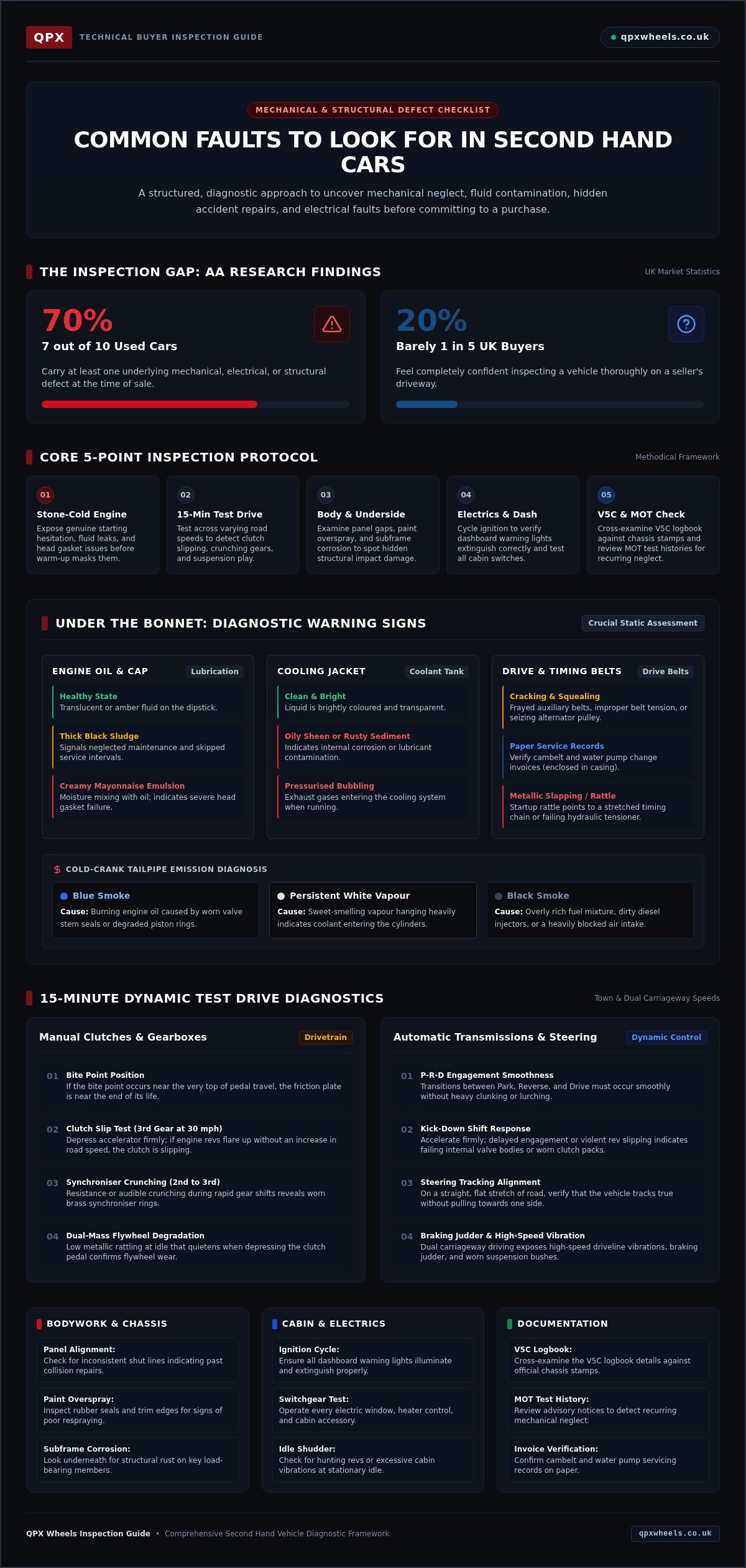
Research by the AA reveals that seven out of ten used cars carry at least one underlying defect, yet barely one in five UK buyers feels completely confident inspecting a vehicle. Knowing the common faults to look for in second hand cars makes the difference between securing a dependable daily runner and inheriting someone else's expensive mechanical trouble.
Standing on a seller's driveway can feel daunting, especially when polished paintwork easily masks worn suspension bushes, fluid leaks, or an ageing clutch. It's completely natural to worry about hidden defects, high-pressure viewings, or making sense of an unfamiliar MOT history. A thorough, methodical approach quickly removes that uncertainty.
You don't need a mechanic's qualification to protect your hard-earned money. In this complete guide, you will discover how to systematically inspect bodywork, evaluate the engine and gearbox, and verify vital legal paperwork, giving you the confidence to negotiate fairly or walk away from a bad deal.
Key Takeaways
- Always begin your inspection with a stone-cold engine to expose genuine starting hesitation, fluid leaks, and telltale head gasket contamination.
- A structured 15-minute test drive across varying road speeds allows you to detect clutch slipping, gearbox crunching, and worn suspension components.
- Checking panel alignment, paint overspray, and subframe corrosion reveals structural issues amongst the most common faults to look for in second hand cars.
- Cycle the ignition and test every cabin switch to verify that dashboard warning lights behave correctly and electrical conveniences function without glitching.
- Cross-examine the V5C logbook against official chassis stamps and review MOT test histories to avoid hidden accident damage or persistent mechanical neglect.
Under the Bonnet: Engine Faults and Fluid Warning Signs
A thorough engine bay assessment is the cornerstone of spotting mechanical neglect. Before you touch an ignition key, place your hand directly onto the engine block to confirm it is completely stone-cold. Sellers sometimes warm up troubled vehicles beforehand to mask rough cold idling, weak batteries, or starter motor hesitation. Catching these warning signs early highlights the vital common faults to look for in second hand cars before you commit to a purchase.
Fluid Checks: Oil, Coolant, and Emulsion Contamination
Pull the dipstick first. Fresh oil should appear amber or translucent, whilst thick, black sludge signals skipped service intervals. Next, unscrew the oil filler cap. A creamy, mayonnaise-like emulsion underneath the cap or on the dipstick indicates moisture mixing with lubricant, pointing towards severe head gasket failure. Check the translucent coolant expansion tank without opening it if hot; the liquid should be clean and brightly coloured. An oily sheen, brown rusty sediment, or pressurised bubbling when running suggests exhaust gases entering the cooling jacket. Finally, shine a torch down into the engine bay to check for active fluid pooling on the undertray.
Cold-Start Behaviour and Exhaust Smoke Diagnosis
During a methodical vehicle inspection, the initial cold crank provides vital clues about compression and fuelling health. Stand by the tailpipe while an assistant starts the ignition to observe the exhaust emissions immediately.
- Blue smoke: Signals burning engine oil, often caused by worn valve stem seals or degraded piston rings.
- Persistent white vapour: Differs from light morning condensation by smelling sweet and hanging heavily in the air, indicating coolant entering the cylinders.
- Black smoke: Points to an overly rich fuel mixture, dirty diesel injectors, or a blocked air intake.
Once fired up, the engine revs should settle smoothly into a steady, quiet idle without hunting up and down or shuddering through the cabin.
Timing Belts, Auxiliary Components, and Ancillary Wear
Examine any visible rubber auxiliary drive belts for lateral cracking, fraying edges, or uneven tracking across pulleys. High-pitched squealing suggests improper belt tension or an alternator pulley seizing up. Because timing belts sit enclosed behind protective casings, you must check paper service invoices to verify that scheduled cambelt and water pump changes were completed on time. Stand over the running engine and listen for sharp metallic ticking or harsh slapping noises from the timing cover. A loose rattle on startup indicates a stretched timing chain or failing hydraulic tensioner, which are catastrophic common faults to look for in second hand cars if left unaddressed.
Test Drive Diagnostics: Gearbox, Clutch, and Suspension Red Flags
A structured 15-minute test drive across varied road conditions is essential. Low-speed town driving tests clutch friction and gear selection, whilst a brief stretch on a dual carriageway exposes high-speed driveline vibrations. This dynamic assessment uncovers critical common faults to look for in second hand cars that remain completely undetectable while parked.
Assessing Manual Clutches and Gearbox Synchronisers
Begin with the car stationary. Depress the clutch pedal and engage first gear. If the bite point occurs near the very top of the pedal travel, the friction plate is near the end of its life. Once rolling in third gear at roughly 30 mph, depress the accelerator firmly. If the engine revs flare up without a matching increase in road speed, the clutch is slipping. Shift quickly between second and third gear during your drive; any resistance or audible crunching indicates worn brass synchroniser rings. Pay attention to any low metallic rattling at idle that quietens when you press the clutch down, as this points towards dual-mass flywheel degradation.
Automatic Transmission Symptoms: Hesitation and Jerking
Modern automatics should transition smoothly between Park, Reverse, and Drive without heavy clunking or lurching. On the move, gear changes ought to be almost imperceptible. Accelerate firmly to trigger a kick-down shift; any delayed engagement, slipping revs, or violent jerking reveals underlying trouble. While minor hesitation can occasionally stem from electronic calibration issues, harsh mechanical shudders usually indicate worn clutch packs or failing internal valve bodies.
Steering Pull, Braking Judder, and Suspension Noises
Find a straight, flat stretch of road to confirm the vehicle tracks true without pulling to one side. Apply the brakes firmly from 50 mph to check for steering wheel vibration or brake pedal pulsing, which indicates warped brake discs or sticking callipers. Pay close attention over potholes and speed humps. Dull thuds or metallic clunks typically reveal perished rubber bushes, split ball joint gaiters, or broken coil springs. When protecting your second hand purchase against unexpected steering and running-gear wear, opting for a reliable used vehicle inventory that has undergone thorough mechanical evaluation ensures you avoid inheriting neglected running gear.
Bodywork, Chassis, and Underside: Spotting Rust and Hidden Accidents
Natural daylight is your greatest ally when inspecting vehicle bodywork. Raindrops and artificial showroom spotlights easily conceal minor ripples, mismatched paint shades, and scratched clear coats. Walk slowly around the vehicle from several paces back, checking that the shut lines between the bonnet, wings, doors, and boot lid remain uniform. Uneven panel gaps are classic warning signs of past impacts or hastily fitted replacement panels, standing out amongst the most critical common faults to look for in second hand cars.
Detecting Past Accident Damage and Substandard Repairs
Crouch down at each corner and sight directly along the vehicle's flanks. Factory panels display a smooth, mirror-like reflection; rippled or wavy surfaces suggest extensive body filler beneath the paint. Open all four doors, the bonnet, and the tailgate to inspect the inner framework. Look out for rough spot welds, fresh sealant beads, or telltale paint overspray dusting the black rubber window seals and plastic wheel-arch liners. Inside the boot, lift the carpet to inspect the spare wheel well; creased metal floor pans indicate an unrepaired rear-end collision.
Structural Corrosion: Surface Rust versus Structural Failure
Differentiating harmless cosmetic blemish from MOT-failing corrosion requires getting low to inspect the chassis:
- Minor surface oxidation: Light, reddish-brown discolouration on exposed exhaust brackets or suspension arms is normal on UK roads and rarely affects safety.
- Perforating panel rust: Blistered or bubbling paint along outer wheel arches and lower door edges indicates corrosion pushing through from the bare metal behind.
- Structural subframe failure: Flaking, crumbly steel on chassis rails, jacking points, and suspension mounting points severely compromises crash integrity and results in an immediate MOT failure.
Tyre Tread Wear and Alignment Warning Indicators
Tyres reveal an accurate story of how well a car tracks on the road. The UK legal minimum depth is 1.6mm across the central three-quarters of the tyre tread, though replacement is strongly recommended once tread wears down to 3mm. Examine the tread wear profile evenly across the entire contact patch. Heavy wear on either the inside or outside shoulder points to misaligned wheel tracking or badly worn steering tie rods. Inspect the outer sidewalls carefully for structural bulges, deep cracks from perished rubber, or mismatched budget tyres on the same axle, which compromise emergency braking stability.
Interior, Dashboard Warnings, and Electrical System Checklist
Electrical and lighting defects account for almost 11% of all UK MOT test failures, making cabin diagnostics essential. Hidden wiring gremlins or disabled safety warnings can cost hundreds of pounds to trace and fix. Thoroughly evaluating the vehicle interior reveals crucial common faults to look for in second hand cars before you commit to buying.
Warning Light Sequences and OBD-II Fault Codes
Turn the ignition key to position two without starting the engine. Watch the instrument cluster closely. Critical warnings, including the Check Engine light, ABS, and airbag symbols, must illuminate and then extinguish independently after a few seconds or once the engine cranks. If the airbag light turns off at the exact millisecond as the oil light, a dishonest seller may have bridged the circuit behind the cluster to conceal an MOT-failing airbag fault. Plugging an inexpensive OBD-II scanner into the diagnostic port quickly reveals pending trouble codes or cleared fault histories.
Climate Control, Infotainment, and Cabin Electronics
Work methodically through every switch. Drop each electric window to its lowest point, adjust both door mirrors, and test the central locking mechanisms using both key fobs. Crank the air conditioning down to maximum chill; the compressor clutch should engage with a gentle click and blow genuinely cold air within 30 seconds. Run your hand across the front footwell carpets feeling for dampness. A wet footwell accompanied by a sweet, chemical odour signals a leaking heater matrix core, which requires an expensive dashboard removal to rectify.
Mileage Verification Through Interior Wear Indicators
A vehicle displaying 40,000 miles on the digital dash should not feature bald rubber pedal pads, a heavily polished steering wheel rim, or sagged seat bolsters. Discrepancies between low indicated mileage and heavily worn cabin touchpoints strongly suggest odometer clocking. Pull the driver seatbelt fully out to check the webbing for fraying and ensure the tensioner retracts crisply. If you want to bypass the risk of tracking down complicated cabin electrical faults, explore our pre-inspected second hand cars for complete reassurance on the road.
Documentation Red Flags and Protecting Your Second Hand Purchase
Mechanical health accounts for only half the battle. A vehicle can run smoothly during a short drive yet harbour severe legal or financial entanglements that make it an illegal purchase or leave you liable for an existing loan. Alongside mechanical issues, documentation irregularities represent some of the most overlooked common faults to look for in second hand cars.
V5C Logbook Checks and Online MOT History Auditing
Ask to inspect the original V5C registration certificate before discussing terms. Hold the document up to the light to confirm the genuine 'DVL' watermark running through the paper fibres. Check that the 17-character Vehicle Identification Number (VIN) printed on the logbook matches both the stamped plate beneath the windscreen and the chassis stamp under the bonnet. Use the official government website to audit its full MOT history. Pay close attention to repeated advisories across multiple years, sudden mileage drops between annual tests, or abrupt gaps indicating long periods off the road.
HPI Provenance Checks: Write-Offs, Theft, and Finance
Never rely solely on a seller's word regarding vehicle background. Run an independent provenance check using the registration plate to uncover critical hidden flags:
- Insurance write-off categories: Category S (structural) and Category N (non-structural) markers indicate past accident damage that insurers deemed uneconomical to repair.
- Outstanding finance: A car under an active Hire Purchase (HP) or PCP agreement remains the legal property of the finance company until settled in full.
- Stolen registers: If police stolen vehicle registers flag the chassis number, law enforcement will seize the vehicle without compensation.
Dealer Assurances: Multi-Point Inspections and Extended Warranties
Private sales operate under caveat emptor, meaning "buyer beware," where your legal remedies are minimal once money changes hands. Purchasing from a registered dealership offers statutory protection under the Consumer Rights Act 2015, requiring vehicles to be fit for purpose, of satisfactory quality, and accurately described. Reputable dealers carry out detailed multi-point mechanical inspections to address hidden wear before handover. To secure complete long-term peace of mind against mechanical breakdown, discover nationwide confidence with quality used cars and vans backed by comprehensive history checks and flexible extended warranties.
Drive Away with Absolute Mechanical Certainty
Equipping yourself with a methodical inspection process changes how you navigate the UK pre-owned market. By assessing cold engine fluids, testing driveline responsiveness under acceleration, and auditing the V5C logbook against official chassis stamps, you can easily identify the common faults to look for in second hand cars. Staying disciplined protects your hard-earned budget and ensures minor cosmetic imperfections never distract you from major mechanical flaws.
If crawling across cold driveways or deciphering complex diagnostic warnings feels overwhelming, you can take a simpler route. Backed by over 16 years of independent UK automotive industry experience, QPX Wheels removes the guesswork from your next purchase. Every car and van undergoes a rigorous multi-point mechanical inspection and comes completely HPI clear. Buyers enjoy total reassurance through flexible extended warranties and convenient nationwide doorstep delivery.
Take control of your motoring journey today. Browse fully inspected, warranty-backed used vehicles and find a dependable model you can drive away with complete peace of mind.
Frequently Asked Questions
What is the most critical mechanical fault to check for when buying a second hand car?
Catastrophic engine failure caused by head gasket breach or timing chain wear is the most critical issue. Unlike brake pads or suspension bushes, which are straightforward wear-and-tear items, internal engine failure frequently costs more to fix than the vehicle's market value. When identifying common faults to look for in second hand cars, always prioritise listening for metal rattles at startup and checking for coolant contamination over minor cosmetic flaws.
How can I tell if a used car has been involved in an undisclosed accident?
Look for uneven body panel gaps and mismatched paint finishes across adjacent panels. Check inner door frames and the boot floor under the spare wheel for distorted metal, non-factory seam welds, or overspray on rubber trim. Commissioning an independent provenance check is also vital, as it confirms whether insurers ever categorised the car as a Category S or N total loss write-off following a collision.
Can an OBD-II scanner detect previously cleared vehicle fault codes?
Yes, an OBD-II scanner can identify recently cleared codes by checking the vehicle's emissions readiness monitors. When a seller clears fault codes, the vehicle resets its internal diagnostic monitors to "not ready." The scanner flags these incomplete drive cycles immediately. It also detects permanent or pending trouble codes stored deep within the electronic control unit that have not yet illuminated the dashboard light.
What does mayonnaise-like sludge underneath the oil filler cap mean?
A creamy, mayonnaise-like emulsion usually signals moisture mixing with engine oil, pointing to a blown head gasket. However, cars driven exclusively on short urban journeys can also form harmless condensation under the cap. To differentiate, inspect the dipstick and coolant expansion tank. If the coolant looks oily or the dipstick oil appears milky, serious internal gasket failure is present rather than simple short-trip condensation.
Is white exhaust smoke normal when inspecting a used car on a cold morning?
Thin white vapour that vanishes quickly into the air is normal condensation burning off the cold exhaust system. In contrast, thick white clouds that linger and carry a sweet, chemical odour signify coolant leaking into the combustion chambers. If dense white smoke continues pouring from the tailpipe after the engine reaches operational temperature, walk away, as the vehicle likely requires major cylinder head repairs.
How do I know if an automatic gearbox is failing during a test drive?
Harsh jolts when selecting Drive or Reverse, delayed gear engagement, and erratic rev flares during acceleration are prime indicators of gearbox failure. The car should shift gears seamlessly without violent clunks or slipping revs. When evaluating common faults to look for in second hand cars, test kick-down acceleration at speed. Excessive shuddering or reluctance to change down signals degraded clutch packs or failing hydraulic valve bodies.
What are the main advantages of buying from a dealer rather than a private seller?
Purchasing through an established dealership provides statutory protection under the Consumer Rights Act 2015, whereas private sales are strictly "buyer beware." Reputable dealers conduct extensive multi-point mechanical checks to rectify defects before collection and verify vehicle provenance. You also benefit from options like tailored HP or PCP finance, flexible extended warranties, and convenient nationwide delivery, giving you total peace of mind on your purchase.


