
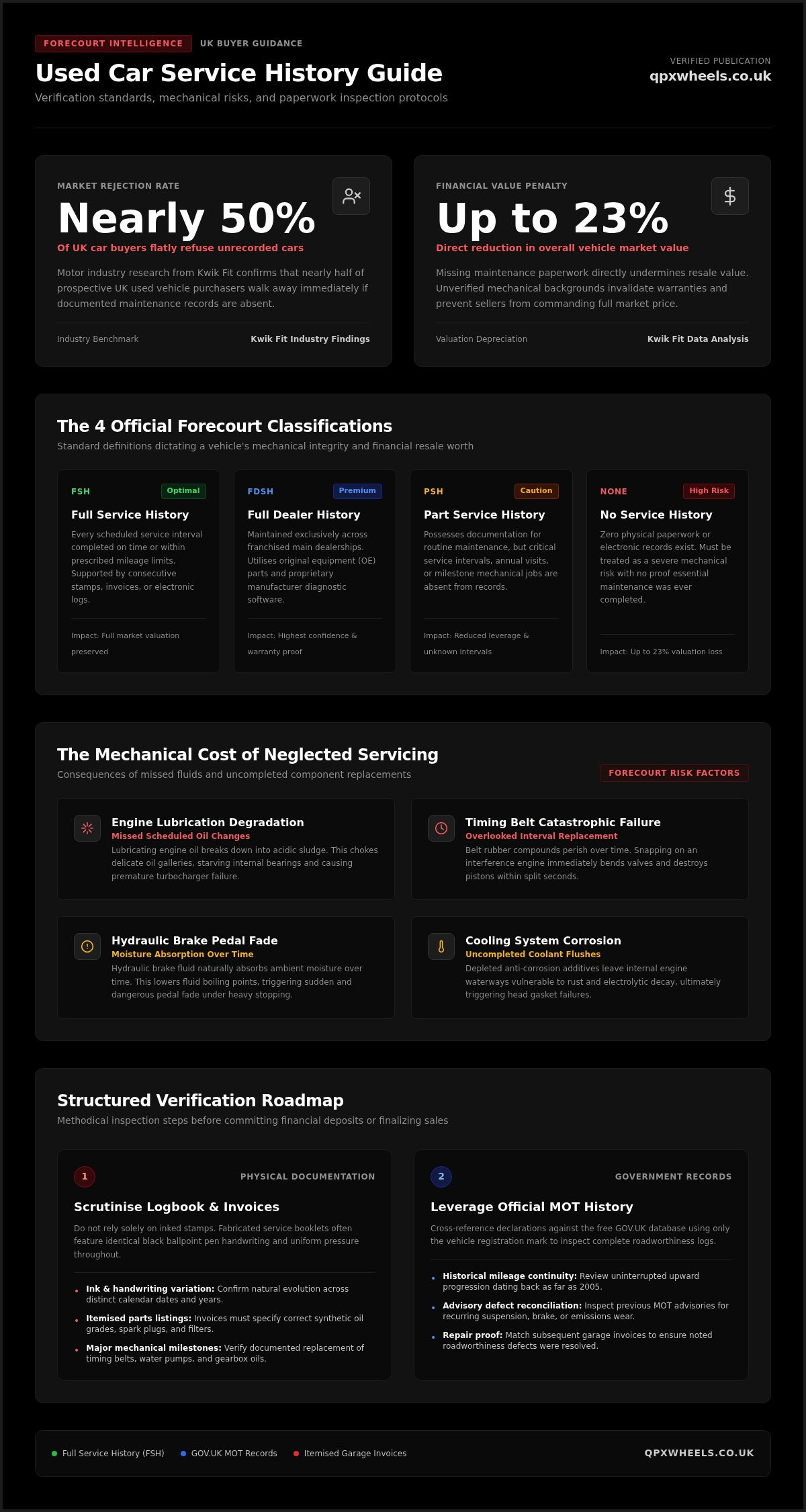
According to motor industry findings from Kwik Fit, nearly 50% of UK car buyers will flatly refuse to buy a vehicle that lacks documented maintenance records. If you feel uneasy about the risk of inheriting someone else's costly mechanical faults or a tampered odometer, you're certainly not alone. Sorting through missing paperwork and unverified dealer claims can feel overwhelming, which is why knowing how to check service history of a used car is the single most important skill you can bring to the forecourt.
A proper verification goes far beyond simply glancing at an inked stamp in a glovebox booklet. In this complete UK guide, you'll discover how to thoroughly verify digital manufacturer records, cross-reference official MOT logs with independent workshop invoices, and spot counterfeit paperwork before handing over any money. We'll give you a clear, methodical roadmap to inspect a vehicle's mechanical background, ensuring you have the confidence to negotiate fairly or walk away when something doesn't add up.
Key Takeaways
- Master the exact process for how to check service history of a used car across physical logbooks, digital portals, and supporting workshop invoices.
- Understand how to access and verify modern Digital Service Records (DSR), which have replaced traditional paper booklets across most vehicle manufacturers.
- Discover how to cross-reference recorded MOT test data with garage receipts to spot counterfeit service stamps and odometer clocking.
- Learn practical strategies for evaluating vehicles with incomplete maintenance logs, including when an independent mechanical inspection is vital.
- Gain the confidence to spot paperwork red flags early, giving you the leverage to negotiate fairly or walk away from high-risk purchases.
What Is Used Car Service History and Why Does It Matter?
A vehicle's service history is its permanent health record. It documents every scheduled oil change, safety inspection, fluid flush, and major component replacement carried out during its lifespan. Understanding this paperwork provides tangible proof that previous keepers treated the vehicle responsibly. It also forms the foundation for protecting future resale value; industry data from Kwik Fit shows that missing records can reduce a car's market value by up to 23%. Without verifiable documentation, securing warranty claims or validating mechanical integrity becomes nearly impossible.
The Four Main Service History Classifications
Classifications on forecourt listings directly dictate a car's mechanical standing and financial worth. Before learning how to check service history of a used car, you should familiarise yourself with these four standard definitions:
- Full Service History (FSH): Every scheduled service interval recommended by the manufacturer has been completed on time or within specified mileage limits, supported by consecutive stamps, invoices, or electronic logs.
- Full Dealer Service History (FDSH): Servicing has been carried out exclusively by franchised main dealerships, using original equipment parts and proprietary brand diagnostic software.
- Part Service History (PSH): The vehicle possesses documentation for some routine maintenance, but critical intervals, annual visits, or major milestone jobs are missing from the timeline.
- No Service History: Zero physical paperwork or electronic records exist. Treat this as a major mechanical risk, as there is no proof the vehicle ever received essential maintenance.
The Financial and Safety Impact of Neglected Servicing
Routine maintenance preserves component tolerances and mechanical safety. Skipping oil changes causes lubricating oil to degrade into acidic sludge, choking delicate oil galleries and triggering premature turbocharger or bearing failure. Overlooked timing belts present an even greater danger; rubber compounds perish over time, and a snapped belt on an interference engine inevitably bends valves and destroys pistons in seconds.
Checking service records also confirms that safety-critical hydraulic systems have received proper attention. Brake fluid absorbs ambient moisture over time, lowering its boiling point and causing sudden pedal fade under heavy braking. Documented coolant flushes prove the engine's internal waterways are protected against corrosion and head gasket failures. Knowing how to check service history of a used car ensures you don't inherit these expensive, hidden liabilities.
Step-by-Step Guide: How to Check Service History of a Used Car
Many online services prompt you to pay for vehicle reports before you even begin viewing documents. In practice, establishing a clear maintenance timeline starts with free, methodical checks. Following a structured procedure helps you spot inconsistencies quickly and avoid purchasing a vehicle with hidden mechanical faults.
Step 1: Scrutinising the Physical Logbook and Supporting Invoices
Begin by examining the physical service booklet page by page. Look for logical progression across dates and recorded mileage, checking that the handwriting and ink colours vary naturally across different years. A booklet filled out in identical black ballpoint pen using uniform pressure often signals a recently fabricated logbook.
Always pair stamped pages with physical workshop receipts. Genuine invoices clearly itemise specific parts, such as correct synthetic oil grades, pollen filters, spark plugs, or auxiliary drive belts. Pay close attention to major milestone maintenance schedules. Check whether timing belts, water pumps, or automatic transmission fluids were replaced at the manufacturer's specified intervals, rather than simply relying on an oil-change stamp.
Step 2: Leveraging the Official UK MOT History Service
Never rely solely on private seller declarations. You can review a vehicle's complete roadworthiness timeline through the official GOV.UK MOT history check service completely free of charge using just the registration number. This database reveals recorded mileage at every annual test dating back to 2005.
- Compare the test mileages against the dates in the service logbook to ensure uninterrupted upward progression.
- Inspect previous failure sheets and advisory notices for recurring wear on suspension bushes, brake discs, or emissions systems.
- Check subsequent service invoices to confirm that previous MOT advisory defects were properly repaired rather than repeatedly ignored.
Step 3: Direct Verification with Servicing Garages
Confirming claimed maintenance entries takes only a few minutes on the telephone. Ring the workshops stamped in the maintenance book, state the vehicle registration mark, and ask the reception staff to confirm whether their internal system holds matching job cards for those dates. Workshop managers cannot share prior customer names under UK GDPR rules, but they are generally happy to confirm whether work was carried out on the vehicle.
If you prefer a simpler approach without tracking down historical garage paperwork yourself, browsing prepared used cars from reputable dealerships with multi-point inspections and clear vehicle provenance provides total peace of mind before you make a commitment.
Digital Service Records vs Traditional Service Books: What You Must Know
Opening an empty glovebox on a modern vehicle can feel alarming, but it rarely means the maintenance history is missing. Most major vehicle manufacturers phased out paper logbooks between 2006 and 2015. Mazda started the shift in 2006, Mercedes-Benz introduced its Digital Service Booklet in 2008, BMW launched cloud logging in 2012, and the Volkswagen Audi Group transitioned around 2013. Knowing how to check service history of a used car in this modern landscape requires understanding these electronic systems.
How Centralised Digital Service Portals Operate
Digital Service Records (DSR) store routine maintenance data directly on secure manufacturer cloud servers rather than paper pages. This shift eliminates physical loss, water damage, and basic stamp forgery. Independent workshops also access these manufacturer platforms, including BMW AOS, Ford DSR, and Volkswagen erWin, under UK competition regulations. As a result, non-franchised garages can officially record oil services, brake fluid renewals, and mechanical inspections directly onto the car's permanent factory file.
Many premium marques allow you to verify this information without leaving the driver's seat. In BMW models fitted with iDrive, navigating to "Vehicle Status" and selecting "Service Requirements" brings up the full electronic service history on screen. Each entry displays the date, recorded mileage, and the operating code of the workshop that performed the work.
How to Obtain Official Digital Record Printouts
You do not need to pay third-party websites to view central maintenance files. Instead, adopt a methodical approach when inspecting candidate vehicles:
- Request a portal extract from the vendor: Ask the private seller or dealer to provide an official PDF printout directly from the manufacturer portal, complete with unique entry codes and itemised operations.
- Consult a franchised service desk: Contact an authorised main dealership service department with the registration and Vehicle Identification Number (VIN). While staff must withhold previous owners' personal details under data privacy laws, they can confirm whether routine maintenance intervals were logged on schedule.
- Review official vehicle companion apps: Sellers with connected apps such as My BMW, Mercedes me, or FordPass can generate an instant maintenance summary on their smartphones during your viewing.
Reviewing digital files forms a core part of verifying vehicle documentation. Following the standard Citizens Advice guidance on buying a used car helps you cross-check these records against the V5C logbook to ensure the seller's documentation matches the actual history before you complete a purchase.
Red Flags and Warning Signs: How to Spot Falsified Service Records
Forged maintenance paperwork represents a serious threat in the secondary vehicle market. Disreputable vendors know that a comprehensive maintenance record commands thousands of pounds more at resale. As a result, blank duplicate service booklets and counterfeit workshop rubber stamps are readily purchased across online marketplaces. Spotting these fabrications requires a discerning eye for physical inconsistencies and conflicting historical data.
Physical Clues of Falsified Logbooks
Authentic vehicle history develops organically over several years. Counterfeit books, by contrast, are typically compiled in a single sitting just before marketing the vehicle. Watch out for these obvious physical red flags when handling paperwork:
- Identical penmanship and ink: Entries completed over five or six years should display natural variations. If every annual service shows identical handwriting, matching ink shades, and uniform stamp impressions, the book was probably forged recently.
- Missing business credentials: Genuine garage stamps always display a valid telephone number, a registered business address, and often a VAT registration number. Search the company on Companies House to confirm they actually existed when the work was purportedly completed.
- Pristine paper condition: A ten-year-old vehicle should not possess an immaculate, uncreased logbook with brilliant white pages. Check the centre staples for rust, tears, or signs of missing pages swapped out to conceal neglected maintenance.
Detecting Mileage Discrepancies and Inconsistent Dates
Mileage tampering, often referred to as clocking, frequently goes hand in hand with falsified service logs. Data from the National Mileage Register indicates that between 1 in 11 and 1 in 14 UK vehicles show recorded mileage anomalies. Unscrupulous sellers routinely alter odometers to reduce mileage between routine MOT tests or lease handovers.
You can catch these manipulations by laying out service invoices alongside annual MOT test certificates in chronological order. A service entry showing 42,000 miles recorded in November, followed by an MOT pass recording 38,000 miles the following January, is undeniable proof of odometer roll-back. Be equally suspicious of lengthy, unexplained gaps where a car's recorded annual mileage suddenly drops from 15,000 miles per year down to 1,000 miles without corresponding statutory SORN records.
Vague workshop invoices also warrant caution. Legitimate independent garages provide itemised bills that break down oil viscosity, filter part numbers, labour hours, and statutory VAT. Invoices listing generic phrases like "vehicle check" or "full service" without itemised replacement components offer zero mechanical proof that critical fluids or timing belts were renewed.
If you want to avoid the stress of deciphering forged stamps and dubious paperwork, you can buy cars with verified provenance and clear background checks from trusted professionals who handle the verification work for you.
What to Do if a Used Car Has Incomplete Service History
Missing paperwork does not automatically mean a vehicle has suffered neglect. Owners misplace folders during house moves, and private sellers sometimes discard workshop receipts needlessly. Even so, gaps in documentation transfer significant mechanical risk directly onto your shoulders. Knowing how to check service history of a used car also means knowing how to respond when those records fall short of expectations.
Negotiation Tactics and Practical Risk Mitigation
Incomplete paperwork gives you substantial commercial leverage. Use these strategic steps to protect your finances before signing a purchase contract:
- Adjust your financial offer: Reflect the missing documentation directly in your opening bid. Missing service records reduce a vehicle's broader market resale appeal, so your purchase price must reflect that future depreciation.
- Commission an independent inspection: Hire an qualified vehicle technician to carry out a comprehensive mechanical assessment. They can test cylinder compression, assess suspension components, and inspect auxiliary drive belts for premature cracking.
- Budget for immediate baseline servicing: If you proceed with the purchase, assume overdue maintenance. Immediately budget for a fresh major service, including oil and filter changes, spark plugs, brake fluid replacement, and a new timing belt kit if age or mileage cannot be verified beyond doubt.
- Know when to walk away: Be prepared to leave complex machinery behind. High-performance models, twin-turbo diesels, and luxury cars with intricate air suspension systems demand precise, unbroken servicing. Buying complex vehicles without paperwork frequently leads to severe mechanical breakdowns.
Prioritising Peace of Mind with Reputable Dealerships
Purchasing through an established dealership removes much of the uncertainty surrounding maintenance records. Trusted motor traders conduct rigorous provenance checks and comprehensive multi-point vehicle preparations before offering any vehicle for sale. This professional vetting confirms the vehicle is mechanically sound and structurally intact before it ever reaches the forecourt.
For dependable motoring, consider exploring quality used cars with transparent provenance that come backed by seasoned industry standards. Reputable retailers handle the legwork of verifying maintenance credentials, cross-referencing records against national registers to give you clear confidence in the vehicle's past.
Pairing transparent provenance with an extended warranty delivers the ultimate safeguard. While mastering how to check service history of a used car helps you avoid neglected stock, comprehensive extended warranty protection defends your household budget against unforeseen electrical or mechanical component failures long after you take delivery.
Take Complete Control of Your Next Used Car Purchase
Thorough paperwork verification protects your hard-earned money and keeps you safe on the road. Knowing how to check service history of a used car gives you the upper hand on the forecourt, allowing you to cross-examine MOT records, verify digital portals, and spot forged logbooks before committing to a purchase. When you approach every viewing with a methodical checklist, you never have to rely on guesswork or high-pressure sales talk.
If you prefer a transparent buying experience backed by verified documentation from day one, we're here to help. With over 16 years of trusted automotive retail experience, every vehicle we stock undergoes rigorous provenance checks and comprehensive multi-point mechanical preparation. You can browse our selection and find your next quality used car with verified provenance at QPX Wheels, complete with flexible extended warranty protection options and convenient nationwide delivery direct to your doorstep. Take your time, inspect the paperwork thoroughly, and enjoy the confidence that comes with driving away in a vehicle that has been properly cared for.
Frequently Asked Questions
Can I check a used car service history online for free in the UK?
There is no single free central UK database for service history, but you can check roadworthiness and recorded mileage for free via the GOV.UK MOT history checker. While MOT logs reveal annual mileage and past mechanical advisories, routine maintenance records must be requested directly from the seller, franchised main dealers, or the vehicle manufacturer's online portal. Understanding how to check service history of a used car using free public records helps confirm mileage authenticity before spending on paid checks.
How do I check if a car has digital service history?
You can check for a digital service history by contacting an authorised franchised dealer with the vehicle's registration and VIN, or by reviewing the in-car infotainment display. Brands such as BMW, Audi, Mercedes-Benz, and Mazda log maintenance electronically on centralised cloud servers. The registered keeper can also generate a downloadable PDF summary or view entries directly through the brand's connected smartphone app during a viewing.
What is the difference between full service history and part service history?
A full service history shows every scheduled maintenance interval has been completed on time according to manufacturer recommendations, whereas a part service history contains missing intervals. Full history features unbroken evidence via stamps, itemised invoices, or electronic entries. A partial record means scheduled visits, major milestone tasks like cambelt replacement, or whole years of maintenance lack documentation, increasing the likelihood of concealed mechanical wear.
Can a garage tell me the service history of a car I do not own yet?
Yes, most garages will confirm past maintenance dates and completed work over the telephone if you provide the vehicle's registration mark. Under UK GDPR rules, garage staff cannot disclose the previous owner's personal details, contact number, or address. They can, however, verify whether specific invoice numbers match their database, what parts were fitted, and the recorded mileage at the time of each visit.
Is it safe to buy a used car with missing or lost service history?
Buying a used car without maintenance paperwork carries elevated mechanical risk, but it can be safe if you take sensible precautions. You should arrange a thorough pre-purchase mechanical inspection by an independent technician and budget immediately for a major service. Alternatively, buying prepared vehicles from an established dealership that provides comprehensive background checks and warranty coverage offers far greater protection than taking chances with unverified private listings.
Can you replace a lost vehicle service book?
You can replace a lost service book by purchasing a blank genuine manufacturer replacement logbook and having previous workshops backdate their entries. If you know which garages maintained the car, contact them with the registration details. Staff can review their archived invoices and re-stamp the replacement booklet. For modern vehicles with digital records, you don't even need a paper replacement; franchised dealers can print a complete factory maintenance summary instantly.
How does service history affect the resale value of a used car?
A missing or incomplete service history typically reduces a used car's resale value by 10% to 23%, with luxury models suffering even steeper depreciation. Prospective buyers view missing records as evidence of neglect. When learning how to check service history of a used car, buyers quickly discover that undocumented maintenance increases breakdown risk. Consequently, vehicles with complete records sell significantly faster and command premium market prices compared to undocumented equivalents.


