
Why can two people looking at similar cars see different finance rates? The factors that influence car finance interest rates include more than the vehicle. Your credit history and affordability can matter, as can the amount borrowed and the agreement you choose. That can make offers difficult to compare, especially if you’re concerned that a past credit issue will affect your options.
A credit issue won’t automatically tell you what rate you’ll be offered. Lenders consider individual circumstances, so an advertised or representative rate isn’t a promise of the rate you’ll receive. It’s also easy to focus on the monthly payment and overlook how the APR, fees and agreement length affect the total amount payable.
This guide explains how personal, vehicle and finance details can shape an offer, and how to compare finance illustrations. You’ll also find practical checks to make before applying. QPX Wheels offers used cars with Hire Purchase and PCP finance options, and understanding the full cost can help you compare them with confidence.
Key Takeaways
- The factors that influence car finance interest rates include your credit history and affordability, as well as the vehicle and agreement details.
- Lenders may consider income, regular outgoings and existing credit commitments when assessing affordability.
- Compare Hire Purchase and PCP by looking at how each agreement is structured, rather than assuming one will always have a lower rate.
- The Bank of England base rate can influence borrowing costs, but it doesn’t automatically set every car finance rate.
- Assess the deposit, APR, agreement length, monthly payments and total amount payable together in a finance illustration.
What are car finance interest rates and why do they vary?
An interest rate is the percentage a lender charges for borrowing money, usually expressed as an annual rate. It affects how much interest builds up over the agreement, but it isn’t the only figure that determines what you’ll pay. APR gives a broader measure of the borrowing cost, while the total amount payable shows the overall sum due under the agreement.
In brief: the interest rate is the charge for borrowing; APR expresses the annual cost of credit, including interest and certain charges. This distinction matters because a lower interest rate doesn’t necessarily mean a lower overall cost. The Car finance overview describes different ways to finance a vehicle. For a specific offer, focus on the figures and terms in its finance illustration.
Interest rate, APR and total amount payable: what is the difference?
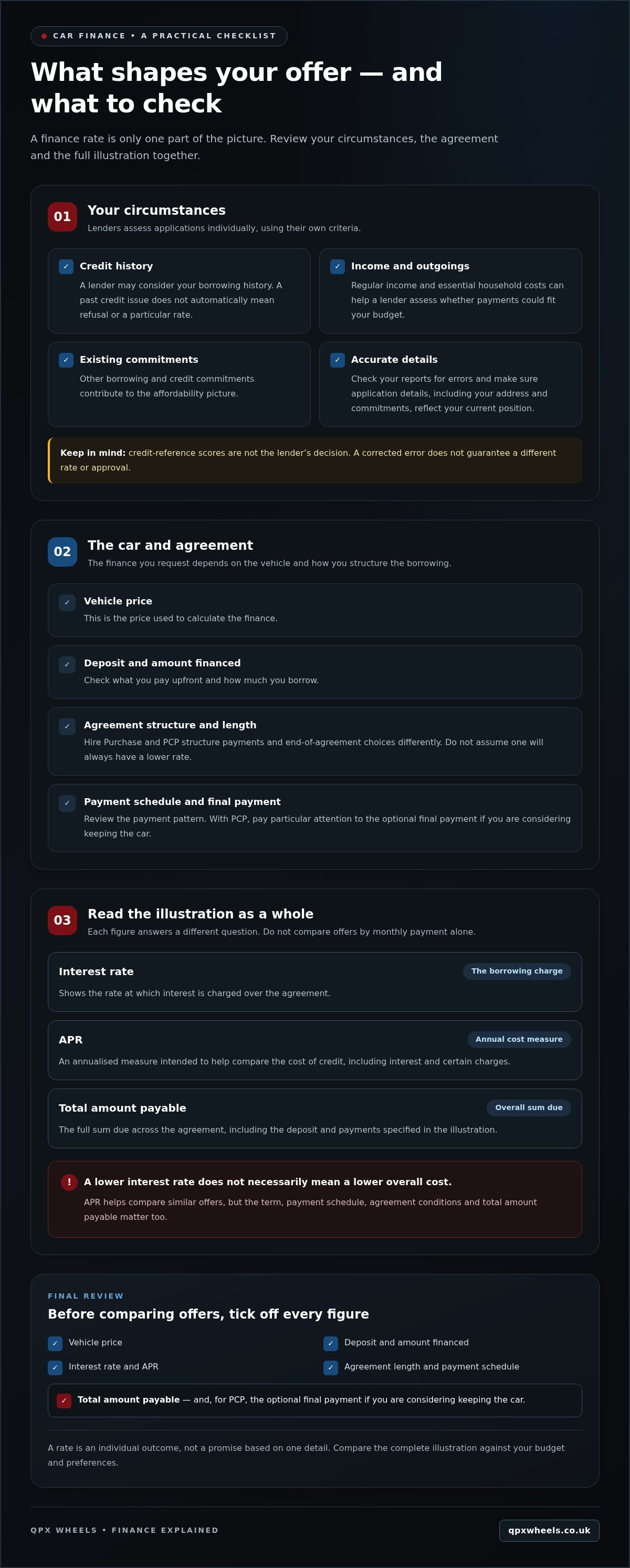
A finance illustration presents related figures that answer different questions. The interest rate shows the rate at which interest is charged. APR is an annualised measure intended to help you compare the cost of credit, including interest and certain charges. The total amount payable is the full sum due across the agreement, including the deposit and payments specified in the illustration.
APR can help you compare similar offers, but it can’t tell you whether an agreement suits your budget or preferences. Check the amount borrowed, deposit, term, payment schedule and any final payment too. With PCP, pay particular attention to the optional final payment if you’re considering keeping the car. The agreement’s conditions also matter, since a headline figure won’t explain every obligation or option.
When reviewing an illustration, identify:
- Vehicle price: the price used to calculate the finance.
- Deposit and amount financed: what you pay upfront and what you borrow.
- Interest rate and APR: the rate charged and the annual cost measure.
- Agreement length and payments: the term and payment schedule.
- Total amount payable: the overall sum due under the agreement.
Why can car finance offers differ between applicants?
A lender assesses an application using its own criteria and the details provided. The outcome is individual: two people considering similar cars may receive different offers, or one may not be offered finance. No single detail guarantees a particular rate or decision. The factors that influence car finance interest rates can relate to both the applicant and the proposed agreement.
A lender may consider your credit history, income, regular outgoings and existing credit commitments. The vehicle’s price, your deposit, the amount borrowed and the agreement structure also define the finance you’re requesting. Even if the cars are similar, applicants may be seeking different amounts or terms, and lenders may assess their applications differently.
Treat the rate as one part of the decision, not a verdict on whether an agreement is affordable. Compare the complete illustration and consider whether its payment pattern and total cost work for you. That gives you a clearer basis for comparing HP and PCP, which structure payments and end-of-agreement choices differently.
How your credit history, income and affordability can influence a car finance rate
Your financial details help a lender assess an application, but they’re considered as part of a wider picture. Credit history may show how you’ve managed borrowing, while income, regular outgoings and existing commitments help indicate whether the proposed payments could fit your budget. These are among the factors that influence car finance interest rates, but they don’t work as a simple formula.
A credit score alone doesn’t determine every car finance offer. Lenders consider credit-reference information alongside their own criteria and an applicant’s wider circumstances. A past issue doesn’t automatically mean you’ll be refused or offered a particular rate. Each lender makes its own assessment, and the result can’t be guaranteed in advance.
Does your credit score affect car finance interest rates?
Credit-reference agencies hold information about your borrowing history, which a lender may use when assessing an application. Their scores or ratings aren’t the lender’s decision: lenders can apply their own criteria and consider other information too. If you’re preparing to apply, review your credit reports for inaccuracies and follow the agency’s process to query any errors. Correcting a mistake doesn’t guarantee a different rate or approval.
Check that the details you provide are accurate and consistent, including your address and financial commitments. If your circumstances have changed, make sure the application reflects your current position rather than relying on old figures. Complete information helps the lender assess the application using the details supplied.
How do income and existing commitments affect affordability?
A lender may consider regular income alongside essential outgoings and credit commitments, such as other borrowing. This helps the lender assess the proposed car finance payment in the context of your finances. There isn’t one universal income threshold. Two applicants with similar earnings may have different commitments and therefore present different affordability pictures.
Before applying, take a realistic look at your monthly budget. Include regular household costs and payments you already owe, then consider whether the proposed instalment would remain manageable alongside them. Don’t judge affordability by income alone or assume that a particular salary guarantees a lender’s decision.
- Review credit-reference information and raise any errors through the relevant agency.
- Gather accurate details of your income, regular outgoings and existing credit commitments.
- Use your current circumstances when completing an application, and avoid guessing or leaving relevant details out.
- Consider whether payments would still be manageable if your usual budget came under pressure.
These checks can help you prepare, but they can’t promise a particular rate or outcome. If you’re considering a vehicle as well, explore used cars and finance options at QPX Wheels, including HP and PCP, and compare the full agreement against your budget.
How the car, deposit and finance agreement shape the offer
The vehicle and agreement help define how much you’re asking to borrow and how repayments are arranged. A higher vehicle price may mean a larger amount to finance, while a deposit reduces the sum borrowed. These details form part of the factors that influence car finance interest rates, but none guarantees a particular rate. Lender criteria and your individual application still matter.
For example, two buyers could choose similar cars, but one might pay a larger deposit or choose a different agreement term. They may borrow different amounts and receive different illustrations, even if their financial circumstances are similar. Borrowing less can reduce the total interest charged if other terms stay the same, but it doesn’t automatically mean the lender will offer a lower interest rate.
Can your deposit or amount borrowed change the rate?
A deposit reduces the amount that needs financing and affects the structure of the agreement. The lender may also consider the amount requested as part of its assessment. However, a larger deposit doesn’t promise a lower rate, just as borrowing less doesn’t guarantee a particular offer. Compare illustrations with the deposit and amount financed clearly shown, and check that they use the same vehicle price.
Do HP and PCP finance have different interest rates?
HP and PCP organise payments and end-of-agreement choices differently, so their illustrations may not be directly comparable by monthly payment alone. With HP, payments are structured towards owning the vehicle once the agreement is completed, subject to its terms. PCP generally includes an optional final payment if you want to keep the car. Neither type always has a lower rate, so compare the APR and full agreement structure.
The agreement length matters too. Spreading borrowing over a longer term can reduce the monthly payment, but may increase the total amount paid because interest is charged over more time. The effect on the rate itself isn’t universal. Check what each illustration offers rather than assuming a longer or shorter term will produce a lower APR.
Use the details below to compare offers side by side:
| Detail | What to check |
|---|---|
| Vehicle price | Is the same car price used in each illustration? |
| Deposit and amount financed | How much do you pay upfront, and how much do you borrow? |
| Agreement type | Is it HP or PCP, and what choices or payments apply at the end? |
| Term and monthly payments | How long does the agreement run, and what is the payment schedule? |
| APR and total payable | What is the annual cost measure and the overall sum due? |
Comparing these details together helps show whether a lower monthly payment reflects a different deposit, a longer term or an end payment, rather than a lower overall cost.
How lenders and wider market conditions influence UK car finance rates
A car finance offer reflects more than the applicant and vehicle. Each lender sets its own eligibility and affordability criteria, while wider economic conditions can influence the cost of providing credit. These forces operate at different levels: market conditions may shape the background for borrowing, but a lender still assesses each application and agreement individually.
A change in a headline economic rate doesn’t translate directly into the same change in every car finance offer. Lenders consider their own costs, criteria and products, alongside the information in an application. The factors that influence car finance interest rates therefore include broad market conditions and lender-specific decisions, not a universal formula that determines every quote.
Does the Bank of England base rate set car finance interest rates?
No. The Bank of England base rate is a benchmark used in the wider financial system, not a rate that automatically sets every car finance offer. Changes can influence market borrowing costs and lenders’ decisions over time, but the effect isn’t necessarily immediate or equal across products. A finance illustration reflects the lender’s offer for that agreement, not a direct calculation from the base rate.
Base-rate conditions can change, so check the Bank of England’s latest published decision if you’re making a current market comparison. Don’t rely on an old headline figure to predict the rate you’ll be offered. The relevant comparison is the APR and terms in the specific illustration available to you.
Why might different lenders assess the same application differently?
Lenders can set different eligibility requirements and affordability criteria, and may offer different products or terms. The same applicant and vehicle could therefore receive different outcomes from different lenders. That doesn’t mean one lender is certain to approve an application or provide a lower rate. Avoid guessing at the details of a lender’s internal assessment methods.
Compare offers on a consistent basis: check that the vehicle price, deposit, amount financed and agreement length match, then review the APR, payment schedule and total amount payable. Differences in those terms can make two offers look more alike, or more different, than their monthly payments suggest.
It’s also useful to separate broad market influences from your application. Inflation and wider economic conditions can affect borrowing costs across the market, while the lender’s criteria shape how it assesses a particular request. Neither the base rate nor a general market trend can tell you exactly what rate an individual will receive.
- Market conditions can shape the background cost of borrowing.
- Lender criteria affect how an individual application is considered.
- Agreement terms determine what the offer includes and how payments are arranged.
Understanding these layers makes it easier to assess an offer without treating a market headline as a personal quote. If you’re considering a used vehicle, explore used cars and finance options at QPX Wheels, including HP and PCP, and compare the full illustration before deciding.
How to compare car finance offers and prepare before applying
A finance illustration is easiest to assess when you compare every part of the offer, rather than choosing by the monthly payment alone. Use this checklist to review the figures consistently. If two illustrations differ, note which terms have changed before deciding whether one suits your needs better.
What should you compare on a car finance illustration?
Check the key figures and agreement terms together. The deposit, APR and payment schedule affect how an offer looks, while the total amount payable gives a broader view of the overall commitment. For PCP, understand the optional final payment and the choices available at the end of the agreement.
- Match the vehicle price. Make sure each illustration relates to the same car and purchase price, so you’re comparing the same starting point.
- Check the deposit and amount borrowed. Confirm how much is paid upfront and how much is financed. A different deposit can change the monthly payments and total cost.
- Compare APR and agreement length. Look at the APR alongside the term. A longer agreement may have lower monthly payments but a higher total amount payable.
- Review the payment schedule. Check the number and amount of regular payments, and note any payment that differs from the others.
- Read the total amount payable and end terms. Check what the total includes and, for PCP, the optional final payment and relevant end-of-agreement choices.
This makes it easier to see why one monthly payment is lower. It might reflect a larger deposit, a longer term or a final payment, rather than a lower overall cost. Compare like with like where possible, and read the agreement details before signing so you understand the commitments and options that apply.
What can you do before submitting a finance application?
Organise the information you’ll need before applying. Check that your personal details are accurate, and that your income, regular outgoings and existing credit commitments reflect your current circumstances. Errors or omissions can make the information less useful for an individual assessment. Be truthful and consistent, and don’t assume that correcting an error guarantees a particular rate or outcome.
Next, review your household budget and decide what payment level feels manageable alongside your regular costs. Consider whether it would remain comfortable if other expenses changed. The factors that influence car finance interest rates may affect the offer, but a sound comparison also needs to account for what you can sensibly afford over the full agreement.
Once you’ve reviewed the figures, explore QPX Wheels’ used vehicles and finance options. QPX Wheels offers used cars with HP and PCP finance, giving you a starting point for comparing different agreement structures. An application doesn’t guarantee approval or a particular rate, so review the full illustration before making a decision.
Make your next finance decision with confidence
A finance offer is useful only if it fits the way you plan to use and keep your next car. Before moving forward, consider how long you expect to drive it, what payment level feels comfortable, and whether you want the option of owning the vehicle at the end. Keeping those priorities clear can help you choose a suitable route instead of letting a headline rate make the decision for you.
The factors that influence car finance interest rates can shape the offer, but they can’t tell you on their own whether an agreement suits your circumstances. Take time to review the terms and choose a commitment that feels manageable, without assuming a particular rate or approval outcome.
QPX Wheels offers used vehicles and finance options, including HP and PCP. Explore used cars and finance options with QPX Wheels to compare your options and take the next step with the full agreement in view.
Frequently Asked Questions
Does my credit score determine my car finance interest rate?
No, your credit score alone doesn’t determine the rate or outcome. A lender may consider credit-reference information alongside its own eligibility and affordability assessment, including your income, regular commitments, borrowing amount and agreement details. Different lenders can assess the same application differently. Before applying, check your credit report for errors, such as an account you don’t recognise or an incorrect payment record, and raise any inaccuracies through the relevant agency.
Can a larger deposit reduce my car finance interest rate?
It may change the offer, but a larger deposit doesn’t guarantee a lower interest rate. Paying more towards the vehicle upfront means you’d need to finance less, which can affect the payment structure and total borrowing. Lenders still apply their own criteria and product terms. Compare offers using the same vehicle price, then consider the APR, deposit, agreement length and total amount payable together.
Does the Bank of England base rate affect car finance interest rates?
It can influence wider borrowing conditions, but it doesn’t directly set every car finance rate. A lender’s funding, product pricing and assessment criteria also play a part, and changes in the benchmark rate don’t necessarily flow through immediately or equally. For a current comparison, check the date on each finance illustration and distinguish the Bank of England base rate from the APR offered for your individual agreement.
Do HP and PCP car finance have different interest rates?
HP and PCP are structured differently, so consider their payments and end-of-agreement choices alongside the rate. Neither can be assumed to have a lower rate in every case. Compare illustrations for the same vehicle and check the APR, deposit, term, regular payments and total payable. With PCP, understand the optional final payment and relevant end-of-agreement conditions before deciding whether the structure suits you.
Can I get car finance with a poor credit history?
A less-than-perfect credit history doesn’t automatically mean every application will be declined, but you can’t assume approval or a particular rate. A lender may also consider your current commitments, affordability and the details of the finance requested. Check your application information carefully and be realistic about the payment your household budget can manage. If a credit report contains an error, query it rather than assuming it will be disregarded.
Does a longer car finance term lower the interest rate?
Not necessarily. A longer term spreads scheduled payments over more time, which may lower each monthly instalment, but it can change the total amount payable and doesn’t guarantee a lower rate. Compare the same borrowing amount over different terms, checking both the monthly payment and overall payable figure. If the offer is PCP, include any optional final payment in your assessment too.
Why are two car finance offers different for the same vehicle?
The factors that influence car finance interest rates can include lender criteria, the applicant’s circumstances and the product terms, so offers for one vehicle may differ. Before drawing conclusions, check that both illustrations use the same deposit, amount borrowed and agreement length. Compare the APR and total payable too. A smaller monthly payment could reflect a longer term or different end payment, not necessarily a lower overall cost.


