
Could a car that struggles to change gear have a worn clutch, a gearbox fault or something else? If you’re unsure how to check clutch and gearbox wear on a manual car, you’re not alone. Symptoms can overlap, and an unsuitable test could make a problem worse, particularly when you’re assessing a used car.
It’s sensible to look for warning signs before they become harder to ignore, but you don’t need to force the car or push it through a demanding test. This guide covers safe, basic checks: what to notice in the clutch pedal, gear changes and the car’s behaviour during a gentle drive. You’ll also learn which signs may point to clutch slip or gearbox wear, and why they don’t confirm the cause by themselves.
If a gear grinds, the clutch slips or a check feels unsafe, stop rather than trying again. Arrange a qualified inspection when needed. If you’re viewing a used car, raise any unresolved concern before deciding whether to buy.
Key Takeaways
- Clutch and gearbox symptoms are useful clues, but they can’t confirm a fault on their own.
- Keep stationary checks simple, and consult the owner’s handbook rather than forcing a resistant gear lever.
- Find out how to check clutch and gearbox wear on a manual car during a permitted, insured road test without trying to provoke a fault.
- Compare common signs, from clutch slip to grinding or gears disengaging, and consider what each may indicate.
- Know when to note a minor observation, seek a qualified inspection or stop testing, and what to ask before buying a used car.
How clutch and gearbox wear affects a manual car
Clutch and gearbox symptoms are clues, not a diagnosis. A slipping clutch may indicate a clutch problem, while a difficult gear change can have several possible causes. If you’re learning how to check clutch and gearbox wear on a manual car, understanding what each part does can help you describe what you notice without jumping to conclusions.
What the clutch and gearbox each do
The clutch connects the engine to the gearbox and lets the driver interrupt that connection to change gear. Its friction plate sits between the engine’s flywheel and the pressure plate. With the pedal released, the pressure plate clamps the friction plate against the flywheel, transferring engine power. Pressing the pedal releases that clamping force so the gears can be changed.
The gearbox selects different gear ratios, changing how engine speed relates to the speed of the road wheels. Lower gears provide more turning force at lower speeds; higher gears let the car travel faster without the engine needing to rev as highly. A manual transmission overview can help explain how these parts work together.
The pedal is part of the picture, too. A cable or hydraulic system transfers pedal movement to the clutch mechanism. A change in pedal feel or clutch operation doesn’t automatically mean the friction plate is worn.
Which early symptoms deserve attention?
Notice changes such as the engine revving without the car gaining speed as expected, a different-feeling bite point, gears becoming difficult to select, crunching during a shift or unusual noises. Slipping under acceleration may suggest clutch trouble, but diagnosis is needed to confirm the cause.
Possible gearbox-related signs include persistent difficulty selecting a particular gear, grinding or whining noises, or a gear seeming to jump out. Symptoms can overlap: a clutch that isn’t disengaging fully, for example, may make gear selection difficult. A noise or change in feel alone can’t identify which component is at fault.
Make a brief note of when the symptom occurs. Record the gear, approximate road speed, whether the engine is cold or warm, and what you were doing, such as accelerating or changing gear. This description can help a qualified professional assess the issue. Don’t repeatedly try to make a symptom happen; keep the checks gentle and never force the gear lever.
Safe stationary checks for clutch and gearbox wear
Checks while the car is parked can help you describe what feels or sounds unusual, but they can’t confirm the condition of internal gearbox parts. To check clutch and gearbox wear on a manual car safely, keep the inspection simple: use level ground, secure the car with the handbrake and follow the owner’s handbook. Don’t crawl beneath the vehicle or reach near moving components.
Check the pedal and clutch engagement
With the engine off, press the clutch pedal smoothly and let it return. Notice whether it feels unusually stiff or loose, vibrates, or sticks instead of returning normally. A sudden change is more useful to report than a general impression that the pedal feels different from another car.
If you know how the vehicle usually behaves, note whether the bite point seems to have changed. It varies between models, so a high or low bite point alone doesn’t prove the clutch is worn. A spongy feel or a pedal that doesn’t return can also involve the hydraulic system or cable, depending on the car. Delphi’s guide to signs of a worn clutch offers further background, but symptoms still need proper assessment. Arrange a qualified inspection if the pedal changes suddenly, fluid appears to be leaking or the clutch is difficult to disengage.
Check gear selection with the engine off
Before selecting gears, secure the car and switch off the engine. Check the handbook for any model-specific guidance. Press the clutch pedal and gently move the lever through the gears, returning it to neutral between selections if that feels natural. Don’t force it. A gear may not engage fully while the car is stationary, so one awkward selection isn’t a diagnosis.
Notice whether resistance happens repeatedly in the same position, whether the lever feels unusually loose or whether you hear an unfamiliar mechanical noise. Stiff selection can involve the gear linkage or other components, not just internal gearbox wear. Note what you observe for a professional to assess.
- Start safely: Park on level ground, apply the handbrake and check the handbook.
- Observe gently: Feel the clutch pedal and select gears with the engine off, without forcing anything.
- Know the limit: Stationary checks can reveal clues, but can’t verify internal wear.
Stop if anything feels unsafe, and don’t inspect beneath the car without suitable equipment. If you’re considering a used manual car, raise unresolved concerns before committing. You can also browse used cars with clearer questions in mind.
How to road-test a manual car for clutch and gearbox wear
A road test can show how the clutch and gearbox behave in ordinary use, but only drive if you have the owner’s permission, appropriate insurance and safe conditions. If you’re viewing a car, agree the route and who will drive before setting off. Don’t test a vehicle if a warning sign already makes it feel unsafe to operate.
The aim is to notice what happens during normal driving, not to make a fault appear. Keep your attention on the road and drive smoothly. If you’re unsure how to check clutch and gearbox wear on a manual car, a calm, ordinary drive gives more useful clues than harsh acceleration or repeated experiments.
Observe clutch behaviour under normal driving
During gentle, routine acceleration, notice whether the engine revs rise but the car’s speed doesn’t increase in step. That mismatch may suggest clutch slip, particularly if it happens with the clutch pedal fully released, but it isn’t proof of a worn clutch. The car’s response can also vary with load, road gradient and driving conditions.
Notice whether the engine’s response feels consistent as you release the clutch after a normal gear change. Don’t deliberately make the clutch slip, accelerate hard to provoke a symptom or try to stall the car. For background on how a manual transmission works, see HowStuffWorks, but treat any driving observation as a clue rather than a diagnosis.
Listen and feel during gentle gear changes
Change up and down through the gears as you normally would, without rushing or forcing the lever. Notice whether each gear engages smoothly. Record any crunching or grinding, a whining noise that changes with gear or speed, or a gear lever that moves unexpectedly. A single sound may not identify the cause, so note when it occurs and which gear you’re using.
Pay attention to how the car responds. If gear engagement becomes uncertain, the vehicle is difficult to control or continuing the test feels unsafe, stop somewhere safe as soon as you can. Don’t repeat the shift to see whether the symptom happens again. A qualified professional can assess persistent concerns more thoroughly.
- Do: Drive gently and observe normal acceleration and gear changes.
- Don’t: Use harsh acceleration, repeated clutch-slip tests or deliberate stalling.
- Record: What happened, in which gear and under what conditions.
If you’re comparing vehicles, keep unresolved clutch or gearbox concerns on your list of questions before deciding whether to buy. You can browse used cars while applying the same careful approach to each viewing.
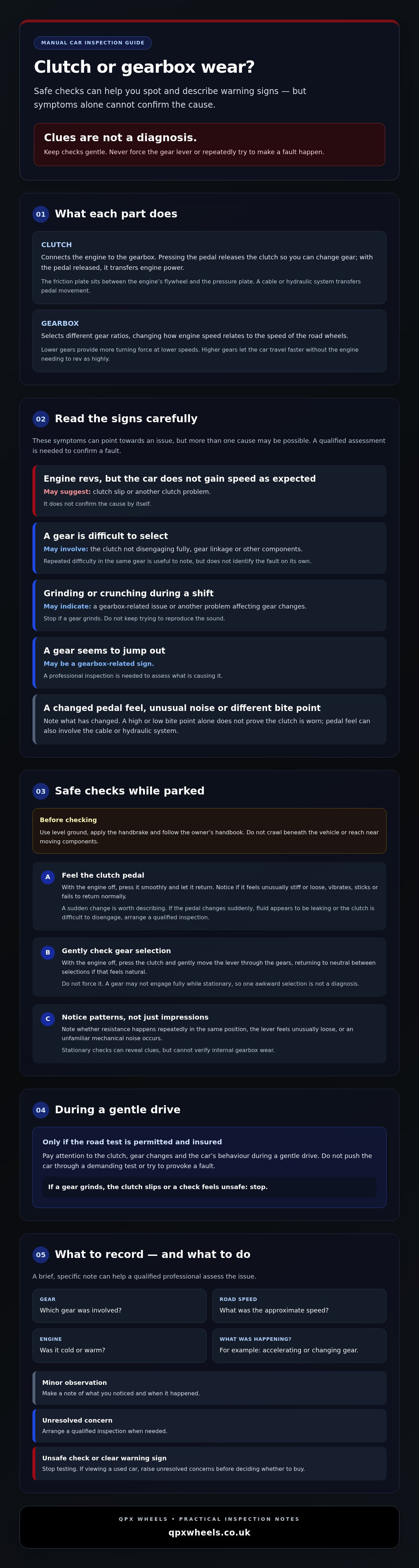
Clutch wear or gearbox wear: how to read the signs
As you learn how to check clutch and gearbox wear on a manual car, look for patterns rather than treating one symptom as proof. A slipping clutch may point towards the clutch, while a crunch or a gear that won’t stay engaged may suggest a gearbox or related issue. Symptoms can overlap, though, and only proper inspection and diagnosis can reliably identify the underlying fault.
Clues that may point towards clutch wear
If the engine revs rise without a matching increase in road speed during normal acceleration, clutch slip is one possibility. A changed bite point or difficulty disengaging the clutch can also be a clue. Neither confirms that the clutch friction plate needs replacing.
A spongy pedal may involve the clutch control system, including its hydraulic parts or cable, rather than the friction plate itself. Record what you notice and when it happens, then seek qualified advice if the symptom persists or affects normal driving.
Clues that may point towards gearbox or related faults
A crunch that repeatedly occurs in the same gear, whining during driving, persistent difficulty selecting a gear or a gear disengaging unexpectedly may point towards gearbox trouble. These signs can have other causes, too. A clutch that isn’t releasing properly can make gear selection difficult, while worn or misadjusted linkage may affect how the lever feels. Lubricant condition or level can also be relevant, but don’t assume a noise tells you which part is at fault.
| Symptom | Possible area involved | Sensible next step |
|---|---|---|
| Revs rise without a matching increase in speed | Clutch slip or another drivetrain issue | Note when it occurs; arrange an assessment if it persists. |
| Changed bite point or difficulty disengaging | Clutch or its hydraulic or cable control | Have the clutch system checked rather than assuming the plate is worn. |
| Spongy pedal or a pedal that behaves differently | Clutch control system, including hydraulic parts or cable | Seek qualified advice, especially if the change is sudden. |
| Crunching or difficulty selecting one gear | Gearbox, clutch operation or linkage | Record which gear and conditions; request a proper diagnosis. |
| Whining or a gear jumping out | Gearbox or related components | Stop testing if safety or control is affected and arrange an inspection. |
This comparison can help you explain the issue, not identify the failed component. Avoid guessing from a sound or gear-lever feel, and don’t keep driving if engagement or control becomes unsafe. If you’re considering a used car, ask about reported symptoms, repair history and any inspection findings before deciding whether to proceed.
Looking for a used car? Browse used cars and raise any unresolved clutch or gearbox concerns before committing to a purchase.
What to do after checking clutch and gearbox wear
Your checks can help you describe a symptom, but they can’t confirm its cause. Use what you’ve noticed to choose a sensible next step: note minor, occasional changes; arrange a qualified assessment if a symptom persists or worsens; and stop testing if the car feels unsafe. Don’t repeat a road test to try to prove a suspected fault.
When should you stop driving and seek help?
If gears won’t engage, the car can’t be controlled predictably or a severe noise develops, stop somewhere safe as soon as you can and seek professional advice before continuing. A sudden change in pedal feel, worsening difficulty changing gear or recurring grinding also deserves prompt attention. Avoid forcing the gear lever or repeating tests; they won’t reliably identify the fault and could add risk.
If the observation is minor and the car remains safe to use, write down what happened, including the gear, driving conditions and whether the engine was cold or warm. If it happens again, share those details with a qualified professional. This gives them a clearer starting point than a guess such as “the gearbox is worn”.
What should a used-car buyer ask before deciding?
If you’re viewing a used manual car, ask whether the clutch or gearbox has shown symptoms or had work carried out. Request relevant repair records and ask whether inspection findings or unresolved concerns are available. During a viewing, note what you experience rather than trying to diagnose the cause yourself.
Arrange an independent inspection by a qualified professional if symptoms occur or answers leave important questions unresolved. Do this before committing to the purchase, so you can understand the concern and make an informed decision. A seller’s explanation or a brief test drive shouldn’t replace an inspection when the signs are significant.
Knowing how to check clutch and gearbox wear on a manual car is most useful when it helps you choose the right next step, not when it encourages increasingly demanding tests. QPX Wheels sells used cars and vans, but doesn’t provide general mechanical repairs or clutch and gearbox diagnosis. If you’re still looking, you can browse QPX Wheels used vehicles and raise unresolved concerns before deciding whether to buy.
Take your next step with confidence
Knowing how to check clutch and gearbox wear on a manual car can help you spot warning signs, but simple checks can’t confirm the fault. Look for changes in pedal feel, slipping, difficult gear selection or unusual noises, and note when they happen. Keep checks gentle, avoid forcing the car and arrange a qualified inspection if symptoms persist. If the vehicle feels unsafe or gears won’t engage reliably, stop testing and seek professional advice.
If you’re considering a used car, ask about clutch or gearbox symptoms, previous repairs and inspection findings. Where concerns remain, an independent inspection can give you clearer information before you decide. QPX Wheels sells pre-owned cars and vans with nationwide delivery, and optional extended warranties are available.
Ready to explore your options? Browse QPX Wheels used vehicles, take your time and make your next decision with confidence.
Frequently Asked Questions
How can I tell if a clutch is slipping?
A slipping clutch may let the engine rev higher without the car gaining speed at the same rate, particularly during ordinary acceleration with the clutch pedal fully released. You might also notice a changed bite point or a burning smell, but no single sign confirms the cause. Avoid trying to provoke the symptom with hard acceleration. If it happens repeatedly, arrange a qualified inspection.
Can you check a clutch without driving the car?
Yes, you can make some basic observations without driving, although they can’t confirm the clutch’s condition. With the car parked securely and the engine off, check whether the pedal feels unusually stiff, loose or spongy, and whether it returns normally. You can gently select gears with the engine off, following the owner’s handbook. Don’t force the lever or crawl beneath the car.
How do I know if a manual gearbox is worn?
Persistent difficulty selecting a particular gear, crunching, whining or a gear disengaging unexpectedly may point to a gearbox problem. These signs can also involve the clutch, gear linkage or lubricant, so they don’t prove that the gearbox itself is worn. Note which gear is affected and when the symptom occurs. A qualified inspection is the reliable way to establish the underlying cause.
Is a high clutch biting point always a sign of wear?
No. A high bite point can be a clue, but the normal engagement point varies between vehicles, so it isn’t proof of clutch wear by itself. Compare it with the car’s familiar behaviour, if known, and look for other changes such as slipping or difficulty disengaging. If the bite point has changed suddenly or the clutch feels abnormal, seek qualified advice rather than relying on this sign alone.
Can a worn clutch make it hard to change gear?
Yes. If the clutch doesn’t disengage fully, selecting gears can become difficult, but that symptom doesn’t establish that the clutch plate is worn. The pedal’s hydraulic system or cable may be involved, and gear linkage or gearbox issues can also affect selection. Note whether the problem happens in one gear or across several. Persistent difficulty deserves professional assessment, especially if gears crunch or won’t engage.
Should I buy a manual car if the clutch feels different?
Don’t decide on pedal feel alone. Clutch engagement varies between models, but a sudden or unexplained change, slipping or difficulty changing gear should prompt further questions. Ask whether there have been symptoms or clutch repairs, and request relevant records or inspection findings. If concerns remain, arrange an independent inspection by a qualified professional before committing, so you can make a decision with clearer information.
Is it safe to test clutch wear by stalling the car?
No. Deliberately stalling the car isn’t a suitable check. It can put unnecessary strain on components and may create a safety risk, particularly in a confined space or near other vehicles. Don’t use harsh acceleration or repeat tests to make a suspected fault appear. Observe how the clutch behaves during normal driving only when you have permission, appropriate insurance and safe conditions. Stop if control or gear engagement becomes uncertain.


