
A digital odometer can be altered, so a believable dashboard reading alone doesn’t prove a car’s mileage is genuine. The clearest signs of odometer tampering in used cars are conflicting readings in MOT and service records, particularly when a later entry shows fewer miles than an earlier one.
Look beyond the dashboard figure: the mileage may seem plausible while the paperwork tells a different story. Compare the reading with the car’s age, history and service records, and check for changes between tests in its MOT history on GOV.UK.
This guide explains how to spot mileage that doesn’t add up, assess physical and dashboard warning signs, and consider whether a discrepancy has a reasonable explanation. Use these practical checks to weigh the evidence before deciding whether to proceed with a used car.
Key Takeaways
- Compare a car’s age and current mileage with earlier readings to spot a figure that moves backwards or seems inconsistent.
- Use the MOT history on GOV.UK to trace recorded mileage between tests and look for unexplained changes.
- Treat low mileage as one clue, not proof: driving patterns and the car’s condition can help explain an unusual reading.
- Look for wear on the steering wheel, seats, seat belts and pedals that seems out of step with the displayed mileage.
- Read the log book and service history in date order, checking each recorded mileage against the current odometer.
Mileage inconsistencies against vehicle age and history
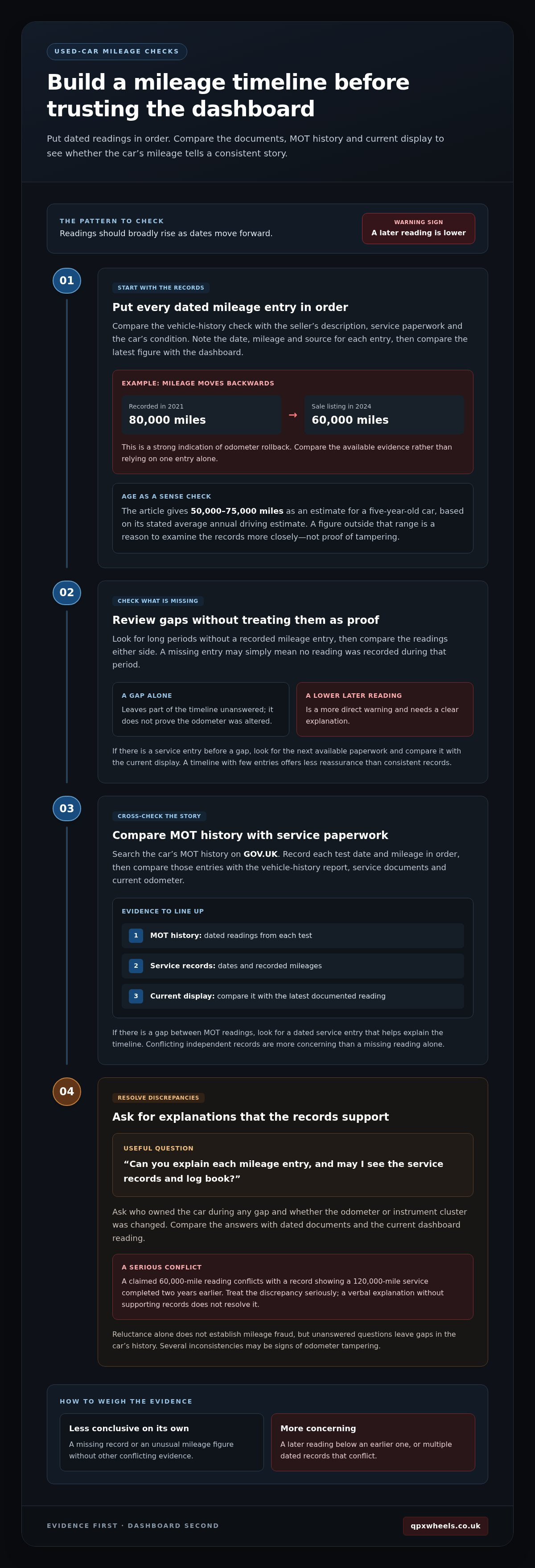
Assess the mileage as a timeline, not just as the figure on the dashboard. Compare the car’s age, recorded readings, MOT history and service paperwork to see whether they tell a consistent story.
-
Check mileage against vehicle history
Start with a vehicle history check and compare its mileage entries with the seller’s description and the car’s condition. Put every dated reading in order, noting the source and whether it came from an MOT test, service record or other vehicle-history entry. A reading that falls between earlier and later figures needs a clear explanation. For example, 80,000 miles recorded in 2021 followed by a 60,000-mile sale listing in 2024 is a strong indication of odometer rollback. Don’t rely on one entry alone; compare the available evidence.
Use the vehicle’s age as another sense check. A five-year-old car may have travelled 50,000 to 75,000 miles, based on the stated average annual driving estimate. A figure outside that range isn’t proof of tampering, but it gives you a reason to examine the records more closely. Check whether the seller’s account fits the dates and condition.
-
Review mileage gaps in history reports
Look for long periods without a recorded mileage entry, then compare the readings either side of each gap. A missing entry doesn’t prove the odometer was altered: there may simply be no reading recorded for that period. A later figure below an earlier one is a more direct warning. Note the dates and readings, rather than treating an unrecorded period as evidence on its own.
Consider what each gap leaves unanswered. If the report shows a service entry before a long blank period, look for the next available paperwork and compare its mileage with the current display. Check that the dates progress and the readings broadly rise. A timeline with few entries offers less reassurance than consistent records, so weigh gaps alongside the MOT history, service documents and seller’s explanation.
-
Ask the seller about mileage records
Ask the seller: “Can you explain each mileage entry, and may I see the service records and log book?” Ask who owned the car during any gap and whether the odometer or instrument cluster was changed. Compare the answers with the dated documents and current dashboard reading.
Notice whether the seller provides records that support their account or avoids straightforward questions about them. Reluctance alone doesn’t establish mileage fraud, but unanswered questions leave gaps in the car’s history. Ask for the reason behind any reading that moves backwards or conflicts with a service entry. For example, a claimed 60,000-mile reading conflicts with a record showing a 120,000-mile service completed two years earlier. Treat that discrepancy seriously and don’t rely on a verbal explanation without supporting records.
-
Compare mileage with MOT history
Search for the car’s MOT history on GOV.UK and compare the mileage recorded at each test with the current odometer. Read the entries in date order. The figures should broadly increase; a later MOT reading below an earlier one is a clear inconsistency to investigate.
Note each test date and mileage, then compare them with the vehicle history report and service paperwork. If there’s a gap between MOT readings, look for a dated service entry that helps explain the timeline. Compare the seller’s account with those records and the car’s condition. Conflicting independent records are more concerning than a missing reading alone, and several inconsistencies may be signs of odometer tampering in used cars.
Can mileage discrepancies be genuine?
Yes. A low reading may have a genuine explanation, so compare it with the car’s age, wear and records. Both digital and mechanical odometers should be checked against the vehicle’s documented history.
-
Compare wear with displayed mileage
Inspect the driver’s seat, steering wheel, seat belts, gear stick and pedals, then compare their wear with the displayed figure. A car showing 35,000 miles with heavily worn seats or a steering wheel smoothed by years of use may have travelled further. Wear alone doesn’t prove tampering, since use and care vary, but several mismatches deserve closer attention.
Look for a pattern across the car’s contact points. A worn brake pedal alongside a tired seat may tell you more than one scuffed surface. Note what you observe and compare it with the seller’s account and service history.
-
Assess mileage against age and condition
Compare the odometer reading with the vehicle’s age, overall condition and stated use. A five-year-old car showing under 30,000 miles may warrant suspicion, but low mileage can have valid explanations. For example, a pandemic-era owner who reduced or stopped commuting might have driven only 4,000 miles over a two-year span.
Ask how the car was used and whether that account fits its condition. A low reading with little wear may make sense for a lightly used vehicle. A low figure alongside substantial wear needs closer scrutiny, but isn’t proof by itself.
-
Review service record frequency and mileage
Read service entries in date order and compare each recorded mileage with the next. Consider both the distance covered and the timing of visits; frequent entries aren’t suspicious by themselves. Monthly oil changes, however, could indicate odometer tampering, particularly if the entries don’t fit the seller’s account.
Check whether the paperwork shows a consistent pattern of servicing and rising mileage. If a record’s date or reading conflicts with another document, ask for an explanation and supporting paperwork. Treat an unexplained inconsistency as a reason to pause.
-
Verify digital or mechanical odometer readings
Compare the displayed mileage with MOT history, service records and other dated paperwork, regardless of odometer type. A digital display doesn’t make the reading self-verifying. Older mechanical odometers use numbered gears, with each wheel representing one digit from 0 to 9, but the displayed figure still needs checking against the car’s records.
Note any dashboard irregularities, then use the same timeline approach for either type of display. Conflicting records matter more than whether the odometer uses screen digits or rotating number wheels.
- If several records conflict, the car’s condition doesn’t fit its mileage, or the seller can’t explain the discrepancy, pause the purchase. Arrange a pre-purchase inspection to assess the car, and don’t proceed if concerns remain. Keep copies of the records and note the conflicting readings, so your concern is based on specific evidence rather than one impression.
Common physical and dashboard warning signs
Inspect the cabin and instrument cluster methodically, then compare what you find with the displayed mileage. A single mark may have an ordinary explanation, so note combinations of clues rather than treating one detail as proof.
- Start with the driver’s controls and seating area. Check the steering wheel, driver’s seat, seat belt, gear stick, brake pedal and accelerator pedal for wear. Look for smooth patches, compressed padding, frayed edges and worn pedal surfaces. Note exactly where the wear appears, rather than simply recording that the interior looks tired.
Compare both sides of the cabin. A heavily worn driver’s seat beside a well-kept passenger seat may reflect regular use by one driver. Consider whether the overall wear fits the displayed mileage and the seller’s account.
- Compare the condition of those contact points with the number on the dashboard. A car showing 30,000 miles should not have a heavily worn driver’s seat or a steering wheel smoothed by years of use. If you see that mismatch, record the details and compare them with the car’s dated documents.
Look for several clues together. A polished steering wheel combined with worn pedal faces may warrant closer attention than a small tear in the seat alone. Driving habits affect wear, so assess the whole cabin rather than relying on one surface.
- Inspect the instrument-cluster display carefully in good light. Fingerprints inside the display can be a warning sign of odometer rollback. Note their location and whether the cluster appears to have been disturbed, then compare the displayed mileage with the vehicle’s records.
Check that the mileage is legible and the display behaves consistently when you switch on the ignition. Note any irregularity, but don’t assume it proves the reading has been changed. Its significance depends on whether other evidence, such as conflicting paperwork, supports the concern.
- Write down your findings before speaking with the seller. Use specific descriptions, such as “smooth patch on the steering wheel” or “fingerprints inside the cluster display”. This makes it easier to discuss what you observed and compare it with the car’s history.
Ask for an explanation of any mismatch, then consider whether it fits the vehicle’s condition and paperwork. If several clues point in different directions, review each one against the available evidence. Physical signs can guide further checks, but the mileage timeline remains important.
Comparing service records with the current odometer reading
Use the log book and service history to build a dated record of mileage readings. Compare each entry with the current odometer and check whether the sequence makes sense.
- Gather the car’s log book, service invoices and any maintenance records before assessing the displayed mileage. Review them for a paper trail of odometer readings. Include entries from different garages, not just one service booklet, and note each document’s date, mileage and source.
Put the records in chronological order. A service invoice may show mileage even when the log book doesn’t. Together, the documents can give you a clearer picture of how the reading changed over time.
- Make a simple timeline with the date and mileage from every record. Check that readings generally rise as dates move forwards. For example, if a later invoice shows a lower figure than an earlier service entry, mark both records and investigate the discrepancy.
Don’t compare mileage without checking the dates. A higher reading on an older document may be perfectly consistent, while a later document showing fewer miles needs an explanation. Note unclear handwriting or entries that look altered, and compare them with other paperwork rather than guessing.
- Compare the latest documented mileage with the current dashboard reading. The displayed figure should not be lower than a previous service reading. If it is, ask the seller to explain the difference and provide supporting records, such as paperwork for an instrument-cluster replacement.
Check the explanation against the dates and details in the documents. A verbal account that doesn’t fit the paperwork leaves the inconsistency unresolved. Ask specific questions: which record is incorrect, why, and what evidence supports the explanation?
- Check whether the service entries form a coherent history, rather than judging each invoice on its own. Compare the mileage progression with the work recorded and the vehicle’s condition. For instance, an invoice describing extensive use should make sense alongside the mileage on nearby entries.
Look for gaps between documents and note where the timeline becomes difficult to follow. A gap alone doesn’t prove tampering, but it limits what the paperwork can establish. Look for another dated record that bridges the gap, then compare its mileage with the surrounding entries.
- Set conflicting records side by side and compare them with the car’s history report and MOT readings. Check that the registration details identify the same vehicle and that the dates align. If one source differs, look for a clear reason, such as a recording error, supported by another document.
Keep copies or notes of the entries you compared. If readings go backwards or documents contradict one another without a credible explanation, pause before buying. A consistent service paper trail supports the displayed mileage, but cannot resolve a conflict the records themselves leave unexplained.
How can I check whether a car's mileage is consistent with its MOT history in the UK?
Use the GOV.UK MOT history service to compare recorded mileages with the current dashboard reading. Review every entry in date order, then investigate any figure that goes backwards or conflicts with other records.
- Find the car’s MOT history using its registration number. Before relying on the test history, check that the vehicle details match the car you’re viewing. Readings for another vehicle won’t help you assess the displayed mileage. Keep the current odometer reading in mind as you review the entries.
- Write down each MOT date and mileage, starting with the oldest entry. Arrange the figures chronologically and check whether they broadly increase over time. This simple timeline makes a backwards reading easier to spot than scanning separate test records. Note the specific entry that raises concern, rather than relying on memory.
- Compare the latest MOT mileage with the dashboard. The current display should not be lower than a previous test reading. For example, if an earlier MOT records a higher figure than the car shows now, treat it as a serious inconsistency. Recheck the entry and compare it with service paperwork before drawing a conclusion.
- Look at the change between each pair of MOT readings. A gap between tests doesn’t prove tampering, but the readings should still form a credible sequence. Compare dates and figures with service records or other vehicle-history entries from the same period. A later record that conflicts with an MOT reading needs a specific explanation.
- Compare the MOT timeline with the seller’s mileage claims and the vehicle’s condition. Ask about any backwards reading or mismatch, then check the answer against dated documents. The seller’s account should make sense alongside the MOT entries and service history. Several conflicting details are more concerning than one unexplained gap.
- Note the MOT dates, readings and any discrepancies in writing. Compare the GOV.UK history with the current display and paperwork, checking that each source refers to the same vehicle. If the figures remain inconsistent, don’t treat the dashboard reading as verified. A coherent sequence supports the mileage claim; conflicting readings need resolving before you decide.
QPX Wheels: Used Vans
QPX Wheels offers used vans and used cars for buyers considering their next vehicle. If your checks raise questions about mileage, compare the available history and records before deciding whether a vehicle suits your needs. A clear record helps you understand the displayed reading, while unresolved inconsistencies are a reason to pause rather than overlook the evidence.
If you’re selling your current vehicle, QPX Wheels provides a Vehicle Valuation Service. Hire Purchase (HP) Finance is another option if you’re considering how to fund a purchase. These services can support different parts of the buying process, but don’t replace your own mileage and history checks.
For a practical next step, browse QPX Wheels’ used cars and vans or contact the team to discuss what you’re looking for.
Choose your next vehicle with confidence
Choosing a used car involves more than the figure on its dashboard. Base your next move on the evidence you’ve gathered and the questions that remain. If signs of odometer tampering in used cars have made you reconsider a purchase, it’s reasonable to step back and focus on a vehicle with a history you can assess clearly.
When you’re ready to consider another option, QPX Wheels offers used cars and used vans. If you’re selling your current vehicle as part of that decision, its Vehicle Valuation Service may also be relevant. These options can help you plan your next step around the type of vehicle you need and what you’re doing with your current one.
For a straightforward conversation about your next vehicle, contact QPX Wheels for help. Take your time, keep the evidence in view, and move forward when the choice feels right.
Frequently Asked Questions
Can digital odometers be altered?
Yes, a digital odometer can be altered, so a modern display doesn’t prove the mileage is genuine. The screen shows a reading, but it doesn’t independently confirm the distance the car has travelled. Check it against dated records and the vehicle’s condition. A digital figure that conflicts with an earlier document needs an explanation, just as it would in a car with a mechanical display.
How common is mileage fraud?
Industry data suggests around 160,000 vehicles are sold with fraudulent mileage in the UK each year. That figure describes the scale of the problem, but it can’t tell you whether a particular car has been clocked. Treat each vehicle individually: assess its records and condition, and don’t use a low or high reading alone to decide whether the mileage is genuine.
Is rolling an odometer back illegal in the UK?
Yes. Altering an odometer or concealing a change can mislead prospective buyers, so mileage should be represented honestly. If an odometer has been replaced or changed for a legitimate reason, the key is to represent the mileage honestly. Keep any paperwork explaining the change, and compare it with the displayed figure and the vehicle’s history.
What is an odometer and why does it matter in 2024?
An odometer is the display that records a vehicle’s accumulated distance travelled, usually in miles on UK cars. Its reading helps buyers understand how a vehicle has been used and assess its history alongside maintenance records and condition. The year mentioned in the question doesn’t change what the device measures: check whether the displayed mileage fits the car’s documented timeline.
What is a car mileage blocker?
A car mileage blocker is described as a device fitted behind the dashboard that temporarily pauses or slows the odometer while the car is driven. It interferes with the distance being recorded, so the displayed reading may not reflect actual use. Don’t use mileage blockers on public highways, and follow local laws and regulations. For buyers, the possibility of their use makes records especially important.
What is odometer fraud, exactly?
Odometer fraud means deliberately misrepresenting a vehicle’s mileage, typically by changing its reading or concealing a change from a prospective buyer. It can make a car appear to have travelled less than it really has. A discrepancy may have an innocent explanation, but knowingly presenting an inaccurate figure as genuine is different. Look for evidence of the car’s mileage over time.
What should I do if I think a vehicle has been clocked?
If you haven’t bought the car, pause the purchase and keep copies of the advert, messages and mileage records that raised concern. Ask the seller for a clear explanation and supporting paperwork; don’t rely on a verbal assurance that conflicts with the evidence. If you’ve already bought it, keep the sale documents and correspondence, then raise the mileage concern with the seller in writing.
What are the common signs of odometer tampering in a used car?
Look for evidence that doesn’t add up, rather than relying on one clue. Examples include a current reading below an earlier recorded mileage, cabin wear that seems inconsistent with the displayed figure, or fingerprints inside the instrument-cluster display. Compare any concern with the car’s paperwork and history. A single physical mark may have another explanation, but conflicting records deserve careful attention.


