
You can ask a dealer whether the price or terms are negotiable, just as you can discuss the asking price with a private seller. The questions to ask a private car seller vs a dealer should also cover the car’s history, condition and paperwork.
Price matters, but it isn’t the only difference. With a private sale, you take more responsibility for checking the car and its records; a dealer purchase comes with different legal protections. Knowing what to ask helps you compare the overall value, not just the asking price.
This guide covers questions about service history and MOT records, test drives, vehicle security and your rights if a problem arises. You’ll also learn what to consider when deciding whether a private sale or dealer purchase better suits your priorities.
Key Takeaways
- Compare the asking price with the checks, paperwork and support included in each type of sale.
- Review the V5C, MOT history and service records, and ask directly about previous owners and known issues.
- Use a proper test drive to assess how the car handles, and consider an independent inspection before a private purchase.
- The Consumer Rights Act 2015 protects used-car buyers from dealers, but not private purchases, according to UK legislation (legislation.gov.uk).
- Understand how vehicle-history checks can help identify outstanding finance or a stolen-vehicle record before deciding how to proceed.
1. Can I See The Service History And MOT Details?
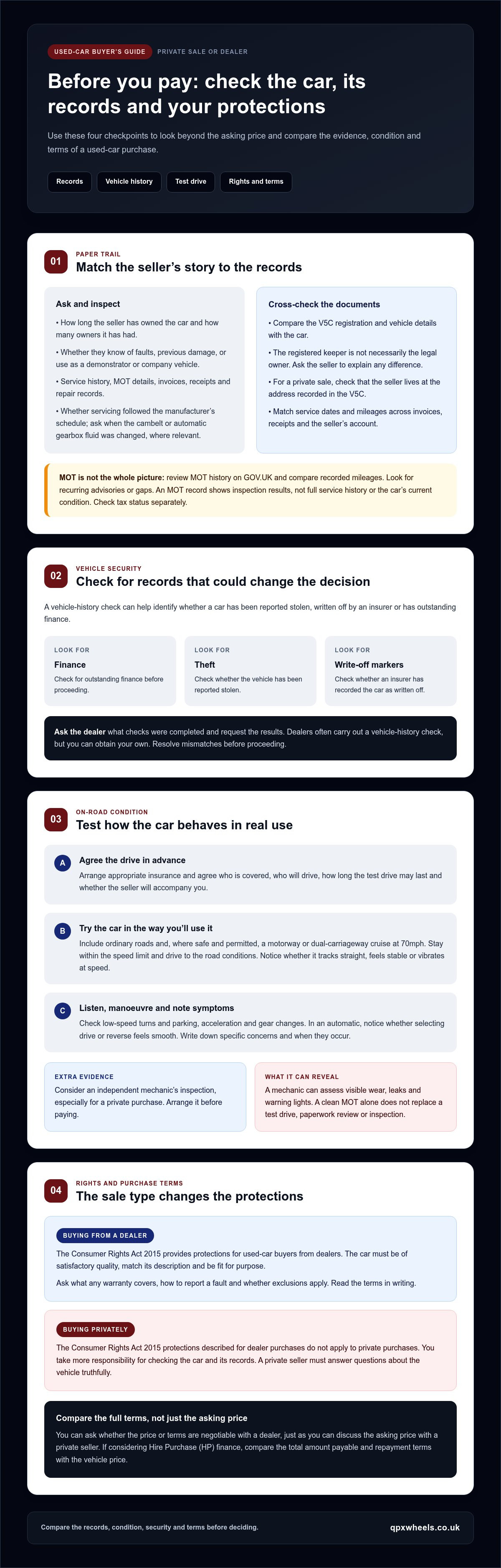
Ask a private seller how long they’ve owned the vehicle, how many owners it has had, and whether they know of any faults. Request the service history, MOT status, receipts and details of previous damage. Ask whether it was ever used as a demonstrator or company vehicle. Compare the seller’s answers with the car’s records.
Check the V5C logbook and compare its registration and vehicle details with the car. The V5C contains the registered keeper’s details, which can help you check the seller’s connection to the vehicle. The registered keeper isn’t necessarily the legal owner, so ask the seller to explain any difference. For a private sale, check that the seller lives at the address recorded in the V5C.
Review the MOT history free on GOV.UK. Compare each recorded mileage with the dashboard reading and the seller’s account; ask for an explanation of any gaps or inconsistencies. Check the MOT results for recurring advisories, such as worn tyres or suspension concerns. An MOT record shows inspection results, not the car’s full service history or current condition.
Ask for service invoices and receipts, not just a stamped booklet. Match dates and mileages across the documents, and check whether servicing followed the manufacturer’s schedule. If the car has a belt-driven petrol, diesel or hybrid engine, ask whether its cambelt has been changed and when. For an automatic, ask whether the gearbox fluid has been changed. Missing records can make future maintenance harder to assess, particularly if repairs could be expensive.
Key questions to ask a private car seller in the UK include: what work has been done, what faults are known, and are there supporting records? Ask about previous owners, accident damage, outstanding finance and any changes in mileage. A private seller must answer questions about the vehicle truthfully. State specific concerns clearly and keep the replies with your purchase notes.
For documents, examine the V5C, MOT certificate or digital MOT record, service history and repair receipts. Dealers often carry out a vehicle history check, but you can obtain your own. A history check can reveal whether the car was reported stolen, written off by an insurer or has outstanding finance. Ask what checks the dealer completed and request the results.
To check MOT history, enter the vehicle registration on GOV.UK, then compare recorded mileages with the service documents. Check tax status separately using the registration before paying; an MOT record doesn’t establish tax status. Use a vehicle history check to look for finance, theft and write-off markers, and resolve any mismatch before proceeding.
Before a test drive or payment, compare the registration and vehicle details against the V5C and records. Arrange appropriate insurance before driving, and consider an independent mechanic’s inspection, especially for a private sale. Don’t rely on a clean MOT alone: review the paperwork, inspect the vehicle and ask about anything that conflicts with its history.
2. Can I Take The Car For A Proper Test Drive?
A proper test drive helps reveal issues that photographs and paperwork can’t show. Agree a route with the seller that includes ordinary roads and, where safe and permitted, a motorway or dual-carriageway cruise at 70mph. This can help you notice whether the vehicle tracks straight, feels stable or develops vibration at speed. Stay within the speed limit and drive according to the road conditions.
Before driving a privately sold car, arrange appropriate insurance and agree who will be covered. Ask the seller whether you can drive, how long the drive may last, and whether they expect to accompany you. These practical questions to ask a private car seller vs a dealer can clarify the arrangements before you arrive. Adjust the seat, mirrors and controls, then listen for unusual engine or gearbox noises as you set off.
Assess the vehicle in the way you’ll use it. Try low-speed turns and parking manoeuvres, and check how the car responds when accelerating and changing gear. In an automatic, notice whether selecting drive or reverse feels smooth. Ask whether the car has any known driving issues, too. Note when a symptom occurs rather than relying on a general description.
An independent mechanic’s inspection before a private purchase can identify faults you may not spot on the road. Arrange it before paying, and agree with the seller how the vehicle will be made available. A mechanic can assess visible wear, leaks and warning lights, then explain which findings need attention. This gives you another source of evidence alongside the test drive.
After driving, write down specific concerns and raise them calmly. If the steering vibrates at speed, for example, ask whether the wheels have been balanced or repaired. A test drive doesn’t guarantee a price reduction, but clear evidence gives you a practical basis for discussing the price or asking about an issue. Include these points in your questions to a private seller or dealer.
With a dealer, ask what any warranty covers, how to report a fault and whether exclusions apply. Read the terms in writing. If you’re considering Hire Purchase (HP) finance, compare the total amount payable and repayment terms with the vehicle price. These are separate parts of the purchase, so understand each before signing.
Once you’ve assessed the car and its terms, compare dealership options, including used cars with HP finance, with the private-sale route. Choose based on the inspection findings, your budget and the arrangements that suit you.
3. Consumer Rights Act protections for dealer purchases
Where you buy matters. According to UK legislation (legislation.gov.uk), the Consumer Rights Act 2015 provides protections for people buying used cars from dealers, but those protections don’t apply to private purchases. A dealer-sold car must be of satisfactory quality, match its description and be fit for purpose. What counts as satisfactory quality depends on the car’s age, price, mileage and condition, so assess it as a used vehicle rather than expecting it to be new.
According to UK legislation (legislation.gov.uk), a used-car buyer may return a car and get a refund if it fails to meet the required standards within 30 days of purchase. Keep the advert, invoice, finance paperwork and messages, then describe the fault clearly to the dealer. If the problem appears during that period, raise it promptly and explain why the vehicle doesn’t meet the required standard. Clear records help show what was advertised and when the issue arose.
After the first 30 days and within the first six months of buying from a dealer, you can ask for a repair or replacement. The dealer is assumed liable for faults that develop in that period, subject to caveats. This doesn’t mean every mechanical problem is automatically covered: the car’s age, mileage, condition and the nature of the fault matter. Explain the defect and give the dealer an opportunity to respond under your consumer rights.
A private purchase offers different protection. A private seller must answer your questions truthfully, and the car must match its description and legally belong to the seller. However, the seller isn’t required to ensure it is of satisfactory quality or fit for purpose, or to repair it before sale. Ask directly about known faults, record the answers and compare them with the advert. If the seller describes the car inaccurately, keep evidence of that description.
Dealer warranties and private-sale guarantees aren’t the same as statutory rights. A dealer warranty may cover specified faults for a stated period, but read its terms, exclusions and claims process; it doesn’t replace your legal rights. A private seller has no obligation to provide support after purchase. Ask whether a dealer warranty applies, what parts it covers, and whether maintenance conditions affect it.
Before buying from a dealer, ask: “Does the car match the advert?”, “What known faults or repairs should I know about?”, and “What does the warranty cover?” Also clarify how to report a fault and whether any promises are recorded in the paperwork. These questions help you understand the dealer’s position and distinguish warranty cover from your protections under the Consumer Rights Act.
For a private sale, ask the same questions about faults and repairs, then keep the seller’s written replies. If the car develops a problem, your options depend on the sale type, the seller’s statements and the evidence. Understanding these differences before paying helps you choose with a clearer view of the protection available.
4. Dealer checks for outstanding finance and stolen vehicles
Before paying, establish whether the car has outstanding finance or a stolen-vehicle marker. UK dealerships are obliged to check both before selling a vehicle. A vehicle history check can show whether it has been reported stolen, written off by an insurer or has outstanding finance. Ask the dealer which checks it completed and what they showed. If a record raises concern, pause the purchase and ask for a clear explanation before agreeing terms.
A finance marker matters because the lender may have an interest in the vehicle until the agreement is settled. Ask whether any finance remains and how it will be cleared as part of the sale. For a private purchase, run a vehicle history check yourself rather than relying only on the seller’s answer. Keep a copy of the result with the advert and messages. If the seller’s explanation conflicts with the check, don’t proceed until the discrepancy is resolved.
For a private sale, compare the registration number on the car with the V5C and the history-check result. Check that the vehicle’s make, model and other details match the documents. Ask to see the seller’s identification and compare the name and address with the V5C details. The V5C identifies the registered keeper, not necessarily the legal owner, so ask who owns the car and why they’re selling it if those details differ. Check that every key offered operates the vehicle, and ask whether any keys are missing.
Negotiating differs by seller. A private sale may cost less, but you take more responsibility for checking the vehicle and handling the sale. With a dealer, discuss the advertised price alongside the car’s condition, paperwork and any included support. Use a specific finding, such as an unexplained finance record or a mismatch in the vehicle details, to ask for clarification rather than simply a lower price. The Consumer Rights Act applies to dealer purchases, but you still need to understand the agreement.
To negotiate constructively, compare the asking price with the car’s condition and the evidence gathered from its records. Ask, “Is there room to discuss the price?” and explain your reasoning calmly. If a seller won’t address a discrepancy, walking away is safer than accepting an unresolved risk. Don’t transfer money until the identity, ownership details, vehicle records and agreed price all align. Use a payment method that gives you a clear transaction record, and make sure the sale details are recorded in writing.
For either seller type, keep the advert, messages, history-check result and sale paperwork together. These records help you remember what was represented during the sale. A dealer’s checks provide an important safeguard, while an independent check gives you a clearer view when buying privately. Use the documents and the seller’s answers to assess whether the vehicle is worth pursuing.
5. Comparing dealership and private-seller security
Security depends on the checks, records and legal protections behind the sale, not simply the seller’s label. UK dealerships are obliged to check whether a car has outstanding finance or has been reported stolen. A vehicle history check can also flag an insurance write-off. These checks help uncover risks, but compare the results with the vehicle and paperwork in front of you.
Dealers inspect used cars and address major mechanical issues before putting them up for sale. Ask what inspection was carried out, what work followed, and whether the records can be shown. A dealer may also handle purchase paperwork, giving you a clearer record of the transaction. Read the advert and any written description carefully, and ask about anything unclear before signing or paying.
A private seller has different obligations. They must answer your questions about the vehicle truthfully, and the car must match its description and legally belong to them. However, a private seller is not legally required to disclose faults unless asked directly. Ask about known damage, mechanical problems, outstanding finance and previous repairs, then keep the answers with the advert and messages.
For a private sale, check that the seller lives at the address shown on the V5C and that the vehicle details match. The V5C names the registered keeper, which may not be the legal owner, so ask who owns the car. Run a vehicle history check for stolen, write-off and finance records. If the seller’s answers conflict with the check or documents, stop and resolve the discrepancy before purchasing.
Consider what happens after the keys change hands. A private seller has no obligation to provide support after the purchase, so your own inspection and records matter. Buying from a dealer brings Consumer Rights Act protections, although those rights don’t make every fault automatically the dealer’s responsibility. A warranty may offer additional cover; read its terms, exclusions and claims process rather than assuming it covers every hidden problem.
Price can also shape your choice. A private sale may suit a buyer prioritising lower cost, provided they’re comfortable managing the checks and risks. With a dealer, compare the price with the vehicle’s condition, paperwork and support, then negotiate using specific evidence rather than a general request for a reduction. In either case, don’t let a low asking price outweigh unresolved finance, an inconsistent description or missing ownership evidence.
For a more structured dealership purchase, explore used-car options and compare the vehicle details and purchase terms before deciding.
QPX Wheels: Used Vans
QPX Wheels offers used vans and used cars for buyers who have compared private-sale checks with dealer protections and are ready to consider their next vehicle. If you’re replacing a car, its Vehicle Valuation Service can help you assess its value as part of your plans. Hire Purchase (HP) Finance is also available if you’re considering how to spread the cost of a vehicle.
Before deciding, use the questions in this guide to compare vehicle condition, records, ownership and purchase terms. Consider which checks and protections matter most to you, then explore the relevant QPX Wheels options. For a straightforward next step, contact QPX Wheels to discuss used vans or cars.
Make your next move with confidence
The questions to ask a private car seller vs a dealer can help you identify the buying route that suits your priorities. Before committing, decide how much of the checking and paperwork you want to manage yourself, and what kind of vehicle fits your day-to-day needs. Make your choice by matching those priorities to the car, rather than settling for the first appealing advert.
If you’re ready to explore dealer options, QPX Wheels offers used cars and used vans. Its Vehicle Valuation Service can also support your plans if you’re considering your current vehicle as part of your next purchase. Take time to compare your options, then contact QPX Wheels to discuss your next step.
Contact QPX Wheels for help exploring your next vehicle. A considered decision can make the buying process feel much more manageable.
According to legislation.gov.uk, the Consumer Rights Act 2015 provides protections for used-car purchases from dealers, but those protections don’t apply to private purchases.
Frequently Asked Questions
Can You Negotiate with a Dealership?
Yes, you can ask a dealer to discuss the price or terms before agreeing to buy. Make your request specific: refer to a comparable vehicle, a feature you don’t need, or a point in the advert that needs clarification. You can also ask whether the deal can be adjusted through the vehicle price or another part of the written offer. Get any agreed change recorded before signing.
Are There Any Additional Fees Or Add-Ons I Should Know About?
Ask for an itemised written breakdown of the amount payable, including any agreed optional products or charges. Ask which items are optional, what each provides and whether declining one changes the agreement. If considering finance, separate the vehicle’s cash price from the finance costs and terms. Don’t rely on a monthly figure alone: read the agreement’s total amount payable and check that it matches your understanding.
Can I See The Service History And MOT Details?
Yes. Ask to see the service records and MOT history before deciding, then compare their dates and mileages with the vehicle’s current reading. For example, query a service invoice that records a higher mileage than a later MOT entry. Ask the seller to explain any discrepancy and keep a note of the answer. For a digital MOT record, search GOV.UK using the vehicle registration.
Can I Take A Look At The Paperwork Before Signing?
Yes, read every document before signing, including the sale invoice, finance agreement and any warranty terms. Check that the vehicle details, buyer’s name, agreed price and payment arrangements are correct. For finance paperwork, make sure the amount borrowed and repayment schedule match the offer you accepted. Read the cancellation and complaint sections too, and ask for corrections before signing if anything is inaccurate.
Can I Take The Car For A Proper Test Drive?
Ask to drive the vehicle before committing, and agree the route and insurance arrangements beforehand. Include ordinary streets and, where safe and permitted, faster roads so you can assess steering, braking and gear changes at different speeds. After driving, note any warning lights, unusual noises or changes in handling. If a symptom appears, describe when it happened and ask for it to be investigated before proceeding.
Has This Car Ever Been Used As A Demo Or Loan Vehicle?
Ask whether the vehicle previously served as a demonstrator, courtesy car or loan vehicle, and request details of its use. A demonstrator may have been driven by different people, so compare its mileage and interior wear with the seller’s description. Ask how its use is reflected in the vehicle’s records and whether the advertised condition accounts for it. Record the answer alongside the advert before deciding.
Is There Room For Negotiation?
There’s no harm in asking, whether the seller is a dealer or a private owner. For a private sale, explain your offer with a clear reason, such as a difference between the advert and the vehicle’s condition. With a dealer, ask whether the price or written terms can be discussed. Keep the conversation polite and specific, and confirm any revised offer in writing before arranging payment.
What Is The Total Price Of This Car?
Ask for the full amount payable to buy the car, including any agreed extras, before you commit. If you’re paying with finance, ask for both the vehicle’s cash price and the agreement’s total amount payable, plus the deposit and repayment schedule. Check whether optional products are included in the figures or priced separately. Comparing the written totals helps you understand the overall commitment, not just the headline price.


