
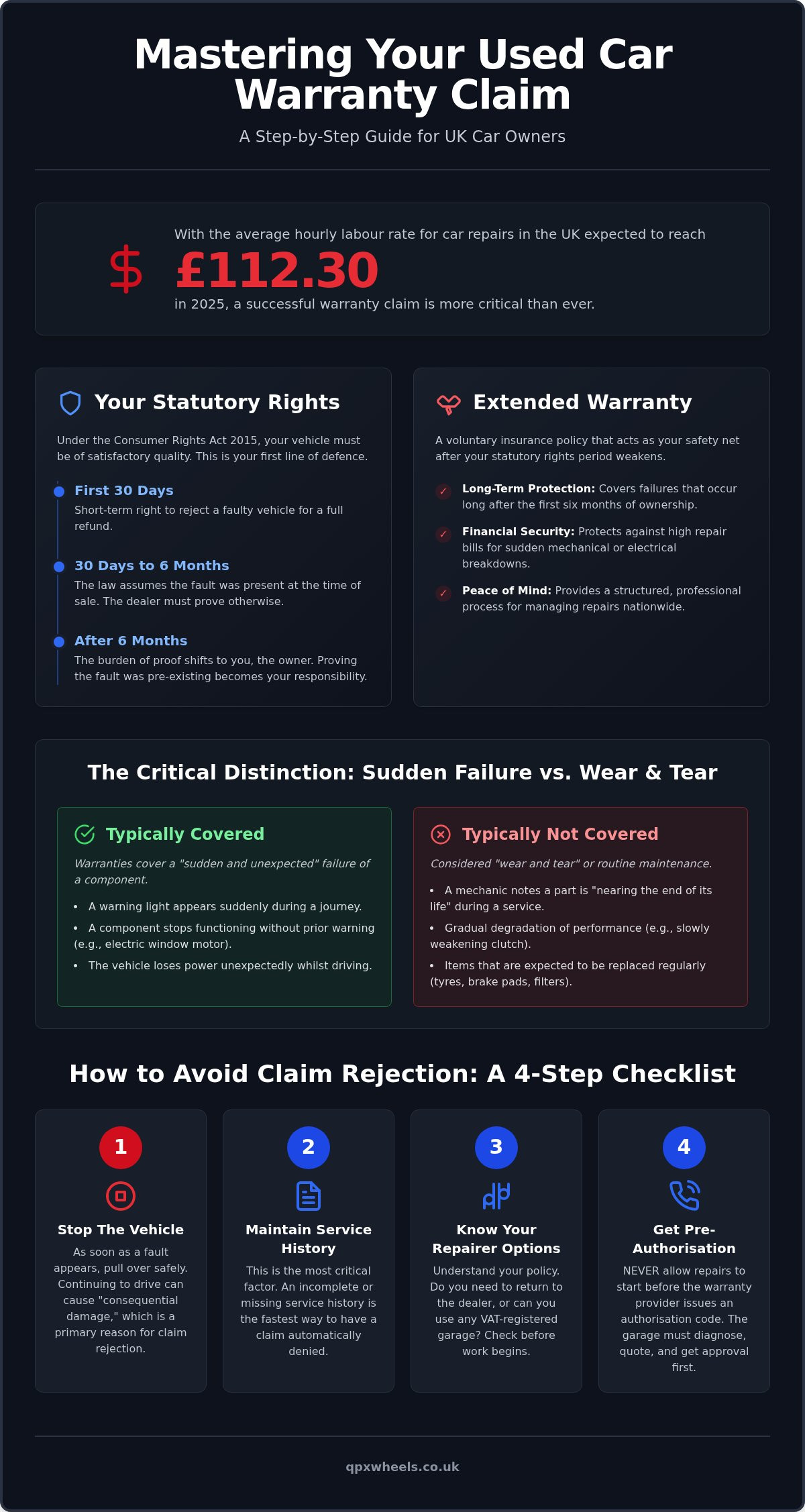
With the average hourly labour rate for car repairs in the UK reaching £112.30 in 2025, the difference between a successful warranty claim and a rejected one has never been more significant. It is completely understandable to feel a sense of anxiety when a warning light appears, particularly if you are worried about complex "wear and tear" clauses or the prospect of being left without a vehicle whilst repairs are carried out. You bought a warranty for peace of mind, and you deserve to have the process work exactly as it should.
This guide will help you master exactly how to claim on used car warranty UK wide, ensuring you follow the necessary steps to secure a zero-cost repair. We will clarify the confusion surrounding authorised garages and show you how to maintain clear communication with your provider, such as AutoProtect. By following this methodical sequence, you can avoid common pitfalls and focus on getting back behind the wheel with minimal downtime and total confidence in your vehicle's reliability.
Key Takeaways
- Distinguish between your statutory rights and your voluntary warranty to ensure you are using the most effective legal protection for your vehicle's specific fault.
- Master the essential procedural steps for how to claim on used car warranty UK policies, including the importance of stopping the vehicle immediately to avoid "consequential damage" exclusions.
- Learn to navigate the "wear and tear" trap by understanding how warranty providers differentiate between a sudden mechanical failure and expected part degradation.
- Recognise why a complete and up-to-date service history is the most critical factor in securing a successful claim and avoiding automatic rejection.
- Discover how opting for an extended warranty from a reputable dealership provides a structured safety net and professional support for long-term vehicle reliability.
Understanding the Used Car Warranty Landscape in the UK
A used car warranty is not a service plan or a guarantee of perfection. It is a specific form of insurance designed to protect you against sudden mechanical or electrical failures that occur after you've driven your vehicle away. Gaining a foundational Understanding Used Car Warranties helps clarify that these agreements are separate from your legal rights as a consumer. In the UK, the process involves three main parties: you as the owner, the garage performing the work, and the warranty provider who underwrites the cost. At QPX Wheels, we've spent over 16 years helping customers understand these relationships to ensure long term satisfaction.
Statutory Rights vs. Extended Warranties
Your first line of defence is the Consumer Rights Act 2015. This legislation dictates that any car sold by a dealer must be of satisfactory quality and fit for purpose. For the first 30 days, you have a short term right to reject a faulty vehicle for a full refund. Between 30 days and six months, the law assumes any fault was present at the time of sale unless the dealer can prove otherwise. This is a powerful legal shield, but it has its limits.
Once you pass that six month milestone, the burden of proof shifts to you. This is exactly where knowing how to claim on used car warranty UK policies becomes essential. An extended warranty provides a voluntary layer of protection that remains active long after your statutory window has narrowed. It moves the financial responsibility from the dealership's balance sheet to a dedicated provider. This ensures you aren't left stranded by high repair bills as the vehicle ages and mileage increases.
The Importance of the "Sudden Failure" Clause
Warranties are built around the concept of "breakdown" rather than "maintenance." A common point of confusion is why a part found to be "excessively worn" during an MOT might be rejected, whilst the same part failing completely on the motorway is covered. Most policies require a component to suffer a "sudden and unexpected" failure to trigger a payout. This means the part must have been working one moment and ceased to function the next.
Identifying if your fault qualifies is usually straightforward. If the car was performing correctly and then suddenly displayed a warning light or lost power, you likely have a valid claim. If a mechanic suggests a part is "nearing the end of its life" during a routine service, this is typically classified as wear and tear. Learning how to claim on used car warranty UK schemes involves recognising this distinction early. It helps you manage expectations and ensures you present the correct information to the claims handler from the very start.
The Different Types of Used Car Warranties and Their Claim Protocols
The process for how to claim on used car warranty UK policies depends largely on who issued the agreement. Not all warranties follow the same administrative path, and understanding these differences before a fault occurs can save you significant time. Generally, you will encounter three main types: dealer-backed, manufacturer approved-used, or third-party extended warranties. Each has a specific set of rules regarding where you can take the vehicle and how the bill is settled.
Manufacturer schemes, such as those from Ford or BMW, typically offer the most seamless experience. They allow you to visit any franchised dealership across the country. In contrast, dealer-backed warranties are often self-funded by the showroom where you bought the car. These usually require you to return the vehicle to their specific workshop for repairs. If you live a significant distance from the original dealership, this can become a major logistical hurdle. At QPX Wheels, we prioritise your convenience by offering Extended Warranties through established third-party providers like AutoProtect. This ensures you have nationwide protection and aren't restricted to a single location in Manchester or the North West.
Dealer-Backed vs. Third-Party Claims
Third-party warranties offer a middle ground of flexibility. They generally permit repairs at any VAT-registered garage in the UK, provided the workshop agrees to the provider's terms. However, they are often stricter regarding the sequence of events. You cannot simply have the work done and send the invoice later. The garage must provide a diagnostic report and a quote to the warranty company, which then issues an authorisation code before any parts are ordered. If you bypass this step, the claim will almost certainly be rejected, regardless of how genuine the mechanical failure is.
Claim Limits and Hourly Labour Rates
One of the most common causes of frustration is the "labour rate cap." As of 2025, the average hourly labour rate for car repairs in the UK reached £112.30, a steady increase from £104.11 in 2023. Many warranty policies, however, may only cover up to a specific amount, such as £60 or £80 per hour. If your chosen garage charges more than your policy's limit, you will be responsible for paying the difference yourself.
You should also verify your total claim limit. This is often either the purchase price of the vehicle or a fixed sum per claim. For example, if you have a £2,000 limit and require a major engine repair, the warranty will cover you up to that amount. It's vital to check if your limit is "per claim" or "in aggregate." An aggregate limit means once you've reached the total value over several small repairs, the policy is effectively exhausted. Understanding these financial boundaries is a key part of mastering how to claim on used car warranty UK agreements effectively.
Step-by-Step Guide: How to Claim on Your Used Car Warranty
The moment a warning light appears or you hear an unusual noise, your immediate priority should be safety. Pull over as soon as it is safe to do so. Continuing to drive a vehicle with a known fault can lead to "consequential damage." This is a specific clause in most policies that allows a provider to reject your claim if they believe your actions turned a minor issue into a major mechanical failure. Once the vehicle is stationary, locate your warranty handbook and review the "What is Covered" section to see if the failing component is listed. Understanding how to claim on used car warranty UK plans starts with this careful preparation.
Before any garage begins work or even starts dismantling the engine, you must contact your warranty provider. They need to log the fault and provide you with a claim reference. If a mechanic begins repairs without prior consent, you will likely be held liable for the entire bill. This initial contact ensures that everyone is following the correct procedural sequence from the outset.
The Diagnostic Phase: The Crucial First Step
You are responsible for authorising the initial diagnostic work. Most garages will charge a fee to identify the exact cause of the failure. It is important to recognise that the warranty company will usually only reimburse this cost if the fault is confirmed as a covered item. If the mechanic discovers the issue is due to a non-covered part or simple wear and tear, you will have to settle the diagnostic bill yourself. To keep things moving, ask the garage to communicate their findings directly to the warranty claims team, providing any necessary error codes or photographic evidence.
Gaining Authorisation: Do Not Start the Repair Yet
An authorisation number is the only guarantee that the warranty company will pay for the repair. Never allow a garage to order parts or begin labour until this number has been issued. In some cases, particularly for high-value claims like a gearbox replacement, the provider may send an independent engineer to inspect the car. This is a standard part of the process designed to verify the "sudden failure" we discussed earlier. Whilst it can add a day or two to the timeline, it is a vital step in securing a successful payout.
Payment Protocols: Direct Pay vs. Pay and Reclaim
There are two ways the final bill is typically settled. Many established workshops are happy to "invoice the warranty company directly," meaning you only pay for any excess or non-covered items. However, some garages require you to pay the full amount upfront. In this scenario, you must send the final, itemised invoice to the provider to reclaim your funds. If you are a VAT-registered business owner, be aware that most warranty companies will only pay the net amount, leaving you to settle the VAT portion yourself. Always clarify which payment method the garage accepts before the work begins to avoid any last-minute financial surprises.
Why Warranty Claims Get Rejected and How to Avoid It
The biggest concern for any driver is having a claim turned down at the final hurdle. Rejection is rarely a matter of the warranty company being difficult; it's usually due to a specific clause in the agreement that hasn't been met. Understanding how to claim on used car warranty UK policies effectively means knowing how to navigate the "wear and tear" trap. Whilst sudden mechanical failures are covered, providers will reject claims for parts that have simply reached the end of their natural life. For example, a gearbox bearing that fails suddenly is a valid claim, but a clutch that has gradually started to slip after 80,000 miles is often classified as expected degradation.
Another major pitfall is the "consequential damage" clause. As we highlighted in the step-by-step guide, you must stop driving the moment a fault occurs. If a small, £30 coolant hose splits and you continue to drive until the engine overheats and seizes, the warranty provider will likely only pay for the hose. They'll argue that the £2,000 engine repair was a direct consequence of your decision to keep driving, leaving you to settle the bulk of the bill yourself.
The Service History Requirement
Your vehicle's maintenance record is the most powerful tool you have when learning how to claim on used car warranty UK successfully. Meticulous records prove that you've taken reasonable steps to prevent mechanical failure. It's a harsh reality that a missed service in 2023 can void a major gearbox claim in 2026. The claims handler will argue that the failure could have been spotted or prevented if the manufacturer's schedule had been followed. Most providers allow a small grace period, usually 30 days or 1,000 miles, but exceeding this even once can jeopardise your future protection. Always ensure your garage uses parts of "equivalent quality" to the originals, as non-standard or budget components can sometimes be used as a reason to deny a claim.
Betterment and Financial Contributions
Betterment is a concept that often surprises car owners. If your high-mileage engine fails and the warranty company pays for a brand-new replacement, your car is technically in a "better" condition than it was before the fault. To account for this, many policies include a betterment scale. If your car has covered over 60,000 miles, you might be asked to contribute a percentage, often around 20%, towards the cost of new parts. This isn't a hidden fee; it's a standard industry practice designed to keep policy costs fair for everyone.
At QPX Wheels, we focus on transparency so you aren't caught off guard by these clauses. We recommend reviewing our Extended Warranties to see how we provide clear, supportive guidance that helps you maintain long-term vehicle reliability without the stress of unexpected rejection.
Securing Long-Term Reliability with QPX Wheels
A successful warranty claim is a vital safety net, but the most reassuring experience for any driver is never needing to use it. At QPX Wheels, we believe that long term satisfaction begins long before you receive your keys. By focusing on the quality of our initial stock and providing clear, honest guidance, we aim to eliminate the typical anxieties associated with the secondary market. Our role is to act as your seasoned guide, ensuring you have the right vehicle and the right protection for the road ahead.
Why We Prioritise HPI Clear and Well-Maintained Stock
Our 16 years of industry experience has taught us that a vehicle's history is the most accurate predictor of its future reliability. We are highly selective about the cars and vans we bring into our inventory, focusing on models with a proven track record for durability. Every vehicle we sell is HPI clear, meaning it has no hidden history of major accidents or outstanding finance that could complicate your ownership experience.
This rigorous selection process is designed to ensure you start with a clean slate. We perform thorough pre-sale checks to identify and resolve potential issues before the car reaches our forecourt. By avoiding high-risk models and prioritising well-maintained examples, we significantly reduce the likelihood of you ever needing to research how to claim on used car warranty UK procedures. We want your relationship with your new vehicle to be defined by reliability rather than repair schedules.
Nationwide Support for Every Buyer
We understand that our customers come from across the country, which is why we offer nationwide delivery to your doorstep. This geographical flexibility is matched by our extended warranty options. Because we partner with established third-party providers, your protection is not tied to our local workshop in the North West. If a fault does occur, you have the freedom to use any VAT-registered garage near your home, provided you follow the authorisation steps we have outlined in this guide.
Our commitment to transparency means we are always here to support you during the first months of ownership and beyond. Whether you need advice on a specific clause or help understanding how to claim on used car warranty UK policies, our team provides the calm, professional assurance you need. We invite you to View our latest used cars and vans with warranty options and discover a more supportive way to purchase your next vehicle. From budget-friendly automatics to luxury vehicles, we ensure every transaction is grounded in ethical conduct and a genuine desire for your long term satisfaction.
Drive Forward with Professional Protection
A successful warranty claim isn't just about the mechanical fault; it's about following a disciplined sequence that protects your finances. By ensuring you stop the vehicle immediately, secure prior authorisation, and maintain a meticulous service history, you remove the common obstacles that lead to rejection. Mastering how to claim on used car warranty UK policies effectively transforms a potentially stressful breakdown into a manageable, zero-cost repair. It's about having the right procedures in place before you ever need them.
With over 16 years of industry experience, QPX Wheels is committed to providing HPI clear vehicles and nationwide delivery to ensure your peace of mind from day one. We believe that transparency and supportive guidance are the foundations of a great car-buying journey. Whether you are looking for a reliable daily driver or a versatile van, we're here to help you navigate every step of ownership with total confidence.
Browse our latest used cars and vans with extended warranty options to start your next journey on the right track. We look forward to helping you find a vehicle that delivers long-term reliability and the professional support you deserve.
Frequently Asked Questions
Can I take my car to any garage for a warranty repair in the UK?
You can generally use any VAT-registered garage if you have a third-party policy, but you must check your handbook first. Some dealer-backed agreements require you to return the vehicle to the original point of sale for all repairs. If you have moved house or bought from a distant dealership, verifying this detail is a vital step before you book any diagnostic work.
Will the warranty cover the cost of a hire car whilst mine is being fixed?
Hire car coverage is not a standard feature in every policy. Many providers offer a daily contribution towards a replacement vehicle, but this usually only triggers once a certain number of labour hours have been authorised for the repair. You should check your specific "Additional Benefits" section to see the daily financial limit and the maximum number of days covered.
What happens if the warranty company disagrees with the garage’s diagnosis?
If there is a dispute over the cause of a fault, the provider will typically appoint an independent engineer to inspect the vehicle. This expert provides an unbiased report on whether the failure was sudden or due to wear and tear. This process ensures a fair outcome for both you and the insurer, though it may slightly extend the repair timeline whilst the inspection is arranged.
Do I have to pay the VAT on a warranty repair?
Private individuals don't usually pay the VAT on authorised repairs as the provider settles this directly with the garage. However, if you are a VAT-registered business owner, the warranty company will often only pay the net amount of the invoice. You'll need to pay the VAT portion yourself and then reclaim it through your usual business tax return at the end of the quarter.
Is a used car warranty valid if I do not have a full service history?
A complete service history is almost always a mandatory requirement for your policy to remain valid. Learning how to claim on used car warranty UK schemes becomes difficult if you cannot prove the vehicle was maintained to the manufacturer's standards. Even a single missed oil change or a late service can be used as grounds to reject a major engine or turbocharger claim.
What is the "betterment" clause and how much will I have to pay?
Betterment is a contribution you pay when a new part improves the car's value beyond its condition before the fault. This is common on high-mileage vehicles. For example, if an engine fails at 80,000 miles and is replaced with a brand-new unit, you might be asked to pay a percentage of the parts cost, often ranging from 10% to 30% depending on the mileage.
Can I claim for a fault that was present when I bought the car?
No, warranties are designed to cover sudden failures that occur during the policy period. If a fault was present at the point of sale, this falls under your statutory rights under the Consumer Rights Act 2015 rather than your warranty. Understanding this distinction is key when figuring out how to claim on used car warranty UK agreements versus seeking a direct dealer repair or rejection.
How long does a typical used car warranty claim take to process?
Most claims are authorised within 24 to 48 hours once the warranty company receives the full diagnostic report and quote from your garage. The total time you'll be without your car depends more on parts availability and the workshop's current workload. Clear communication between the mechanic and the claims handler is the most effective way to speed up the authorisation process.


