
Why spend weeks haggling with strangers online when your current vehicle could be the secret to a much cheaper upgrade today? Finding a fair valuation for your px car is about more than just the number on the screen. It is the most effective way to bridge the gap between the vehicle you have and the one you want without the stress of a private sale.
We know that many drivers feel anxious about receiving low-ball offers or getting lost in a mountain of confusing paperwork. It's a common concern, especially when you want to ensure your finance is settled correctly and your deposit is maximised. This guide will help you discover how to navigate the part-exchange process to secure the best possible value for your current vehicle whilst upgrading to your next one.
You will learn exactly which documents you need for a 2026 transaction, how to calculate your "cost to change," and what the latest VED changes mean for your trade-in. We'll provide a clear roadmap to help you manage the transition with ease, ensuring you feel confident that every detail is under control.
Key Takeaways
- Understand how a part-exchange acts as an immediate deposit, allowing you to upgrade your vehicle in a single day without the hassle of a private sale.
- Learn why focusing on the "cost to change" is more beneficial for your budget than just the individual valuation of your px car.
- Discover how simple preparations, such as organising your service history and a professional valet, can significantly boost your vehicle's trade-in value.
- Gain confidence in navigating the 2026 UK regulations, ensuring all finance settlements and V5C paperwork are handled correctly and securely.
- Explore how to combine your part-exchange with tailored HP or PCP finance to reduce monthly outgoings and secure a better specification vehicle.
What is a PX Car? Understanding the Value of Part-Exchange
A px car is essentially the vehicle you currently own that you trade in to a dealership to offset the cost of your next purchase. It serves as a form of practical currency. Instead of paying the full price of your new car in cash or taking out a much larger loan, the value of your old one is deducted from the total. If you are looking for a foundational definition, asking What is part-exchange? reveals it is the most common method in the UK to simplify the transition between vehicles.
One of the biggest hurdles in car ownership is the "gap" period. Selling a car privately often leaves you without transport for days or weeks, or forces you to own two vehicles at once whilst you wait for a buyer. Part-exchange removes this friction entirely. You drive to the dealership in your old car and drive home in the new one. The UK market is shifting heavily towards this model because it prioritises safety. You don't have to invite strangers to your home or worry about the risks of fraudulent bank transfers from unverified buyers.
The Financial Benefits of Trading In
When you use a px car, the valuation acts as an instant deposit. This is incredibly useful if you are looking at Hire Purchase (HP) or PCP finance agreements. By increasing your initial deposit through a trade-in, you reduce the total amount you need to borrow. This usually leads to lower monthly payments and less interest paid over the life of the agreement. For business users trading in vans, dealers often use the VAT Margin Scheme for second-hand vehicles, which ensures VAT isn't charged multiple times on the same asset. You also avoid the hidden costs of private sales, such as the £50 to £100 spent on advertising listings and the many hours lost dealing with time-wasters.
Is Your Vehicle Eligible for Part-Exchange?
Most reputable dealerships accept a wide range of vehicles, from high-mileage budget hatchbacks to luxury vans and disabled-friendly vehicles. If you have outstanding finance on your current car, the process is still straightforward. The dealer can often settle your existing agreement directly with the finance company. If your car is worth more than the settlement figure, you have "positive equity" to use as a deposit for your next purchase. Even if you are in "negative equity," where the car is worth less than the remaining loan, options exist to roll that balance into a new plan. To secure the best valuation, ensure your car has a valid MOT and is in a roadworthy condition. While you can technically trade in a car without a V5C logbook, having your paperwork organised makes the transition much faster.
How Part-Exchange Works: A Step-by-Step Process
Getting the best value for your px car starts with understanding the sequence of events. It is not just about handing over keys; it is a structured transition designed to be efficient. The process begins with an accurate valuation based on current UK market trends. Because the used car market fluctuates based on seasonal demand and supply levels, using live data ensures the offer reflects the true worth of your vehicle at that specific moment.
Once you have a valuation, the next step is to negotiate the "cost to change." This is a vital concept for any savvy buyer. Rather than fixating solely on the trade-in price of your old car or the sticker price of the new one, you should focus on the difference between the two. This figure represents the actual amount you will need to pay or finance. It is the most transparent way to see if the deal aligns with your budget.
Integrating your part-exchange value into a finance agreement is where the process becomes truly seamless. Whether you choose Hire Purchase (HP) or PCP finance, the trade-in value acts as your deposit. This reduces the total amount you borrow, which in turn lowers your monthly repayments and the overall interest you pay. While you move through these financial steps, it is wise to be aware of your consumer rights when buying a car to ensure you feel fully protected throughout the transaction.
Finally, you will organise the handover. Modern dealerships often provide nationwide delivery, meaning you don't even need to leave your driveway to complete the swap. The delivery driver arrives with your new vehicle, performs a final check of your trade-in, and takes your old car away in one smooth motion. To get started, you can request a professional vehicle valuation to see exactly where you stand.
The Valuation Phase
Accurate valuations rely on transparency. When describing your car, being honest about its condition prevents unexpected price adjustments during the physical inspection. Dealers typically consult CAP and Glass’s Guide data to ensure their offers are competitive and fair. Market value is the realistic balance between what a dealer would pay at trade-in and what a car would fetch on a retail forecourt. This data-driven approach removes the guesswork, giving you a firm foundation for your next purchase.
The Final Handover and Paperwork
Preparation is key to a stress-free handover. You must ensure the V5C logbook is ready to be transferred to the dealership, as this is the legal proof of the trade-in. Gathering all sets of keys, the original owner's manuals, and the service history books will help maintain the agreed valuation. For those opting for nationwide delivery, the "doorstep swap" is a practical solution. The driver will verify the documents and the vehicle's condition on-site, ensuring the transition is completed safely and correctly without any delay to your schedule.
Part-Exchange vs. Private Sale: Which Is Right for You?
Choosing between a part-exchange and a private sale usually boils down to a trade-off between the highest possible price and the lowest possible stress. Whilst a private listing might show a higher headline figure, your px car offers a guaranteed, immediate transaction that a private buyer simply cannot match. In January 2026, the average used car price reached £17,294, making these high-value transactions a target for scammers. Dealing with a professional dealership removes the risk of fraudulent payments or the anxiety of hosting strangers at your home.
Speed is the second major factor. A part-exchange is typically finalised in a single afternoon. In contrast, selling privately can take weeks of waiting for the right buyer. During this time, you're often paying for a new car whilst still funding the insurance and tax on the old one. If you're using finance, the interest saved by starting your new agreement sooner often outweighs the small price premium of a private sale. Dealerships also prefer clean, well-maintained stock, meaning a car with a clear service history will always command a strong, fair offer without the need for haggling.
The Hidden Costs of Selling Privately
Private advertising isn't free. Major UK platforms charge significant fees for premium listings that actually get seen. You also have to consider the "time-cost" of answering dozens of messages, many of which will be from "tyre-kickers" who have no intention of buying. Hosting test drives also requires you to verify that the potential buyer has the correct insurance, adding another layer of administrative burden. Additionally, you must keep the vehicle taxed and insured until the moment it's sold, which can eat into your eventual profit if the car sits on your drive for a month or more.
When Part-Exchange is the Clear Winner
There are specific scenarios where part-exchange is undeniably the better choice. If your current vehicle has outstanding finance, a dealership can settle the balance professionally, ensuring the HPI record is cleared correctly. This is much safer than trusting a private buyer to pay off your loan. It's also the best route if you have a niche or heavily modified vehicle. These can be difficult to sell to a general audience, but a specialist dealer understands their true market value. Finally, if you need a vehicle immediately for work or family, the seamless "old-for-new" swap ensures you're never left without transport.
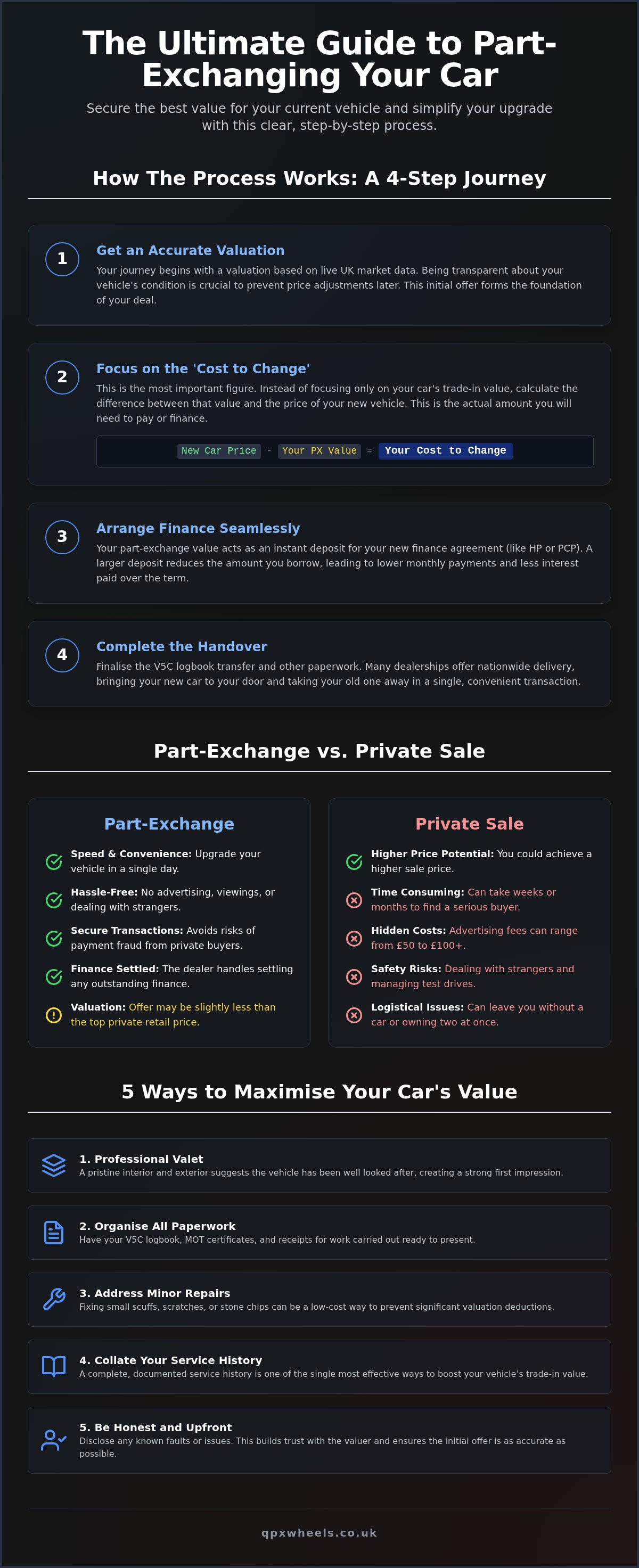
5 Ways to Maximise Your Car’s Part-Exchange Value
While market data provides a baseline, the final valuation of your px car is heavily influenced by how you present it to a dealership. A car that looks and feels well-maintained gives an appraiser confidence that the mechanical components have been equally respected. By taking a few simple steps before your valuation, you can significantly increase the final offer and reduce the "cost to change" for your next vehicle.
To get the best possible result, focus on these five key areas:
- Organise Your Paperwork: A complete service history with all the correct stamps can add hundreds of pounds to a valuation compared to a car with missing records.
- The Visual Impact: Investing in a professional valet helps the car stand out. A clean interior and polished exterior suggest a higher level of ownership care.
- Address Minor Repairs: Fixing small stone chips or wheel scuffs prevents a dealer from making larger "reconditioning" deductions from your offer.
- MOT Status: Try to ensure your car has at least six months of MOT remaining. A short MOT can signal upcoming maintenance costs that a dealer will factor into their price.
- Fluid and Tyre Checks: Ensure your oil, coolant, and screenwash are topped up, and check that all tyres meet the legal depth and pressure requirements.
To see how these improvements impact your specific trade-in, you can request a vehicle valuation from our experienced team for a transparent and fair assessment.
The Power of Documentation
Documentation serves as the physical proof of your car's health. You should gather all receipts for significant recent work, such as cambelt changes, new tyres, or brake pad replacements. These documents prove that the vehicle has been maintained beyond the bare minimum. You must also ensure the V5C logbook is in your name and registered to your current address. A missing spare key is more than a minor annoyance; it can lead to a deduction of between £150 and £300 from your final offer because the dealer will have to order and programme a replacement themselves.
The "Kerb Appeal" Factor
First impressions matter during a vehicle appraisal. Before the dealer sees the car, remove all personal items, dashcam wires, and rubbish from the cabin. A well-presented car signals a well-cared-for engine. If the interior is cluttered or dirty, an appraiser might assume that the mechanical maintenance has been similarly neglected. A quick check of your tyre pressures and fluid levels shows you are an attentive owner, which often leads to a smoother negotiation and a more favourable final figure for your trade-in.
Why Part-Exchange with QPX Wheels?
Choosing where to trade in your vehicle is just as important as the vehicle you choose to buy next. At QPX Wheels, we draw on over 16 years of industry experience to ensure the process is handled with professional assurance. We understand that your px car represents a significant portion of your next investment. Our team provides a transparent valuation service that reflects real-world UK market data, giving you a firm foundation for your upgrade without the typical anxieties of the secondary market.
One of our core strengths is how we integrate your trade-in with tailored finance products. Whether you are looking at Hire Purchase (HP) or PCP finance, we use your vehicle's value to directly lower your monthly outgoings. This approach makes higher-specification vehicles more accessible by reducing the total amount borrowed. Our inventory is intentionally diverse, featuring everything from budget-friendly automatics and luxury vehicles to practical used vans. We take pride in being a dependable guide for all types of drivers, regardless of their budget or requirements.
Distance is never an obstacle to a fair deal. We offer a nationwide delivery and collection service that simplifies the logistics of your purchase. We bring your new vehicle directly to your home or workplace and take your old one away in a single, coordinated visit. This service saves you the time and expense of travelling to a physical showroom. It allows you to manage the entire transition from your own home, knowing that the paperwork and finance settlements are being handled by experts.
Our Customer-Centric Approach
We have built our reputation on a supportive, customer-centric atmosphere. You won't find aggressive sales tactics here; instead, you'll find an expert partner ready to guide you through complex trades. This includes providing specialist valuations for disabled-friendly vehicles and luxury stock. Every vehicle we sell is HPI clear, ensuring your peace of mind and long-term satisfaction. We value our standing in the local community and our reputation as a trusted provider across the UK, focusing on transparency at every stage of the transaction.
Getting Started with Your Valuation
Starting the process is straightforward and methodical. Our online vehicle valuation service requires just a few key details to provide an accurate quote. You will need to provide your registration number, current mileage, and an honest description of the car's condition. Having your service history to hand will help us give you the most competitive offer possible. Once you have your valuation, our team is available to discuss how that figure fits into your next purchase and your chosen finance plan.
Get a fair valuation for your car today
Secure a Better Deal for Your Next Vehicle
Managing the transition to your next vehicle doesn't have to be a source of stress. By focusing on the "cost to change" and preparing your paperwork in advance, you can ensure your px car provides the maximum possible deposit for your upgrade. Whether you are moving from a budget hatchback to a luxury van or simply refreshing your daily driver, the steps we've covered will help you handle the process with complete confidence.
QPX Wheels brings over 16 years of industry expertise to every transaction, serving as a seasoned guide for drivers across the UK. We specialise in integrating trade-in values with flexible HP and PCP finance plans, making your next purchase more affordable. With our nationwide delivery service, we can even handle the entire swap at your doorstep, ensuring a seamless experience from start to finish.
Discover your car’s part-exchange value with QPX Wheels today and take the first step towards a fairer deal. We look forward to helping you find a vehicle that fits your lifestyle perfectly.
Frequently Asked Questions
Can I part-exchange a car with outstanding finance?
Yes, you can trade in a vehicle with outstanding finance. The dealership will contact your finance provider to obtain an official settlement figure and pay off the remaining balance on your behalf. If your car is worth more than the settlement amount, you can use the remaining equity as a deposit for your next purchase. If it is worth less, the difference can often be rolled into a new agreement.
What documents do I need to bring for a part-exchange?
You must provide the V5C logbook, the car's full service history, and a valid MOT certificate. It is also essential to bring all sets of spare keys and your driving licence for identification. Having these documents organised ensures the transaction is completed legally and allows the dealer to verify the vehicle's maintenance record and ownership status without any unnecessary delay.
Do I need to clean my car before a part-exchange valuation?
Yes, presenting a clean vehicle is highly recommended to secure the best possible offer. A professional valet signals that you have cared for the car, which often leads to a higher valuation. If an appraiser has to look past dirt and rubbish, they may factor in the cost of professional cleaning or assume the mechanical components have been equally neglected. A well-presented px car avoids unnecessary reconditioning deductions.
Can I part-exchange my car for a used van?
You can certainly trade in a car for a used van. Many drivers choose this route when their lifestyle or business needs change. At QPX Wheels, we specialise in both cars and vans, allowing for a seamless transition between different vehicle types. This is a practical way to use the equity in your current car to fund a more functional commercial vehicle or leisure van whilst avoiding a private sale.
What happens if my part-exchange car is worth more than the new one?
If your trade-in is worth more than the vehicle you are buying, the dealership will pay you the difference. This scenario is common when downsizing to a more economical model or a budget-friendly automatic. Alternatively, you can choose to put the entire value towards a higher-specification car to significantly reduce your monthly HP or PCP finance repayments and lower your total interest costs.
Does a part-exchange affect my car finance eligibility?
A part-exchange doesn't directly change your credit score, but it can improve your finance eligibility. By using your px car as a deposit, you reduce the total amount you need to borrow for your next purchase. A lower loan-to-value ratio is often viewed more favourably by lenders, which can lead to better interest rates or a higher chance of approval for your new finance agreement.
Can I part-exchange a car that has no MOT?
You can trade in a car without an MOT, though it will impact the final valuation. The dealership must factor in the cost of transporting the vehicle and the potential repairs needed to make it roadworthy again. Whilst it is a more complex transaction, professional buyers can still facilitate the trade, provided you are transparent about the vehicle's condition and any known mechanical faults before the appraisal.
How is the final part-exchange price calculated?
The final price is determined by combining live market data with a physical appraisal of the vehicle. Dealers use industry-standard tools like CAP and Glass’s Guide to find the current trade value based on the car's age and mileage. They then adjust this figure based on the specific condition, service history, and any necessary reconditioning work. The most important figure remains the "cost to change" between the two vehicles.


