
What if that annual warranty premium is actually the most expensive "peace of mind" you'll never use, or conversely, the only thing standing between you and a £2,600 engine exchange? It's a question that keeps many UK buyers awake at night. You want the excitement of a new-to-you vehicle, yet you're likely bracing for the moment a warning light appears on the dashboard. We understand that hesitation. Buying a used car is a significant investment, and the fear of facing a four-figure repair bill for a faulty gearbox or alternator is completely natural.
In this guide, we'll help you decide is a used car warranty worth it by weighing up genuine mechanical risks against your existing legal rights under the Consumer Rights Act 2015. You'll learn how to spot the difference between a robust safety net and a policy riddled with "wear and tear" exclusions that rarely pay out. We'll provide a clear framework to assess your specific vehicle and its mileage, whilst ensuring you feel confident and fully informed before you sign on the dotted line.
Key Takeaways
- Distinguish your legal protections under the Consumer Rights Act 2015 from the additional mechanical coverage provided by a dedicated warranty.
- Evaluate whether is a used car warranty worth it for your budget by comparing annual premiums against the rising costs of UK labour and parts.
- Identify the "sweet spot" for vehicle age and mileage where an extended policy offers the most effective financial safety net.
- Understand common policy exclusions like "wear and tear" and "betterment" to ensure you aren't caught out by the fine print during a claim.
- Learn how a professional 39-point inspection and a standard three-month warranty provide an essential baseline of reliability for any used purchase.
Used Car Warranties vs. Legal Rights: What UK Buyers Must Know
A Car warranty is essentially a service contract. It's an agreement where a provider promises to pay for specific mechanical or electrical repairs over a set period. Whilst many people confuse them with insurance, they are distinct products designed to manage the risk of vehicle failure. When you're standing on a forecourt, you might find yourself asking: is a used car warranty worth it when the law already protects me? The answer depends on your appetite for risk and your understanding of how UK legislation actually works in practice.
The law provides a baseline of protection, but it isn't a "fix-everything" guarantee. Legal rights are designed to protect you from being sold a "lemon," whereas a warranty is designed to protect your wallet from the unpredictable nature of mechanical parts. Understanding where one ends and the other begins is the first step toward a stress-free purchase.
The Consumer Rights Act 2015: Your Statutory Safety Net
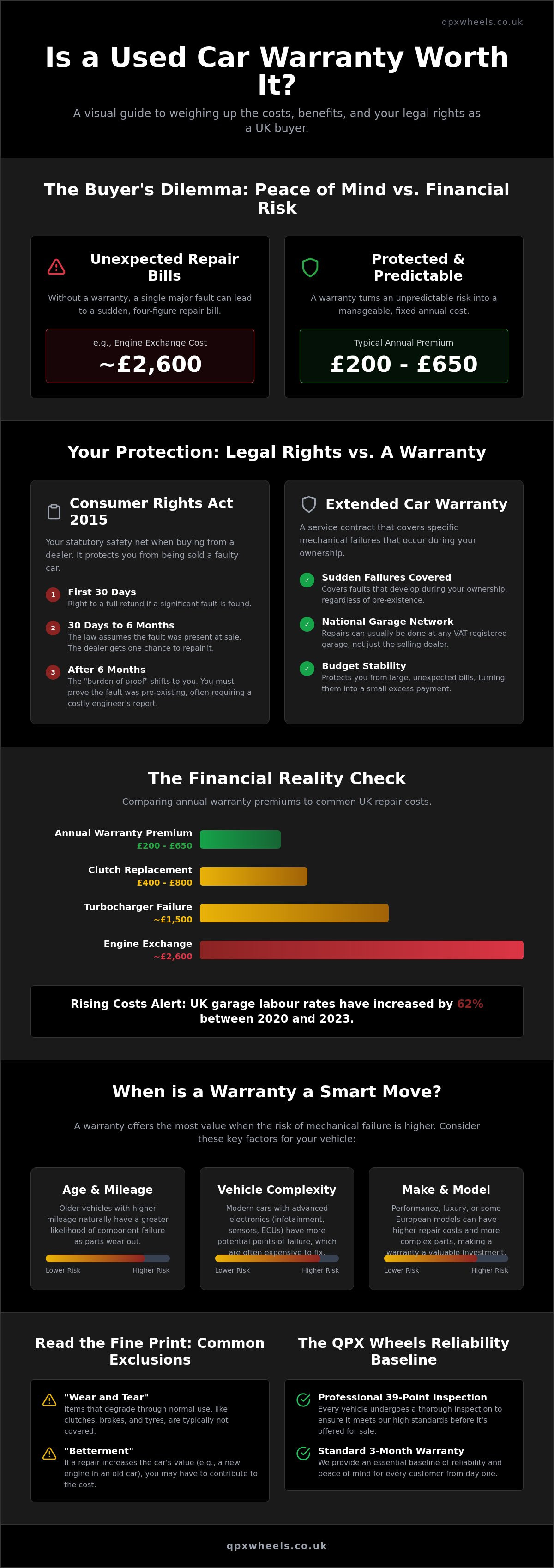
The Consumer Rights Act 2015 is your primary shield when buying from a professional dealer. It stipulates that any vehicle sold must be of "satisfactory quality," "fit for purpose," and "as described." If a fault appears within the first 30 days, you have a legal right to reject the car for a full refund. Between 30 days and six months, the law assumes any major fault was present at the time of sale. In this window, the dealer is entitled to one attempt at a repair. If that repair fails, you can then request a refund or a price reduction.
However, "satisfactory quality" is a subjective term. A court will look at the car's age, price, and mileage. You can't expect a ten-year-old hatchback with 90,000 miles to behave like a brand-new vehicle. This ambiguity is often where disputes begin, making the legal route feel slow and confrontational compared to a straightforward warranty claim.
How a Warranty Complements Your Legal Protection
Relying solely on your statutory rights becomes much harder after the first six months. At this point, the "burden of proof" shifts. It's no longer the dealer's job to prove the car was fine; it's your job to prove the fault was there when you bought it. This often requires paying for independent engineer reports, which can cost hundreds of pounds with no guarantee of success.
A warranty removes this hurdle. It covers faults that develop suddenly during your ownership, regardless of whether they were "pre-existing." There are several practical reasons why this makes sense for many UK buyers:
- National Coverage: Legal rights usually require you to return the car to the original dealer. A warranty typically allows you to use any VAT-registered garage in the UK.
- Speed of Repair: Warranty claims are usually processed quickly, getting you back on the road without waiting for legal mediation.
- Budget Stability: It protects you from "mechanical shock." If a turbocharger fails eight months into ownership, a warranty can turn a £1,500 bill into a small excess payment.
By combining your legal rights with a robust warranty, you create a comprehensive safety net. You're protected against the dealer's mistakes by the law, and you're protected against bad luck by your policy.
The Financial ROI: Comparing Warranty Costs to Common UK Repair Bills
Deciding whether is a used car warranty worth it often comes down to a simple calculation: does the annual premium cost less than the likely repairs? In the UK, a third-party warranty typically ranges from £200 to £650 per year. Whilst that might seem like a significant upfront expense, it looks much smaller when compared to the "mechanical shocks" that modern vehicles can deliver. With labour rates rising by 62% between 2020 and 2023 to an average of £76 per hour, even minor faults now carry a heavy price tag.
Modern cars are essentially computers on wheels. A decade ago, a fault might have been a simple mechanical fix. Today, a failing infotainment screen or a faulty parking sensor can require entire modules to be replaced at a cost of hundreds of pounds. This increased complexity has shifted the financial risk firmly onto the owner, making the predictable cost of a warranty more attractive for those who want to avoid sudden, unmanageable bills.
Common Mechanical Failure Costs in the UK
To understand the value of a policy, you have to look at the current market rates for parts and labour. For popular UK hatchbacks, a clutch replacement can easily cost between £400 and £800 depending on the garage. If you are driving a car with a more complex DSG or automatic gearbox, a major failure can see bills soar to £1,200 or more. Other common "big ticket" failures include:
- Alternator replacement: approximately £600
- Timing belt failure: £800 to £1,000
- Turbocharger replacement: £1,000+
- Engine exchange: upwards of £2,600
Diagnostic fees alone can now reach £100 per hour at many franchised dealerships. If your vehicle develops an intermittent engine management fault, you could spend hundreds just identifying the problem before a single part is even ordered.
Calculating the 'Peace of Mind' Premium
Some drivers prefer "self-insuring" by putting £50 a month into a dedicated savings account. This works well if nothing goes wrong in the first two years, but a major engine failure in month three would leave you with a massive deficit. A warranty provides immediate protection from day one, which is why many buyers find it's a better fit for a fixed monthly budget. If a dispute does arise regarding a claim, The Motor Ombudsman provides a framework for resolution, giving you an extra layer of professional support.
Beyond the repair bills, a transferable warranty can also boost your car's resale value. It shows a potential buyer that the vehicle has been protected and maintained to a high standard. To get started with a vehicle that already includes a baseline of protection, you might want to browse our latest range of high-quality used cars which come with a 39-point inspection as standard.
Why Claims Get Rejected: Navigating Exclusions and 'Wear and Tear'
Many UK buyers feel a deep sense of distrust toward warranty providers. You've likely seen forum posts where drivers claim these policies "never pay out." Whilst it's true that claims are rejected every day, it's usually because of a misunderstanding of the contract's boundaries. A warranty is a mechanical breakdown service, not a comprehensive maintenance plan. If you're wondering is a used car warranty worth it, you must first accept that it won't cover every single trip to the garage.
Providers generally exclude "consumable" items. These are parts designed to wear out through normal use. You should budget separately for the following, as they are almost never covered:
- Tyres and wheels: Punctures, tread wear, and alloy damage.
- Braking components: Pads, discs, and shoes.
- Batteries: Most standard 12V batteries are seen as wear items.
- Exhaust systems: Specifically the piping and silencers, though some policies cover the catalytic converter.
You may also encounter a concept called 'betterment.' If a major component like an engine fails and is replaced with a brand-new unit, the provider might argue the car is now in better condition than before the fault. In these cases, they may ask you to contribute a percentage toward the cost of the new part. It's a standard industry practice, but it can be a shock if you aren't prepared for it.
The 'Wear and Tear' Minefield
The biggest hurdle in any claim is the distinction between a part that "failed" and a part that simply "wore out." For instance, if a gearbox bearing begins to whine because it's old, that's wear and tear. If the bearing disintegrates and stops the car, that's a failure. High-mileage vehicles are particularly susceptible to rejections on suspension components like bushes and shock absorbers, as these are expected to degrade over time. To protect yourself, look for a policy that includes "consequential failure," which covers damage caused to a covered part by the failure of a non-covered part.
Pre-Existing Faults and the Importance of Inspection
A warranty is designed to cover the unknown future, not the known past. If a provider can prove a fault was present when you bought the car, they will reject the claim as a pre-existing condition. This is why a professional 39-point inspection is so valuable. It provides a documented "clean bill of health" for the vehicle on day one. When you can prove the car was in "satisfactory quality" at the point of sale, it becomes much harder for an insurer to argue that a later fault was already there. When considering is a used car warranty worth it, remember that your claim's success often depends on the quality of the maintenance records and the initial inspection you received.
Your service history is equally vital. Missing a single oil change or exceeding a service interval by even a few hundred miles can void your entire policy. Insurers view regular maintenance as the primary way to prevent breakdowns, so keep every receipt and stamp in your logbook.
Decision Framework: When is a Used Car Warranty Actually Worth It?
Determining whether is a used car warranty worth it requires an honest assessment of your vehicle's life stage and your own financial flexibility. Not every car needs an extended policy, but for certain vehicles, it is a vital safeguard. The "sweet spot" for coverage is typically between three and seven years old. At this age, the manufacturer's original warranty has expired, yet the vehicle hasn't yet entered the high-mileage phase where parts are expected to fail as a matter of course. Once a car passes the 80,000-mile mark, providers often increase premiums or introduce more restrictive clauses, as the statistical likelihood of a major component failure rises sharply.
Your choice of brand also dictates the risk level. A German luxury saloon with air suspension and complex infotainment carries a much higher repair risk than a simple Japanese city car. If you are opting for a hybrid or a high-specification SUV, the sheer volume of sensors and electrical modules makes a warranty far more attractive. A single fault in a modern radar-guided cruise control system can cost more to recalibrate than the annual cost of the policy itself. If you are currently browsing for your next vehicle, you can view our latest range of used cars, each of which has been vetted to minimise these early ownership risks.
The 'Risk Profile' Checklist
Before you commit to a policy, run through these three essential checks to see if the protection is necessary for your specific situation:
- Common Model Faults: Research your specific engine and gearbox. If the model is known for timing chain issues or turbocharger failures, a warranty is a sensible strategic move.
- Service History: A car with a patchy service record is a high-risk purchase. Conversely, a car with a full, documented history is less likely to have hidden issues, but the warranty protects that history from being interrupted by a sudden failure.
- The Purchase Source: If you buy from a private seller, you have almost no legal backup if the car breaks down a week later. In these cases, an independent warranty is your only real safety net.
Choosing the Right Level of Cover
When reviewing a policy, look beyond the monthly price. You must choose between "Listed Component" cover, which only protects specific parts named in the document, and "All Mechanical & Electrical" cover, which is far more comprehensive. It is also vital to check the "Single Claim Limit." If your car is worth £10,000 but the claim limit is capped at £500, the policy won't be much help if the engine fails. Whilst a higher excess can lower your monthly premium, ensure the amount is something you can comfortably afford to pay at short notice when a fault occurs. Evaluating these details carefully will help you decide if is a used car warranty worth it for your specific budget and vehicle choice.
How QPX Wheels Removes the Warranty Guesswork
Choosing a new vehicle should be an exciting milestone, not a source of financial anxiety. While you've spent time considering is a used car warranty worth it, we believe the best answer lies in the quality of the car itself. At QPX Wheels, we've spent over 16 years building a reputation as a trusted local expert and a reliable national partner. We don't just sell cars; we provide a transparent, supportive environment where you can make a decision with total confidence. Our approach is designed to eliminate the "Skepticism Gap" by providing a solid baseline of protection from the moment your vehicle arrives.
We believe in building long-term relationships with our customers. This means moving away from high-pressure sales and toward a methodical, honest service that values your peace of mind. By combining rigorous preparation with clear, upfront protection, we take the stress out of the "is it worth it" calculation.
The QPX Wheels 39-Point Safety Standard
A warranty is most effective when it isn't actually needed. To ensure your vehicle meets the highest standards of "satisfactory quality," every car and van we sell undergoes a rigorous 39-point mechanical and safety inspection. This process isn't just a quick glance over the bodywork. Our experienced technicians examine critical components, from engine health and braking systems to electrical modules and safety equipment. By identifying and resolving potential issues before a vehicle is even listed, we significantly reduce the likelihood of you ever needing to make a warranty claim.
Transparency is at the heart of our community-oriented philosophy. Every vehicle is HPI-clear, meaning you don't have to worry about hidden finance, previous accidents, or stolen status. We provide this level of detail to ensure you feel supported through every stage of your purchase, whether you're visiting us in person or utilising our nationwide delivery service. This thorough preparation ensures that when you drive away, you're starting from a position of reliability and care.
Your Safety Net: Our Three-Month Warranty
Even with the most thorough inspection, mechanical parts can be unpredictable. That's why we include a free three-month warranty as standard on every vehicle we sell. This isn't just a token gesture; it's a genuine safety net designed to give you immediate peace of mind whilst you settle into your new car. It covers major mechanical and electrical components, ensuring you aren't left facing an unexpected bill in those first crucial months of ownership.
If you decide that is a used car warranty worth it for the long term, we also offer the flexibility to extend this cover at competitive rates. This allows you to tailor your protection to your specific needs and mileage. We pride ourselves on our after-sales support and our commitment to professional excellence. Our goal is to be your stable and dependable partner for years to come. If you're ready to find a vehicle that comes with built-in reliability, we invite you to View our latest range of inspected used cars and vans and experience a more honest way to buy.
Drive Away with Total Peace of Mind
Deciding if is a used car warranty worth it ultimately depends on your desire for financial predictability. While the Consumer Rights Act 2015 offers a vital legal safety net, a robust warranty provides the day-to-day protection against unexpected mechanical shocks that the law simply isn't designed to cover. By understanding the "wear and tear" exclusions and focusing on vehicles within that three-to-seven-year "sweet spot," you can turn a potential gamble into a strategic investment in your peace of mind.
At QPX Wheels, we've spent over 16 years refining our process to ensure you feel supported long after you leave the forecourt. We combine a rigorous 39-point inspection with a free three-month warranty as standard, giving you a reliable starting point for your next chapter. Whether you are nearby or utilising our nationwide delivery service across the United Kingdom, we are here to act as your trusted guide through every step of the purchase.
Ready to find a vehicle that meets our exacting standards? Browse our stock of 39-point inspected used cars and vans today. We look forward to helping you get on the road with total clarity and confidence.
Frequently Asked Questions
Is a used car warranty worth it for a car with high mileage?
A warranty is often a sensible choice for cars over 80,000 miles because the statistical risk of a major component failure is much higher. Whilst you'll likely face higher premiums and more restrictive "single claim limits," the protection against a £2,600 engine exchange is invaluable. You must check the fine print to ensure that high-mileage exclusions don't strip away the coverage you need most.
What is the difference between a manufacturer warranty and a third-party warranty?
Manufacturer warranties are provided by the car's maker and are typically the most comprehensive, usually lasting three to seven years from new. A third-party warranty is a service contract from an independent provider for older vehicles. These independent policies are more flexible for used buyers but often have stricter rules regarding "wear and tear" and require you to use VAT-registered garages for all repairs.
Does a used car warranty cover the MOT test?
No, a standard mechanical breakdown warranty does not cover the MOT test fee or any repairs needed to pass the inspection. These are classified as routine maintenance and safety requirements rather than sudden mechanical failures. Some providers offer "MOT insurance" as a separate add-on, but you should generally budget for your annual MOT and servicing costs as part of your normal vehicle running expenses.
Can I take my car to any garage for warranty repairs?
Most UK warranty providers allow you to use any VAT-registered garage, giving you the freedom to choose a local independent specialist. However, you must obtain "prior authorisation" before any work begins. If your mechanic starts stripping the engine or ordering parts before the warranty company has issued a claim number, your claim will almost certainly be rejected, regardless of the fault.
What happens to the warranty if I sell my car?
If you sell your vehicle to a private individual, most third-party warranties can be transferred to the new owner for a small administration fee. This is a significant selling point that can help justify a higher asking price. It's important to note that warranties usually don't transfer if you sell the car to a dealership or a car-buying service; the cover simply ends at the point of sale.
Does a used car warranty cover 'wear and tear'?
Standard policies don't cover "wear and tear" on consumable parts like tyres, brake pads, or clutches. These items are expected to degrade through normal driving behaviour. Some premium policies may cover wear on mechanical components like suspension bushes or bearings, but this usually only applies after a "waiting period" of 30 to 90 days to ensure the fault wasn't pre-existing when you bought the policy.
Do I need a warranty if I have the Consumer Rights Act?
The Consumer Rights Act 2015 protects you against faults that were present at the time of sale, but it doesn't cover new faults that develop through bad luck. Deciding is a used car warranty worth it often comes down to how you'd handle a breakdown six months into ownership. A warranty provides a faster, less confrontational way to handle repairs without having to prove a legal case against a dealer.
How much should I expect to pay for a used car warranty in the UK?
You can expect to pay between £200 and £650 per year for a third-party warranty in the UK. Many providers offer monthly payment plans starting from approximately £19, though this varies based on your car's age and mileage. For premium German brands or high-performance SUVs, costs can be higher to reflect the increased price of specialist parts and dealership labour rates.


