
What if you could walk away from your current car finance agreement today without the fear of breaking the law? Many UK drivers feel a sense of dread when considering selling a car with outstanding finance, often worrying they are "stuck" in an agreement until the very last payment is made. It's a common concern, especially with the Bank of England base rate sitting at 3.75% as of June 2026, which can make older finance deals feel more restrictive than you'd like.
The good news is that you don't have to wait. We're here to show you that transitioning to a new car is entirely possible, legal, and straightforward when you have the right roadmap. In this guide, we'll explain how to obtain an accurate settlement figure, navigate the complexities of negative equity, and ensure you get a fair valuation. You'll discover how a professional dealership can handle the logistics for you, providing the peace of mind that every penny of the debt is settled correctly whilst you focus on choosing your next ride.
Key Takeaways
- Understand the legal distinction between a registered keeper and a legal owner to ensure your sale remains fully compliant with UK law.
- Identify whether your agreement is HP or PCP and how specific hurdles like balloon payments affect your final settlement figure.
- Learn the simple formula for calculating equity to determine if your vehicle's value will cover your debt or act as a deposit for your next car.
- Follow our step-by-step guide to selling a car with outstanding finance, from gathering the correct paperwork to requesting an official settlement figure.
- Discover how a professional dealership can streamline the transition by paying your lender directly and managing all the logistics on your behalf.
Can You Legally Sell a Car with Outstanding Finance?
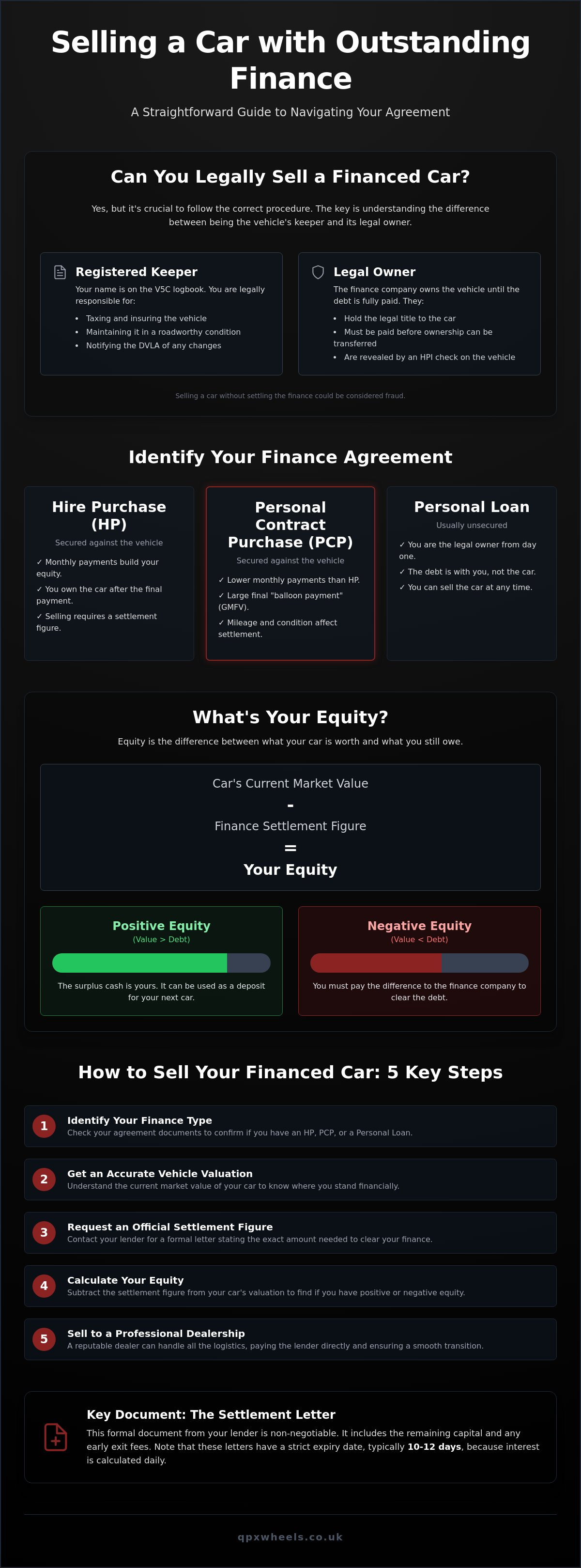
The short answer is yes, but the process requires a specific sequence of actions to stay on the right side of the law. When you're selling a car with outstanding finance, you are essentially facilitating a structured transition between yourself, the buyer, and the finance company. It's vital to understand that until the final payment is made, the vehicle isn't actually yours to sell. You're the person responsible for it, but the title remains with the lender.
Outstanding finance refers to any secured debt linked to the vehicle. This includes Hire Purchase (HP), Personal Contract Purchase (PCP), or even a logbook loan. If you sell the car privately without informing the buyer or clearing the debt first, you could be committing fraud. You're effectively selling property that belongs to someone else. Most savvy buyers will run an HPI check, which will immediately flag the car as having "active finance," stopping a private sale in its tracks before it even begins.
Registered Keeper vs Legal Owner: Why It Matters
The DVLA V5C logbook is often a source of confusion for many drivers. You might see your name on the front and assume you're the owner. However, the V5C simply identifies the "registered keeper," which is the person responsible for taxing, insuring, and maintaining the vehicle. Under UK law, the finance company remains the legal owner of a financed vehicle until the agreement is fully settled. An HPI check reveals this distinction to the motor trade and private buyers alike. Ensuring your car becomes "HPI Clear" is the only way to prove you've gained the legal right to transfer the title to someone else.
The Role of the Finance Settlement Letter
To bridge the gap between being a keeper and an owner, you need an official settlement figure. This is a formal document from your lender stating the exact amount required to end the agreement early. It's not a simple tally of your remaining monthly instalments; it includes the remaining capital balance plus any early exit fees. Most UK lenders provide a settlement letter that is valid for 10 to 12 days. Because interest is calculated daily, this expiry date is strict. If you don't settle the balance within that specific window, you'll need to request a fresh figure to reflect the updated interest and capital amounts.
Understanding Different Finance Agreements: HP, PCP, and Loans
Before you commit to selling a car with outstanding finance, you must identify exactly which type of agreement you signed. The rules for a private sale change significantly depending on whether your debt is secured against the vehicle itself or just your personal credit. For most UK drivers, this usually means choosing between Hire Purchase, Personal Contract Purchase, or an unsecured personal loan.
Hire Purchase (HP) and Personal Contract Purchase (PCP) are both forms of secured finance. This means the car acts as collateral for the debt. If you stop making payments, the lender can repossess the vehicle. Because of this security, you aren't the legal owner during the term, and you cannot sell the car privately without the lender's permission. If you're unsure about your specific consumer rights for car finance, it's worth checking your original contract for any specific clauses regarding early settlement.
Personal loans are different. These are typically "unsecured," meaning the bank lends you the money based on your creditworthiness rather than the car's value. In this scenario, you become the legal owner the moment you pay the seller. You can sell the car privately whenever you like, though you're still legally obligated to repay the bank according to your agreed schedule.
Selling a Car on Hire Purchase (HP)
With HP, your monthly payments gradually build up your stake in the vehicle. Most agreements include a small "Option to Purchase" fee at the very end, which officially transfers ownership to you. To sell before this point, you'll need to log into your lender's portal and request a settlement figure. If the car is worth more than this amount, you have positive equity. If you're looking for a clear starting point, our vehicle valuation service can help you determine how much equity you currently hold.
Selling a Car on Personal Contract Purchase (PCP)
Selling a PCP car requires careful timing. The Guaranteed Minimum Future Value (GMFV) is based on your predicted mileage and the car's condition. If you've exceeded your mileage limit or the car has damage beyond "fair wear and tear," your settlement figure might be higher than the car's market value. One useful tip is the "50% rule." Under the Consumer Credit Act, if you've paid back at least half of the total finance amount, including interest and the balloon payment, you may have the right to a "voluntary termination." This allows you to hand the car back without further payments, provided it's in good condition.
Positive vs Negative Equity: What It Means for Your Sale
Understanding your equity position is the most critical step when selling a car with outstanding finance. Equity is simply the difference between the current market value of your vehicle and the amount you still owe to your lender. Depending on how long you've had the car and your initial deposit, you'll find yourself in one of two positions: positive or negative equity. Both are perfectly manageable, but they require different approaches to ensure a smooth transition.
Positive equity is the ideal scenario for any seller. If your car is valued at £12,000 and your settlement figure is £10,000, you have £2,000 in positive equity. You can use this surplus as a deposit for your next vehicle or simply take it as cash. Negative equity, on the other hand, occurs when your car's value has dropped faster than you've paid off the loan. This is common with new cars, which can lose 15% to 25% of their value in the first year alone. It can feel disheartening to owe more than the car is worth, but it's a standard part of the automotive lifecycle and certainly isn't a barrier to moving on.
How to Calculate Your Equity Position
Knowing exactly where you stand removes the guesswork and anxiety from the process. Follow these three steps to find your balance:
- Step 1: Get an accurate valuation. Avoid generic online estimates that don't account for your car's specific condition. Using a professional vehicle valuation service ensures you have a realistic figure based on current market demand and our rigorous 39-point inspection standards.
- Step 2: Request your settlement figure. Contact your lender for a written statement. Remember, this figure changes daily, so ensure it's current.
- Step 3: Do the maths. Subtract the settlement figure from your valuation. A positive number means you're in the clear; a negative number indicates a shortfall.
Solutions for Dealing with Negative Equity
If you find yourself in a negative equity position, don't worry. You have several practical paths forward. The most straightforward method is to pay the shortfall directly to the dealership when they buy your car. This clears the debt entirely and lets you start fresh. Alternatively, some lenders allow you to "roll over" the negative equity into a new finance agreement, though this depends on your credit status and the lender's criteria. If you aren't in a rush, you might also choose to wait. As you continue making monthly payments, you'll eventually reach a "break-even" point where the debt and the car's value align. We're here to help you weigh these options without any pressure, ensuring you make the choice that's right for your budget.
How to Sell a Financed Car: A Step-by-Step Guide
Moving from the theory of equity to the actual transaction requires a bit of organisation. While selling a car with outstanding finance might seem like a daunting administrative task, it's actually a very logical process when broken down into manageable steps. Success lies in having your paperwork ready and choosing a buyer who understands the legal requirements as well as you do. You'll need your V5C logbook, a full service history, and your most recent finance agreement to hand before you begin.
Step 1: Requesting the Settlement Figure
The first practical move is to contact your lender for an official settlement letter. Under UK law, finance companies must provide this figure within 12 days of your request. When you receive it, look closely at the "per diem" rate. This is the amount of daily interest added to your balance. Because interest accrues every 24 hours, the settlement figure is merely a "snapshot" of what you owe at that exact moment. Most letters are valid for 10 to 12 days; if you miss this window, you'll need to request an updated version to ensure the transaction is accurate.
Step 2: Choosing the Right Dealership
You essentially have two choices: a private sale or a dealership. Selling privately is complex because most buyers are rightly hesitant to pay thousands of pounds for a car they don't technically own yet. A professional dealership is almost always the smoother route. When choosing, ensure the business is authorised and regulated by the Financial Conduct Authority (FCA). This gives you an extra layer of protection. It's also worth looking for a buyer that prioritises transparency, such as those who perform a 39-point vehicle inspection to justify their offer. For many of our customers, the added benefit of nationwide delivery and collection means the entire process can be handled from their driveway.
Once you've accepted a valuation and provided your settlement figure, the dealership will pay the finance company directly. This is the most critical part of the process. You should never be expected to pay the lender yourself and then wait for the dealer to reimburse you. Instead, the dealer settles the debt, pays you any remaining equity balance, and takes possession of the car. Within a few working days, you'll receive a confirmation from your lender that the agreement is closed. This document is your final proof of a successful sale, leaving you free to focus on your next vehicle without any lingering debt.
Why Sell Your Financed Car to QPX Wheels?
Choosing the right partner makes all the difference when you're ready to move on from your current vehicle. At QPX Wheels, we've spent 16 years refining the process of selling a car with outstanding finance, ensuring that every transition is handled with professional care. We don't just buy your car; we act as the bridge between you and your lender, removing the administrative burden from your shoulders. Because we buy cars directly from the public to replenish our own stock, we can offer a fair, transparent price that reflects the true condition of your vehicle.
Our approach is built on honesty and thoroughness. Every vehicle we acquire undergoes a rigorous 39-point inspection. This isn't just a box-ticking exercise; it's our way of ensuring that our valuations are grounded in reality. This transparency builds immediate trust, as you'll see exactly how we've arrived at our offer. Best of all, the entire transaction is remarkably efficient. From the moment you accept our valuation to the point where the finance settlement is initiated, the process can often be completed in a single afternoon.
A Transparent and Reassuring Process
We believe that clarity is the best way to reduce the anxiety often associated with car debt. Our team will sit down with you and walk through your settlement letter, explaining the maths behind the interest and the final balance. Once we agree on a figure, we pay your finance company directly. You'll receive immediate proof of this payment before you even leave our site. Our professional-casual approach ensures you feel supported throughout the afternoon, making what could be a complex financial hurdle feel like a simple, friendly conversation amongst experts.
Transitioning to Your Next Vehicle
If you've built up positive equity in your vehicle, that surplus belongs to you. You can take it as a cash payment or, as many of our customers prefer, use it as a part-exchange deposit for your next upgrade. We maintain a diverse range of high-quality used cars and used vans, all of which have passed the same strict inspection standards we apply to the cars we buy. Whether you're looking for a more fuel-efficient commuter or a larger family vehicle, we can help you settle your old debt and start your next agreement on the same day. We invite you to reach out for a no-obligation vehicle valuation today and see how simple the transition can be.
Take the Next Step Toward Your New Car
Navigating the transition to your next vehicle doesn't have to be a source of stress or confusion. By understanding the distinction between a registered keeper and a legal owner, you've already taken the first step toward a successful sale. Remember that your settlement figure is simply a tool to unlock your car's value; whether you have positive or negative equity, there is always a clear path forward. Selling a car with outstanding finance is a standard procedure that we manage every day, ensuring that your debt is cleared legally and your paperwork is handled with absolute precision.
With 16 years of industry experience and our status as an FCA regulated finance brokerage, QPX Wheels provides the stability and expertise you need. Our 39-point vehicle inspections ensure you receive a transparent and honest valuation based on your car's actual condition. We're here to act as your trusted guide, making the entire process feel like a smooth hand-off rather than a complex financial hurdle. Get a fair valuation for your financed car at QPX Wheels today and move forward with total confidence. We look forward to helping you get behind the wheel of your next favourite car.
Frequently Asked Questions
Is it illegal to sell a car with outstanding finance privately?
It is illegal to sell a car privately if you haven't cleared the finance first because the lender remains the legal owner. Selling a vehicle without the lender's consent or without settling the debt can be classified as fraud. If you're selling a car with outstanding finance, the safest route is to involve a professional dealership that can settle the balance directly with your lender during the transaction.
How long does it take for finance to show as settled on an HPI check?
It typically takes between two and five working days for a car to show as "HPI Clear" once the payment has reached your lender. While the finance is technically settled the moment the funds are cleared, there is a small administrative delay whilst the lender updates the central databases used by HPI and Experian. We usually recommend keeping your settlement confirmation letter as proof during this brief transition period.
What happens if I sell my car for less than the settlement figure?
If your car's valuation is lower than your settlement figure, you'll need to pay the difference, known as the shortfall, to the buyer or the lender. This is a common situation called negative equity. When you sell to a dealership, they'll explain the exact amount needed to bridge the gap, ensuring the finance is fully closed off so you aren't left with any lingering debt after the car is gone.
Can I sell a car on finance if I have lost the settlement letter?
You can still sell your car, but you'll need to request a fresh settlement letter from your lender before the transaction can proceed. Most UK finance companies can email a digital copy of your settlement figure within minutes. Having this document is essential because it provides the "per diem" interest rate and the final expiry date required for a legal and transparent transfer of ownership.
Do I need to tell the DVLA if I sell a car with outstanding finance?
You must notify the DVLA that you are no longer the registered keeper of the vehicle, just as you would with any other car sale. However, you don't need to inform the DVLA about the finance status specifically. Their records focus on who is responsible for the vehicle's tax and mot, whilst the financial interest is tracked separately by credit reference agencies and the central HPI register.
Can I sell my car back to the finance company directly?
Most finance companies won't buy the car back from you directly as they don't operate as motor dealerships. Their primary business is lending money, not managing or reselling vehicle stock. To settle the debt, you'll need to find a buyer who can provide an accurate valuation and facilitate the payment to the finance house on your behalf, which is a service we provide daily.
What is voluntary termination and when can I use it?
Voluntary termination is a legal right under the Consumer Credit Act that allows you to return your car to the lender if you've paid at least 50% of the total amount payable. This total includes interest, fees, and any balloon payments. It's a useful option if you find yourself in significant negative equity, provided the vehicle is in a condition that meets the lender's fair wear and tear standards.
Can I sell a financed car if I am in arrears with my payments?
Yes, you can still sell the vehicle, but any arrears and late fees will be included in the final settlement figure provided by your lender. selling a car with outstanding finance when you've missed payments can actually be a proactive way to protect your credit score. By settling the debt in full through a sale, you stop further interest from accruing and remove the risk of the vehicle being repossessed.


