
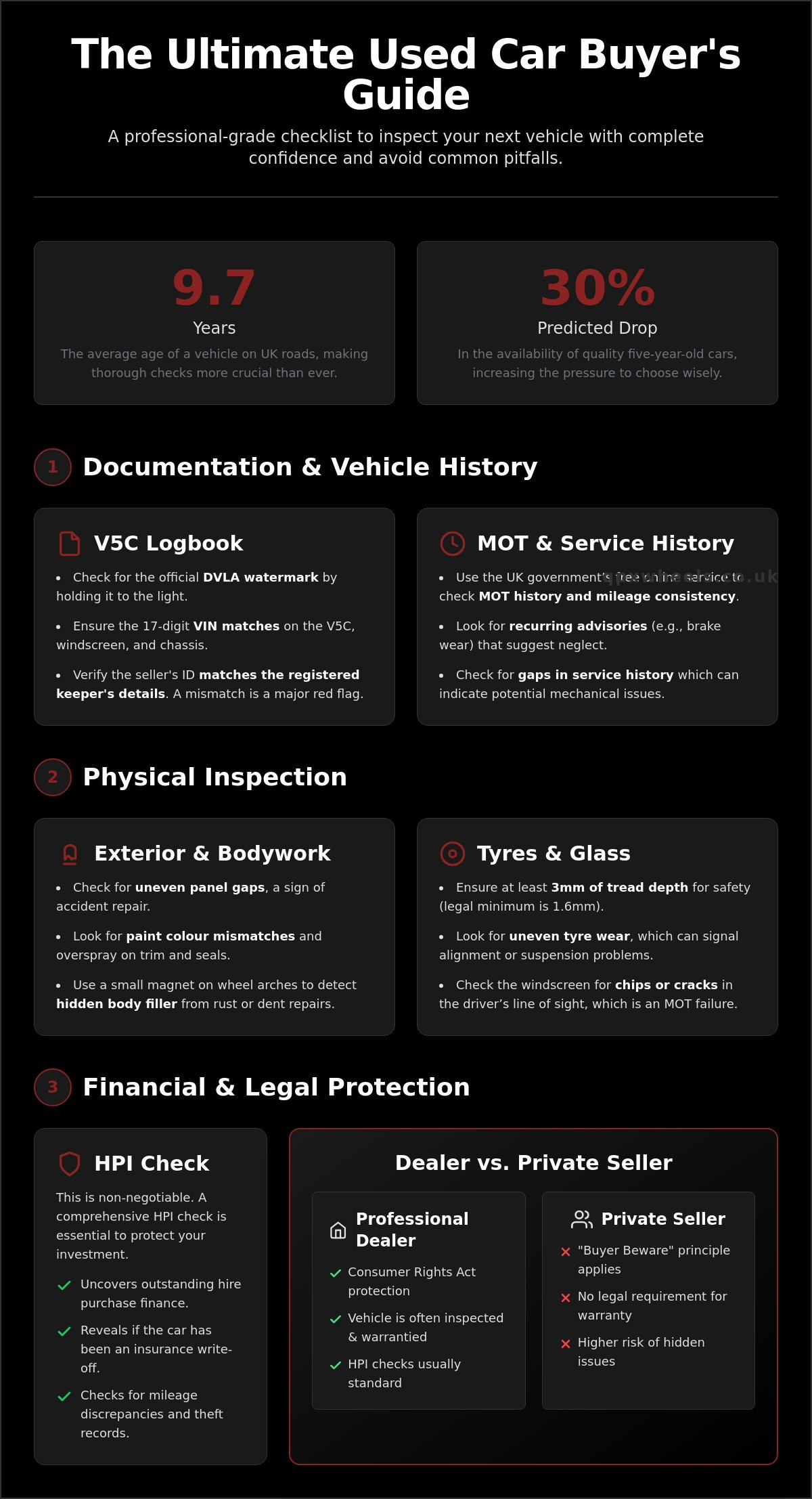
Did you know that the average age of a vehicle on UK roads has now reached 9.7 years? This shift means that knowing exactly what to look for when buying a used car is no longer just a helpful skill; it's an essential shield against inherited mechanical headaches. With a predicted 30% drop in the availability of quality five-year-old cars this year, the pressure to make the right choice first time has never been higher.
We understand that the process can feel like a bit of a minefield. Whether you're worried about hidden HPI finance, confused by the 2026 VED tax changes, or simply anxious about being "sold a lemon," those feelings are completely valid. You deserve a reliable vehicle without the stress of a bad deal or a documentation nightmare. It's about finding that perfect balance of value, safety, and reliability for your next journey.
This guide is designed to give you complete peace of mind. We'll walk you through a professional-grade inspection checklist, covering everything from the V5C paperwork to the mechanical red flags that mean you should walk away. You'll gain the confidence to negotiate fairly and understand exactly how the law protects you when buying from a professional dealer, ensuring your next car is a source of joy rather than a burden.
Key Takeaways
- Learn how to verify the V5C logbook and cross-reference VIN locations to ensure the vehicle's identity and history are genuine.
- Master the art of spotting hidden bodywork repairs and mechanical red flags, giving you a clear list of what to look for when buying a used car.
- Understand why a comprehensive HPI check is essential to protect yourself from outstanding hire purchase finance or undisclosed insurance write-offs.
- Discover the legal protections provided by the Consumer Rights Act when buying from a dealer versus the "buyer beware" risks of a private sale.
- See how a professional 39-point inspection and a solid warranty can remove the anxiety of a purchase and provide long-term reliability.
Essential Documentation and Vehicle History Checks
Before you even pop the bonnet or adjust the driver's seat, you need to be a bit of a detective. Documentation is the foundation of a safe purchase. If the paperwork doesn't stack up, it doesn't matter how shiny the paintwork looks; you should walk away. Understanding exactly what to look for when buying a used car starts with verifying the vehicle's identity and its legal history long before you hand over any money.
The V5C Logbook: Your First Line of Defence
The V5C logbook is much more than a piece of paper. It is the vehicle's birth certificate and history book rolled into one. Hold the document up to the light to check for the official DVLA watermark. If it is missing, the document is likely a forgery. You must also ensure the 17-digit Vehicle Identification Number (VIN) printed on the V5C matches the one stamped on the car's chassis and the one visible at the base of the windscreen. If these numbers don't align perfectly, the car could be a clone. Always ask for a form of ID to confirm the seller is the registered keeper listed on the document; a mismatch here is a major red flag.
Decoding the MOT and Service History
Digital records are now the standard in 2026. Many modern vehicles no longer come with a physical book full of rubber stamps. This is a common stumbling block for buyers, but you can bridge this gap by asking the seller for a printout of the digital service record. If they cannot provide one, a quick call to the manufacturer’s local service centre with the VIN can often confirm the maintenance history. This level of due diligence is a core part of Wikipedia's guide to used cars and remains the best way to avoid hidden mechanical issues.
Use the UK government’s free MOT check service to look for recurring advisories. If you see "brake pad wear" or "suspension bushes" mentioned three years in a row, it suggests the previous owner did the bare minimum to pass. This neglect often leads to larger bills later. We use our 16 years of industry experience to vet these details for you. At QPX Wheels, we perform a rigorous 39-point vehicle inspection on every car we sell to ensure the paperwork and the mechanics are in perfect harmony.
When reviewing the history, keep an eye out for these specific details:
- Mileage Consistency: Ensure the mileage jumps between MOT tests are logical and match the current odometer reading.
- Gap in Service: Look for long periods where the car wasn't serviced, which can lead to premature engine wear.
- Safety Recalls: Check if the vehicle has any outstanding safety recalls that haven't been addressed by a main dealer.
Taking the time to scrutinise these documents ensures you aren't just buying a car, but a transparent history. This preparation gives you the confidence to move forward or the clarity to walk away from a potential disaster.
Physical Inspection: Spotting Hidden Bodywork and Interior Issues
Once you've confirmed the paperwork is in order, it's time to get hands-on. A thorough physical inspection is where you often find the truth that a service history might miss. Knowing exactly what to look for when buying a used car during a walk-around can save you thousands in future repair bills. It's about looking past the polish to find the true condition of the metal and plastic underneath.
The Exterior Walk-Around
Start by looking down the side of the car in clear daylight. Are the panel gaps uniform? If the gap between the door and the wing is wider at the top than the bottom, it's a classic sign of poor-quality accident repair. Similarly, look for colour mismatches. Even a slight variation in the shade of silver on a rear bumper suggests a respray. Check rubber seals and plastic trim for "overspray", tiny dots of paint where they shouldn't be. You can also run a small magnet along the wheel arches; if it doesn't stick, there's likely plastic filler hiding rust or dents. Don't forget the glass. Even a small chip in the driver's line of sight can lead to an MOT failure, as outlined in the official government checks for a used car.
Tyres tell a story. They are your only contact with the road, so their condition is vital. Ensure there is at least 3mm of tread across the central three-quarters of the tyre. While the legal limit is 1.6mm, 3mm is where wet-weather safety begins to drop significantly. Look for uneven wear. If the inner edge is bald but the outer is fine, the wheel alignment is out. This is often a simple fix, but it can sometimes point to deeper, more expensive suspension issues.
Inside the Cabin: Wear, Tear, and Tech
Inside the cabin, your focus on what to look for when buying a used car shifts to the finer details of comfort and electronics. Open the door and look at the driver's seat bolster and the rubber on the pedals. If they are heavily worn but the odometer only shows 30,000 miles, the car might have been "clocked" or used for heavy stop-start city driving. Lift the floor mats and feel for dampness. A wet carpet often means a leaking door seal or a failing heater matrix.
Before you start the engine, run through this quick electronic checklist:
- Ignition Lights: Turn the key to position two. Every warning light should illuminate and then disappear once the engine starts.
- Climate Control: Ensure the air conditioning blows ice-cold and the heater gets uncomfortably hot.
- Windows and Mirrors: Test every window regulator and electric mirror motor for smooth, quiet operation.
- Infotainment: Check the touchscreen, Bluetooth connectivity, and DAB radio to ensure no dead pixels or software glitches.
If these checks feel a bit daunting, you can always choose a vehicle that has already been through a professional vetting process. Every one of our quality used cars undergoes a 39-point inspection to ensure these physical standards are met before you even see the keys. This takes the guesswork out of your purchase and lets you focus on the drive.
Under the Bonnet and the Test Drive Performance
Mechanical health is the heart of any vehicle purchase. While a shiny exterior is pleasing, it's the engine and drivetrain that will determine your daily reliability. Knowing exactly what to look for when buying a used car under the bonnet is your best defence against unexpected repair bills. This stage requires a methodical approach, starting with a cold engine and ending with a varied road test.
Engine Bay Essentials
Always ask the seller to keep the engine cold before you arrive. Feel the bonnet; if it's warm, they might be hiding a smoky start or a noisy timing chain. Open the oil filler cap and look inside. While dark, thick oil is perfectly normal in a used engine, a creamy, "mayonnaise-like" residue is a major warning sign of head gasket failure. Check the coolant reservoir next. The fluid should be clear and brightly coloured, usually pink, blue, or orange. If it looks murky or has oily beads floating on top, it suggests internal engine leaks.
Inspect the engine block for fresh fluid leaks and check the ground beneath the car for stains. A "too clean" engine bay might be an attempt to hide a recent oil leak by steam cleaning away the evidence. Listen carefully when the engine first fires up. Any rattling or metallic tapping that doesn't disappear within seconds could indicate serious timing chain or valve issues. A healthy engine should settle into a smooth, consistent idle without hunting for revs.
The Dynamic Test Drive Checklist
A thorough used car pre-purchase checklist must always include a test drive on varied roads. Don't just stick to quiet side streets. Take the car on a dual carriageway to see how it performs at 70mph and find a bumpy road to test the suspension. Listen for knocks or creaks over speed bumps, which often point to worn bushes or shock absorbers.
During the drive, pay close attention to these specific performance markers:
- Clutch and Gearbox: Test for a "slipping" clutch by accelerating in a high gear at low speed; if the revs rise faster than the car's speed, the clutch is worn. Ensure every gear slots in smoothly without crunching.
- Braking Balance: On a straight, empty road, grip the steering wheel lightly and apply the brakes. The car should stop in a straight line without pulling to one side or vibrating through the pedal.
- Exhaust Emissions: Use the mirrors to check for smoke under acceleration. Blue smoke indicates burning oil, whilst thick white smoke suggests a coolant leak.
- CV Joints: Find a car park and drive in a tight circle on full lock in both directions. Any rhythmic clicking sounds mean the CV joints need replacing.
By being systematic during the test drive, you turn a subjective feeling into a factual assessment. This clarity ensures that when you finally make an offer, it's based on the car's actual mechanical condition rather than just its appearance.
Financial Due Diligence and HPI Verification
Even if a vehicle looks pristine and drives like a dream, it could still be a financial trap. Physical checks only tell half the story; the other half is hidden in digital databases. Knowing exactly what to look for when buying a used car includes a deep dive into its financial and insurance history. Skipping this step is the most common way buyers lose their investment entirely.
A comprehensive HPI check is your most powerful tool. For around £19.99, a full check provides a £30,000 guarantee and reveals if the car has a hidden past. It cross-references the National Mileage Register to detect "clocking", where the odometer has been wound back to increase the car's value. It also flags if the vehicle has been reported as stolen or if there are any "scrapping" alerts that should have taken it off the road permanently.
Understanding Insurance Categories
When a car is involved in an accident, insurance companies decide if it is worth repairing. If they deem it a "total loss", it is given a category. Category S (Structural) means the car has sustained damage to its frame or chassis. Unless you are a professional mechanic, these should generally be avoided. Category N (Non-structural) means the damage was cosmetic or electronic. Whilst Cat N cars often look like bargains, they are significantly harder to insure and have a much lower resale value. Always check these details before you fall in colour with a car that might be difficult to protect later.
Outstanding Finance Risks
This is perhaps the biggest risk in the private market. If a car has outstanding Hire Purchase (HP) finance, the lender still legally owns the vehicle. If the seller stops making payments after you've bought it, the finance company can legally repossess the car from your driveway. You would lose both the car and your money. If you're buying privately, you must insist the seller settles the remaining balance in your presence before you transfer any funds.
This complexity is why many motorists prefer the security of a professional environment. We take this burden off your shoulders by ensuring every vehicle in our stock is 100% clear of any financial encumbrance or hidden history. You can explore our range of fully vetted used cars with the confidence that the only thing you need to worry about is which colour you prefer. We handle the due diligence so you don't have to.
Before you commit to any purchase, ensure your history check covers these four pillars:
- Finance Status: Confirmation that no bank or lender holds a lien over the vehicle.
- Insurance Write-off: A clear record showing the car has never been a total loss.
- Stolen Vehicle Check: Verification against the Police National Computer.
- Mileage Analysis: A logical progression of mileage across all recorded owners.
Taking these steps turns a potential gamble into a calculated, safe investment for your future travels.
The Final Decision: Private Sellers vs. Reputable Dealerships
Choosing where to buy is just as vital as knowing what to look for when buying a used car. In a private sale, you are largely on your own; the principle of "caveat emptor" or "buyer beware" means you have very little recourse if a mechanical fault develops a week later. Dealerships operate under a completely different legal framework. The Consumer Rights Act 2015 provides a 30-day "right to reject" a faulty vehicle for a full refund. Additionally, the "six-month rule" places the burden of proof on the dealer to show a fault wasn't present at the time of sale, offering a level of protection a private individual simply cannot match.
This legal safety net is bolstered by the professional preparation that established businesses provide. Whilst a private seller might give the car a quick wash, a reputable dealer ensures the vehicle is mechanically sound and aesthetically pleasing through professional valeting. This transition from a gamble to a guaranteed standard is what provides long-term peace of mind and builds immediate trust.
Why a 39-Point Inspection Beats a DIY Checklist
Even the most diligent DIY checklist has its limits. You might spot a worn tyre or a flickering interior light, but professional technicians see the things that remain hidden to the untrained eye. At QPX Wheels, we perform a rigorous 39-point vehicle inspection on every car before it reaches our forecourt. Our team uses advanced diagnostic tools to scan for ECU fault codes and inspects the underbody for brake line corrosion or subtle suspension play. This level of rigour removes the gambling element from the process, ensuring that every vehicle meets our high standards for safety and reliability.
Buying with Confidence via Nationwide Delivery
The used car market in 2026 is no longer limited by your local geography. If you find the perfect vehicle but it's hundreds of miles away, you don't have to risk a long, expensive journey for a car that might not meet your expectations. Distance selling regulations provide enhanced protection for those who purchase online, often including a cooling-off period that isn't available in traditional face-to-face private transactions. We facilitate safe nationwide delivery to ensure your new car or van arrives at your doorstep exactly as described.
By combining our 16 years of industry experience with a free three-month warranty, we act as a reliable partner through the complexities of your purchase. We take pride in our transparent approach, ensuring you feel supported at every stage of the journey. Whether you're looking for a compact hatchback or a hard-working van, our commitment to quality remains the same.
Ready to find a vehicle that has already passed the ultimate test? Browse our fully inspected used cars and vans today and drive away with total confidence.
Drive Away with Absolute Peace of Mind
Mastering what to look for when buying a used car is about more than just kicking tyres; it's about systematic verification. By prioritising clear documentation, performing a methodical physical inspection, and understanding your legal rights, you've already moved ahead of most buyers. These steps ensure that your hard-earned money is spent on a vehicle that is safe, legal, and ready for the road.
We believe that finding your next vehicle should be an exciting milestone, not a source of anxiety. That's why we apply our 16 years of industry experience to every vehicle we stock. Every car and van in our collection undergoes a rigorous 39-point inspection to ensure it meets our high standards before it ever reaches you. With a free three-month warranty for total peace of mind and nationwide delivery available across the UK, we make the process as smooth as possible.
View our range of 39-point inspected used cars and vans and start your next journey with a partner you can trust. You've done the research, now let's get you behind the wheel of a car you'll truly enjoy.
Frequently Asked Questions
What is the most important thing to check when buying a used car?
The most important check is the vehicle's documentation, specifically the V5C logbook and MOT history. These documents verify the car's identity and its legal status. Without a clear history, even a mechanically perfect car can become a financial liability. This is why documentation is the first step in knowing what to look for when buying a used car. It ensures you aren't accidentally purchasing a stolen or cloned vehicle.
Can I buy a used car if it has outstanding finance?
You should never complete a purchase on a car with outstanding finance because the lender remains the legal owner. If the seller doesn't settle the debt, the finance company can legally repossess the vehicle from you. Always run an HPI check before handing over any money. If finance is present, the seller must settle the balance in your presence and provide a clearance letter from the lender to ensure the title is clear.
How much tread should used car tyres have?
Used car tyres must have a legal minimum tread depth of 1.6mm across the central three-quarters of the tyre. However, we recommend at least 3mm for optimal safety in wet conditions. Tyres with less than 3mm of tread have significantly reduced grip and longer braking distances. During your inspection, check for uneven wear, which often signals alignment issues or suspension damage that will require immediate attention from a professional.
What documents should I receive when buying a second-hand car?
You should receive the V5C logbook, a current MOT certificate, and all available service history records. It is also helpful to get the original owner's manual and any receipts for recent repairs or part replacements. Ensure the V5C is the latest version with the correct watermark. If you're buying from a dealer, you should also receive a sales invoice detailing the price, date, and any warranty terms included with the vehicle.
Is a 3-month warranty enough for a used car?
A 3-month warranty is a solid starting point that protects you against immediate mechanical or electrical failures. Most major faults that weren't detected during a test drive will appear within this initial period. Whilst it provides great initial peace of mind, many of our customers choose to upgrade to an extended warranty for longer-term protection. This ensures you remain covered against the costs of unexpected repairs as the vehicle continues to age.
What does a 39-point inspection actually cover?
Our 39-point inspection is a thorough assessment of the vehicle's most critical systems. It covers engine health, braking performance, suspension integrity, and all essential electronic components. Our technicians also check fluid levels, tyre condition, and safety features like seatbelts and airbags. This professional review goes much deeper than a standard DIY checklist, using diagnostic equipment to identify fault codes that aren't visible to the naked eye during a casual viewing.
How do I know if a used car has been in an accident?
You can spot accident damage by looking for uneven panel gaps and slight colour mismatches between body panels. Check for "overspray" on rubber seals and use a magnet to find plastic filler on wheel arches. A professional HPI check is also vital, as it reveals if the car has been recorded as an insurance write-off. These physical and digital checks are essential parts of what to look for when buying a used car to avoid structural issues.
Should I buy a used car without a full service history?
Buying a car without a full service history is risky and should only be considered if the price is lower and the vehicle passes a rigorous inspection. A missing history makes it difficult to verify if essential maintenance, such as timing belt changes, has been performed. If records are sparse, look for other signs of care, such as high-quality tyres and a clean interior, but always proceed with extra caution and consider a professional mechanical check.


