
What if the cheapest car to buy costs more to own? When comparing used cars for new drivers UK, look beyond the asking price. Insurance, fuel, vehicle tax and everyday practicality all affect whether a car fits your budget and routine.
It’s understandable to focus on the upfront cost, especially when you’re buying your first car. But a manageable choice also depends on the vehicle’s condition and history, its insurance quote and the checks you complete before committing. This guide shows you how to compare those factors and build a shortlist around your total ownership costs, not the price alone.
We’ll cover running costs, practical features and pre-purchase checks, then explain how to think about your purchase options. QPX Wheels sells used cars and offers HP and PCP finance, nationwide delivery and extended warranties. You can consider the vehicle, finance and delivery options together as part of your purchase.
Key Takeaways
- Build a shortlist of used cars for new drivers UK around your budget, regular journeys and practical needs, rather than purchase price alone.
- Compare insurance, fuel or energy, vehicle tax and maintenance to understand how ownership costs may add up.
- Weigh small hatchbacks, compact family cars and automatics by visibility, space and ease of manoeuvring.
- Before choosing, check the registration, MOT history and vehicle details using authoritative UK resources.
- Compare HP and PCP finance as different ways to fund a purchase, and consider how each fits your circumstances.
Used cars for new drivers UK: what makes a good first car?
Your first car can shape how confident you feel on the road, how easily you manage everyday journeys and what motoring adds to your household budget. The right choice isn’t automatically the newest, smallest or cheapest vehicle. It’s one that suits the driver, fits the full budget and works for the journeys you actually make. A little understanding of the used car market can also help you assess listings with realistic expectations.
Start with your needs, then compare suitable cars. The advertised price is only one part of ownership. Insurance, fuel or energy, vehicle tax, routine maintenance and occasional repairs can all affect the total cost. A lower asking price may be offset by higher running costs or more maintenance, so compare both the likely expenses and the car’s practical fit before deciding.
How should a new driver define the right first car?
Think through a typical week. Will you mainly drive short urban journeys, travel longer distances, carry passengers or need room for bulky items? Consider where you’ll park and how much you expect to drive. For rough context, average UK car mileage is around 8,000 to 10,000 miles a year, though your own use may be quite different.
Write down essentials separately from nice-to-haves. Essentials might include enough seats, a manageable size for your parking space or an automatic gearbox if that suits your needs. Put features that would be pleasant but aren’t necessary on a second list. This keeps your shortlist focused when a car has appealing extras that don’t address your main requirements. Ease of use matters too: clear visibility, familiar controls and a comfortable driving position may support confidence more than a long list of specifications.
Which first-car assumptions can lead to a poor choice?
The smallest or oldest car isn’t always the cheapest to own. A low purchase price may be offset by higher insurance, fuel use or maintenance needs, so compare the whole picture instead of using age or size as a shortcut. Likewise, a larger car isn’t automatically impractical if it better suits regular passengers or luggage.
Insurance premiums depend on both the individual driver and the vehicle, so don’t assume a particular model will be affordable based on someone else’s quote. Get insurance estimates for specific cars on your shortlist before deciding. There’s no single body style or fuel type that suits every new driver. Choose according to your journeys, parking, passenger needs and budget. For used cars for new drivers UK, a clear set of priorities makes comparing options more confident and considered.
Compare first cars by insurance, fuel use and ownership costs
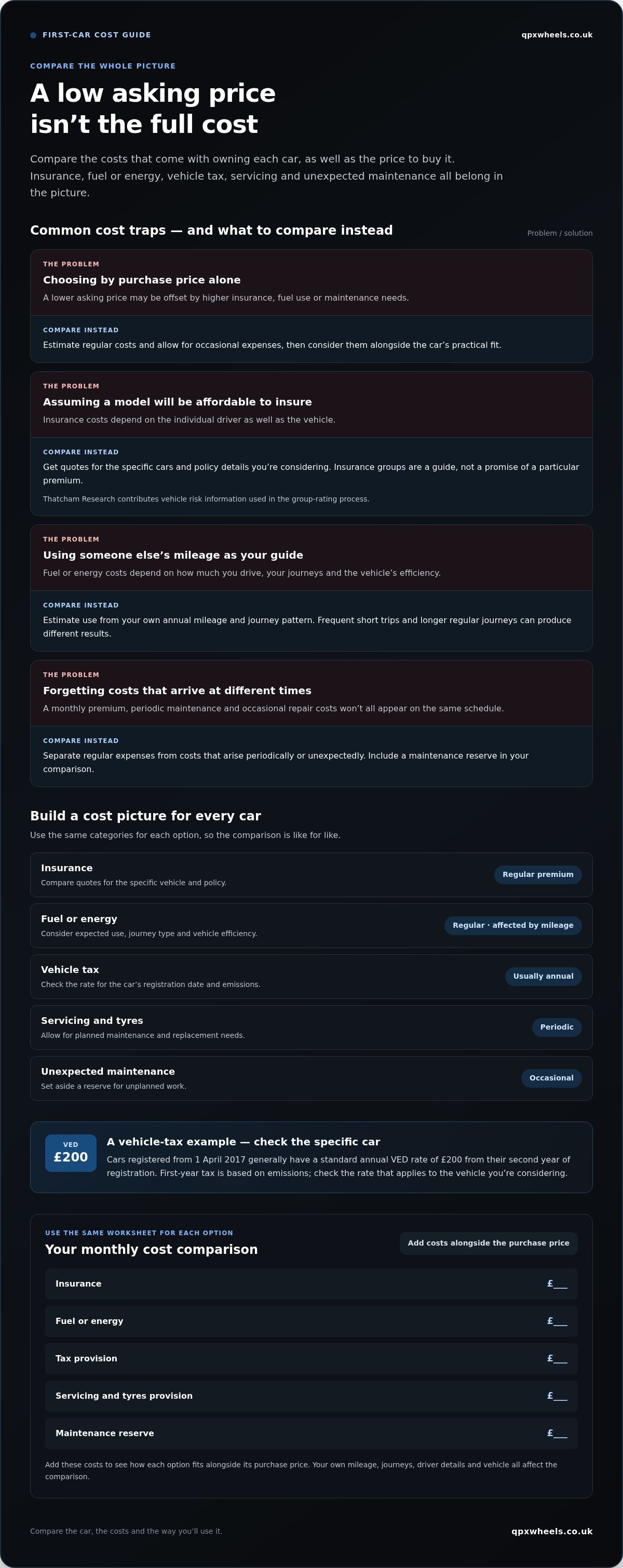
A fair comparison looks beyond the advertised price. For each car on your shortlist, estimate regular costs and allow for less predictable expenses too. Insurance is especially important for new drivers: quotes vary with the driver, vehicle, address and policy details. A model that looks affordable on paper may not fit your budget once you have a quote.
The RAC’s guide to best first cars for new drivers can help you explore model options. Use recommendations as a starting point, then compare individual vehicles and your own projected costs.
How can new drivers compare insurance suitability?
Get insurance quotes for the specific cars you’re considering before making a purchase decision. Insurance groups can help you compare vehicles: Thatcham Research contributes vehicle risk information used in the group-rating process. Treat a group as a guide, not a promise of a particular premium. Your personal details and policy choices also affect the quote.
What running costs belong in a first-car budget?
Use a simple comparison like this, and fill it in for each option. Separate regular monthly expenses from costs that arise occasionally, so the purchase price doesn’t disguise the likely cost of ownership.
| Cost area | What to compare | How often |
|---|---|---|
| Insurance | Quotes for the specific vehicle and policy | Regular premium |
| Fuel or energy | Expected use, journey type and vehicle efficiency | Regular, affected by mileage |
| Vehicle tax | Rate for the car’s registration date and emissions | Usually annual |
| Servicing and tyres | Planned maintenance and replacement needs | Periodic |
| Unexpected maintenance | A reserve for unplanned work | Occasional |
For example, cars registered from 1 April 2017 generally have a standard annual VED rate of £200 from their second year of registration; first-year tax is based on emissions. Check the rate that applies to the specific vehicle. Estimate fuel or energy use using your own annual mileage and journey pattern. Frequent short trips and longer regular journeys can produce different results.
Make the comparison personal with a monthly worksheet: insurance £___; fuel or energy £___; tax provision £___; servicing and tyres provision £___; maintenance reserve £___. Add these costs to see how each option fits alongside its purchase price. Explore used cars from QPX Wheels and apply the same cost framework to vehicles you’re considering.
Which used-car types suit different new-driver needs?
Body style shapes the everyday experience of a car, but it doesn’t tell the whole story. Consider how well a vehicle fits your regular journeys, who or what you carry, and how confident you feel behind the wheel. When comparing used cars for new drivers UK, weigh the practical trade-offs rather than assuming one type suits everyone.
- Small hatchbacks: Compact dimensions can make parking and narrow streets easier to manage. The trade-off may be less room in the back or boot for passengers, shopping and luggage.
- Compact family cars: These can offer more passenger and boot space for regular trips with others or bulkier items. Their larger dimensions may take more thought when manoeuvring or parking.
- Automatics: These avoid the need to change gear manually, which some drivers may prefer in stop-start traffic. Compare the specific vehicle’s insurance quote and running costs rather than assuming an automatic will suit your budget.
Is a small hatchback a sensible first car?
It can be a practical match for solo journeys, errands and tight parking spaces, especially if a large boot or regular rear-seat use isn’t a priority. Check the actual cabin and boot against your needs: a car that feels easy to place on the road may be less comfortable on longer journeys or when carrying passengers. Condition matters too. A compact body style doesn’t make a neglected example a sound choice.
Should a new driver choose an automatic or another body style?
Choose the transmission that fits your experience, confidence and licence. If your licence is restricted to automatic vehicles, a manual won’t be a suitable choice. For other drivers, consider which feels easier to use and compare insurance quotes for the specific cars. A larger vehicle may make sense for regular passengers, accessibility needs or luggage, but can be less convenient in tight spaces.
Fuel type also deserves a practical check. Think about journey length and frequency, then consider whether the vehicle suits those trips. If your regular routes pass through a clean air zone, check the relevant zone’s current vehicle requirements before choosing. Rules can vary between zones and vehicle types.
Before deciding, sit in the car and assess your visibility, driving position, controls and parking confidence. Check rear-seat access and boot space using the things you’d routinely carry. The best fit is the one that works for your real journeys and budget, not simply the vehicle with the most appealing shape or features.
Use this used-car checklist before choosing your first car
A clear process makes it easier to compare used cars for new drivers UK without feeling rushed. Work through these steps for each car on your shortlist, and keep notes so you can review the details afterwards.
- Set your needs and budget. Write down your typical journeys, passenger and luggage needs, preferred transmission and overall spending limit. Allow room in your budget for insurance and ongoing ownership costs.
- Shortlist suitable cars. Compare vehicles that fit those needs, then get insurance quotes for the specific cars before committing to a viewing.
- Check the history. Use the official GOV.UK MOT history service to review test results, recorded mileage and advisories. Use the DVLA vehicle information service to check details such as tax and fuel type.
- Compare the records. Check that the registration and vehicle details match the car and its documents. Compare the vehicle identification number (VIN) shown on the vehicle with the relevant paperwork. Review service records and note gaps or details that need explaining.
- Arrange a thorough viewing. Inspect the car in good light and, where appropriate, arrange a test drive. Take your time with the checks below and write down questions rather than relying on memory.
- Read the paperwork before agreeing. Review the purchase details and, if using finance, the full finance documents. Make sure you understand the terms and what you’re agreeing to before signing or paying.
What should you check during a viewing and test drive?
Look over the bodywork for damage, uneven gaps or signs of poor repairs. Check the tyres for visible damage and uneven wear, then test the lights, windows, mirrors and cabin controls. Notice any warning lights or signs of neglect inside. During a permitted test drive, check that the seating position and visibility feel comfortable, and try the controls and parking manoeuvres that matter in your usual driving. Don’t rush. Record anything that concerns you and seek an independent condition assessment if you’re unsure about the car’s condition.
Which records and details should a buyer review?
MOT and DVLA records are useful checks, but they’re not a full inspection and may not capture every issue. Compare recorded mileage with the car’s paperwork and service history, and check that the VIN matches across the vehicle and relevant documents. Note any unexplained differences. A careful review of the documents, vehicle and test drive gives you a more complete basis for deciding.
Ready to put your checklist into practice? Explore used cars at QPX Wheels and compare options at your own pace.
How QPX Wheels can help you buy a used car as a new driver
Once you’ve defined what you need and what you can afford, use that shortlist to guide your search. QPX Wheels sells used cars, giving you vehicles to compare against your priorities, from everyday practicality to the journeys you expect to make. Focus on finding a suitable fit, rather than choosing a car simply because it matches a general first-car recommendation.
What support can simplify a first used-car purchase?
Buying your first car can involve unfamiliar decisions. QPX Wheels brings over 16 years of industry experience to the process. Use your checklist to compare vehicles on passenger and boot space, transmission, insurance suitability, condition and overall budget. Review the details of each vehicle when building your shortlist, rather than relying on assumptions about a particular model or body style.
Support after purchase may matter to your decision too. Extended warranties are available as an option. Consider one alongside the vehicle’s details and your budget, and read the relevant terms carefully so you understand what applies before deciding.
How can buyers consider finance and delivery options?
QPX Wheels offers Hire Purchase (HP) and Personal Contract Purchase (PCP) finance. They’re different finance routes, so neither is automatically the right choice for every buyer. HP generally involves paying towards the vehicle over an agreed term, while PCP has its own payment structure and end-of-agreement options. The exact terms depend on the agreement. Before committing, read the full documents, understand the payments and any applicable conditions, and consider whether they remain affordable within your wider budget.
If buying remotely would suit you, nationwide delivery is available. This lets you consider vehicles beyond what’s nearby while keeping the same priorities in view: review the listing and vehicle details, understand the purchase arrangements, and make sure the delivery option fits your plans. You can consider vehicle, finance and delivery choices as part of one purchase journey.
Choosing among used cars for new drivers UK is easier when you bring together your practical needs, running-cost checks and purchase budget. Take a steady approach and give yourself time to compare. Explore the current used cars at QPX Wheels to see which options fit your shortlist, then consider the available finance, delivery and warranty choices as you work towards a confident decision.
Choose your first car with confidence
The right first car is the one that fits your journeys, driving confidence and budget, not simply the one with the lowest advertised price. Compare insurance quotes and ongoing costs alongside space, transmission and everyday practicality. Before you commit, review the vehicle’s MOT history and documents, inspect its condition and take time to decide whether it suits you.
Finding suitable used cars for new drivers UK buyers can feel confident about is easier with a clear shortlist and a careful approach. QPX Wheels brings over 16 years of industry experience to your purchase journey, with used cars, nationwide delivery and HP and PCP finance options to consider. Take time to understand the applicable finance terms and choose a vehicle that works for your needs.
Ready to take the next step? Explore used cars at QPX Wheels and compare current options at your own pace. Your first car can be a confident choice when you know what matters most.
Frequently Asked Questions
What is a good first car for a new driver in the UK?
A good first car suits your regular journeys, budget, parking arrangements and passenger needs. There’s no single model that works for every driver, so compare specific vehicles rather than relying on size or purchase price alone. Get insurance quotes for your shortlist and factor in fuel or charging, tax and maintenance. Check each car’s condition and records, then consider whether its space, controls and visibility feel practical for your everyday use.
Are used cars cheaper to insure for new drivers?
Not necessarily. Insurance premiums depend on the driver, vehicle, location, policy details and other individual circumstances. A car’s insurance group can be a useful comparison point, but it doesn’t set your final premium. Get quotes using accurate details for each car before deciding. Include the quoted premium in your ownership budget alongside fuel or charging, vehicle tax, servicing, tyres and maintenance, so you compare the likely overall cost rather than the asking price alone.
Should a new driver buy a manual or automatic used car?
The right choice depends on your licence, confidence, preferences and likely journeys. An automatic may feel simpler in some driving situations, while a manual may better suit another driver’s experience or requirements. Compare the actual vehicles available in both categories, including their insurance quotes and running costs. If you can arrange a suitable test drive, check that the car’s controls, seating position and visibility feel comfortable and manageable before making a decision.
What should a new driver check before buying a used car?
Check the car’s condition, service records, MOT history, registration details and vehicle identification number (VIN). Look for visible damage, worn or damaged tyres, warning lights and controls that don’t work. Use the GOV.UK MOT history and DVLA vehicle information services to review official records, then compare details with the car and its documents. Arrange a test drive where possible. History checks support due diligence, but they don’t replace assessing the vehicle’s present condition.
How can a new driver estimate the running costs of a used car?
List insurance, fuel or charging, vehicle tax, servicing, tyres and maintenance for each shortlisted car. Estimate costs using your expected annual mileage and journey pattern, since frequent short trips and longer journeys can affect what you spend on fuel or energy. Get personalised insurance quotes and use current information for other costs. Keep a margin for unexpected expenses, as actual running costs vary by vehicle and driver. Compare the total with your budget before committing.
Can a new driver buy a used car on finance?
QPX Wheels offers used-car finance options including Hire Purchase (HP) and Personal Contract Purchase (PCP), subject to the applicable agreement terms and eligibility. Before choosing, review the full documents and compare the deposit, payments, overall commitment and any end-of-agreement conditions. Consider how the payments fit alongside insurance and running costs, not just whether they fit your purchase budget. Take time to understand the agreement before committing, as the right route depends on your circumstances.
Is nationwide delivery available when buying a used car from QPX Wheels?
Yes, QPX Wheels offers nationwide delivery for customers buying a used vehicle. It can make it possible to consider cars beyond your immediate area, while your usual checks still matter. Review the vehicle information and purchase documents, and make sure you understand the delivery arrangements before completing the transaction. The best choice is still the vehicle that suits your journeys, practical needs and budget, wherever you’re buying from in the UK.


